Securitization in Focus — May 2026
Headlines
VantageScore adoption expands across major mortgage lenders
Following last month’s announcement that the Federal Housing Finance Agency (FHFA) and Federal Housing Administration (FHA) will implement VantageScore 4.0 across the government-sponsored mortgage market, VantageScore announced that homebuyers can now use VantageScore 4.0 credit scores to qualify for home loans at the top 30 mortgage lenders.
The expansion includes Rocket Mortgage, the largest mortgage lender in the country. Broader adoption could expand the pool of eligible borrowers, support mortgage origination volumes and eventually influence collateral characteristics across agency and non-Agency Residential Mortgage-Backed Securities (RMBS) markets.
Student-loan repayment restart may create pockets of stress
Beginning in June 2026, Saving on a Valuable Education (SAVE) borrowers must resume payments once they select a new payment plan. Historical experience suggests borrowers often struggle after exiting forbearance. After the 3.5-year pandemic-era payment pause ended, student-loan delinquencies increased by nearly 25%.
Expected cuts to federal student loan programs could also push more borrowers toward private student loans, supporting future originations in the private student-loan Asset-Backed Securities (ABS) market.
Treasury volatility feeds through to mortgage rates
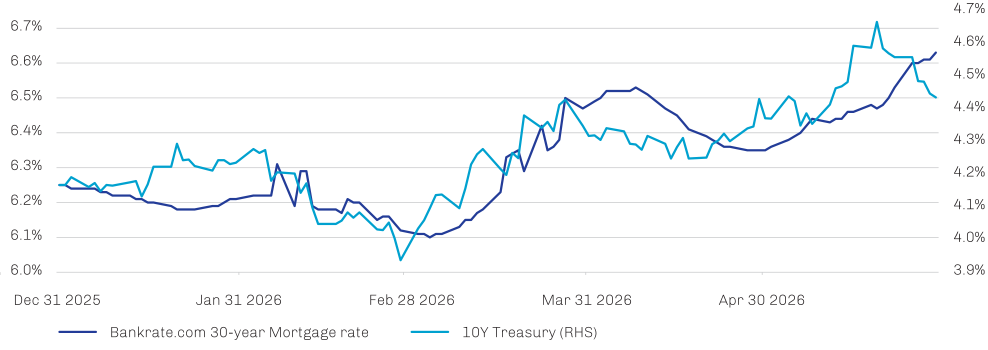
Mortgage rates remain closely tied to Treasury market volatility. Since the start of the Middle East conflict at the end of February, the 10-year Treasury yield has moved meaningfully higher and lower as markets reacted to changing geopolitical headlines.
Since the end of February, the 10-year Treasury yield has climbed nearly 50 basis points (bps), translating into a 51-bps-increase in the Bankrate 30-year mortgage index. Housing market softness persists, while inflation data remains stubbornly high — reinforcing the market’s “higher-for-longer” rate narrative.
30Y Mortgage Rate vs. 10Y Treasury Yield
Spreads tighten in May despite macro volatility
Spreads continued to fluctuate with the changing geopolitical and interest rate environment, but May ended with tightening across most sectors.
High yield corporates narrowed from 274.7 bps at April 30 to 256.2 bps at May 31. Investment grade corporates tightened from 79.4 bps to 71.3 bps. Securitized sectors also tightened, with credit card ABS ending May at 29.9 bps, auto ABS at 47.2 bps and non-Agency Commercial Mortgage-Backed Securities (CMBS) at 108.9 bps. Agency RMBS was the exception, widening modestly to 22.0 bps.
Spread Movement, Dec 31 2025–May 31 2026 (bps)
|
Corporate Credit ABS |
Auto ABS |
Non Agency CMBS |
Agency RMBS |
Investment Grade Corporates |
High Yield Corporates |
| Dec 31 2025 |
32.5 |
53.7 |
121.0 |
21.8 |
77.4 |
268.1 |
| Jan 31 2026 |
31.1 |
48.8 |
111.7 |
15.7 |
72.5 |
263.6 |
| Feb 28 2026 |
29.9 |
49.3 |
113.6 |
20.9 |
83.7 |
292.8 |
| Mar 31 2026 |
32.4 |
53.9 |
119.1 |
23.9 |
88.7 |
320.2 |
| Apr 30 2026 |
32.4 |
51.6 |
113.3 |
21.3 |
79.4 |
274.7 |
| May 31 2026 |
29.9 |
47.2 |
108.9 |
22.0 |
71.3 |
256.2 |
| Average |
31.2 |
50.6 |
113.8 |
20.1 |
78.3 |
276.6 |
Asset-Backed Securities
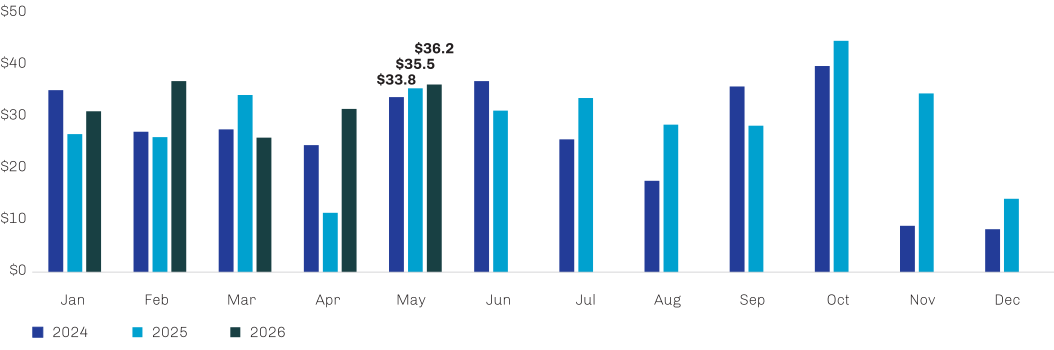
ABS issuance continued to rebound from March’s low point of $26.0 billion, which was the lowest non-December monthly level since April 2025. May delivered the second-highest monthly issuance total of 2026.
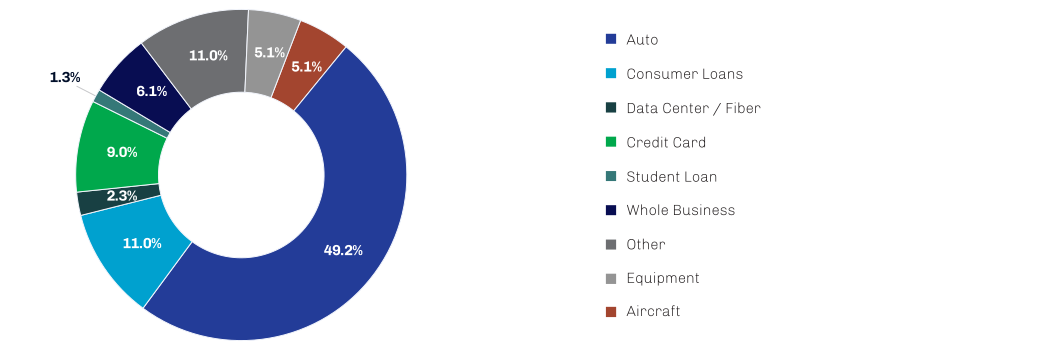
Credit card ABS continued to recover after issuance stalled in January and February, with $3.25 billion in new deals in May. Overall 2026 ABS issuance now stands at $161.7 billion, well ahead of the same period in 2025 ($133.9 billion) and 2024 ($148.1 billion).
For the first time this year, no data center ABS deals priced during the month. Despite the lack of May issuance, the sector remains on pace to match 2025’s full-year issuance total of $20.9 billion.
Monthly ABS Issuance (billions)
May ABS Issuance (%)
Commercial Mortgage-Backed Securities
The CMBS market recovery continued in May, with 2026 year-to-date production surpassing the comparable period in 2025: $76.5 billion vs. $67.3 billion. Both periods remain well ahead of 2024’s $38.2 billion.
May production totaled $16.8 billion, second only to February’s $17.4 billion issuance total. Single-Asset Single-Borrower (SASB) transactions continued to lead the market, with $11.1 billion in May issuance and $43.7 billion year to date.
Market implication: CMBS issuance remains constructive despite persistent property-level stress, with SASB transactions continuing to anchor new supply.
CMBS Trends in May
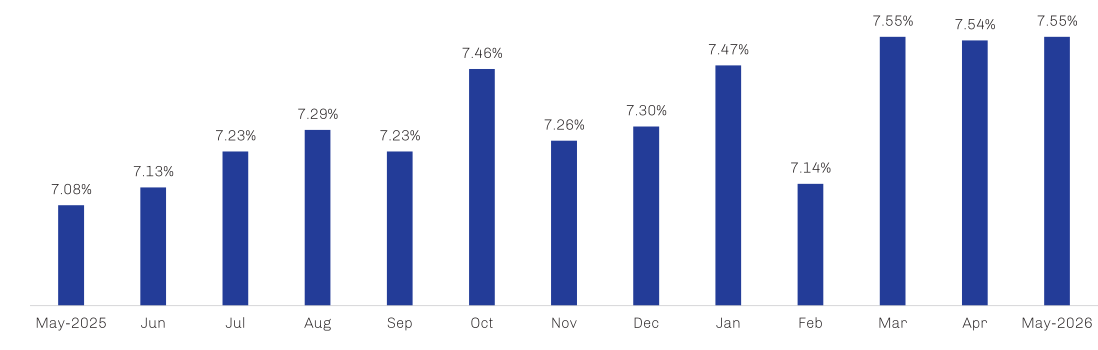
Overall CMBS delinquencies returned to March levels, rising to 7.55% in May after dipping to 7.54% in April. Year over year, the CMBS delinquency rate increased 47 bps, from 7.08% to 7.55%. New delinquencies remained concentrated. The five largest newly delinquent loans accounted for $1.86 billion of the $4.04 billion in new delinquencies, including an Orlando hotel portfolio, a Times Square ground lease loan, a suburban New Jersey regional mall, a SoHo mixed-use asset and a Richmond central business district office property.
30+ Day CMBS Delinquencies (%)
At the property-type level, three of the five major categories improved while two weakened:
- Multifamily: down 76 bps to 6.95%, reversing April’s spike as cures outpaced new delinquencies
- Office: down 16 bps to 11.53%, despite continued large delinquencies across major assets
- Lodging: down 51 bps to 6.01%, with the decline driven by new originations increasing the overall outstanding balance
- Industrial: up 35 bps to 1.31%, reflecting newly delinquent logistics and manufacturing loans
- Retail: up 30 bps to 6.61%, as multiple shopping centers and regional malls became delinquent
Seriously delinquent loans—60+ days past due, in foreclosure, real estate owned (REO) or nonperforming—increased to 7.30% from 7.27% during the month.
Residential Mortgage-Backed Securities
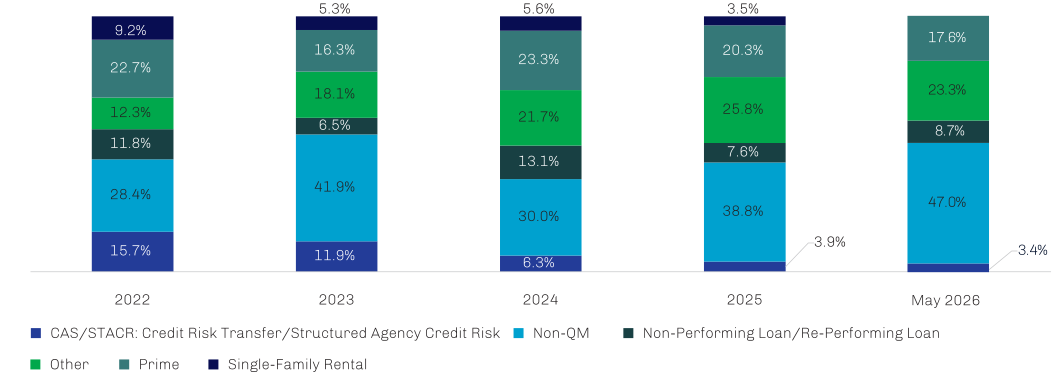
May non-Agency RMBS issuance totaled $15.0 billion, slightly below April’s $15.6 billion and below the year-to-date monthly pace of $17.7 billion.
Non-qualified mortgage (non-QM) RMBS remained the dominant issuance category, accounting for 47% of May issuance and 48% of year-to-date issuance. Non-QM RMBS do not meet qualified mortgage guidelines set by the Consumer Financial Protection Bureau and typically offer more flexibility in borrower eligibility and documentation criteria.
The “Other” category—which includes home-equity loans, home-equity lines and reverse mortgages—matched April’s $3.5 billion in issuance. Year-to-date issuance in the category now totals $19.5 billion, ahead of the comparable pace in both 2025 ($18.7 billion) and 2024 ($11.8 billion).
Monthly Non-Agency RMBS Issuance (%)
Sources: Deutsche Bank, Bloomberg.
See diamond-hill.com/disclosures for a full copy of the disclaimer.
The views expressed are those of Diamond Hill as of June 2026 and are subject to change without notice. These opinions are not intended to be a forecast of future events, a guarantee of future results or investment advice. Investing involves risk, including the possible loss of principal. Past performance is not a guarantee of future results.