Capital Asleep at the Wheel: Neglected Opportunities in Small Companies
After extended underperformance by small-cap indices relative to their large-cap brethren, it is reasonable to ask: Why have exposure at all? Why take on the risk? And if I do, how should I invest to be successful? We seek to answer these questions. First, we examine several secular trends that, while many may be aware of, we think are underappreciated in terms of setting up a time of great opportunity for investing in small businesses. Second, we outline our approach and explain why we believe it is the best path for small company investors and positions us well to deliver returns respectable for any capitalization.
Falling asleep—how we got here
Over the past decade, three related shifts, in our opinion, have resulted in capital essentially falling asleep down the market cap spectrum as fewer investors seek to identify undervalued businesses—namely, the shift to passive, increased asset manager concentration and a shrinking of the sell-side.
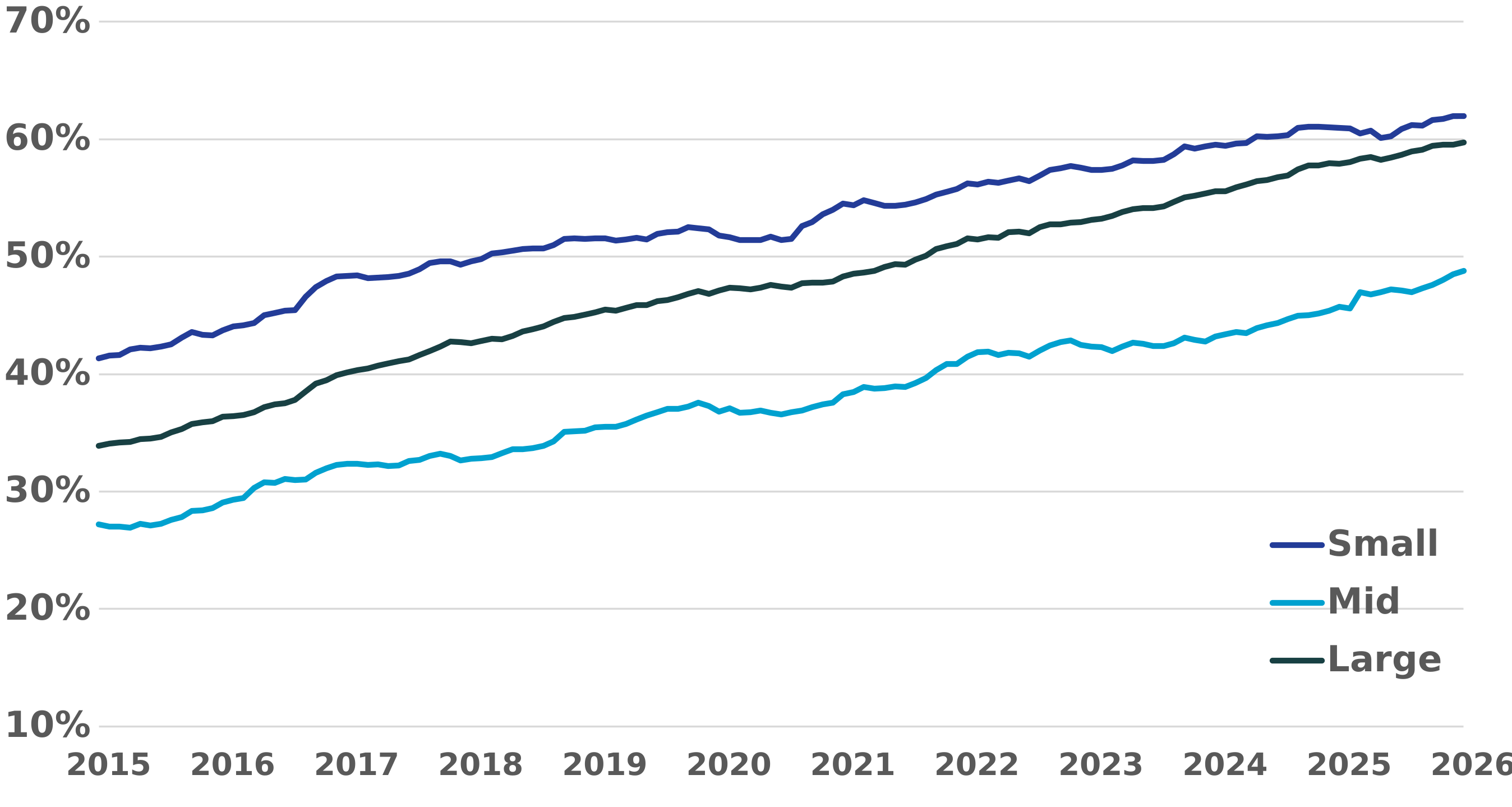
Much ink has been spilled on the shift from active to passive, and while initially, this may spur thoughts of significant moves within the large-cap space, this has surprisingly been more prevalent (on a percentage basis) within the small-cap universe. Over just 10 years, the percentage of passive small-cap funds grew from 44% to 62% today. Passive assets have grown 14% annually over the past 20 years—over 2X the category and 4X the active pace.
Exhibit 1. Growth of Passive in Small Cap
% of assets that are passive (index funds) for large, mid and small
Source: ISS MI MarketPulse powered by Simfund, BofA US Equity & Quant Strategy, data as of March 31, 2026. Used with permission.
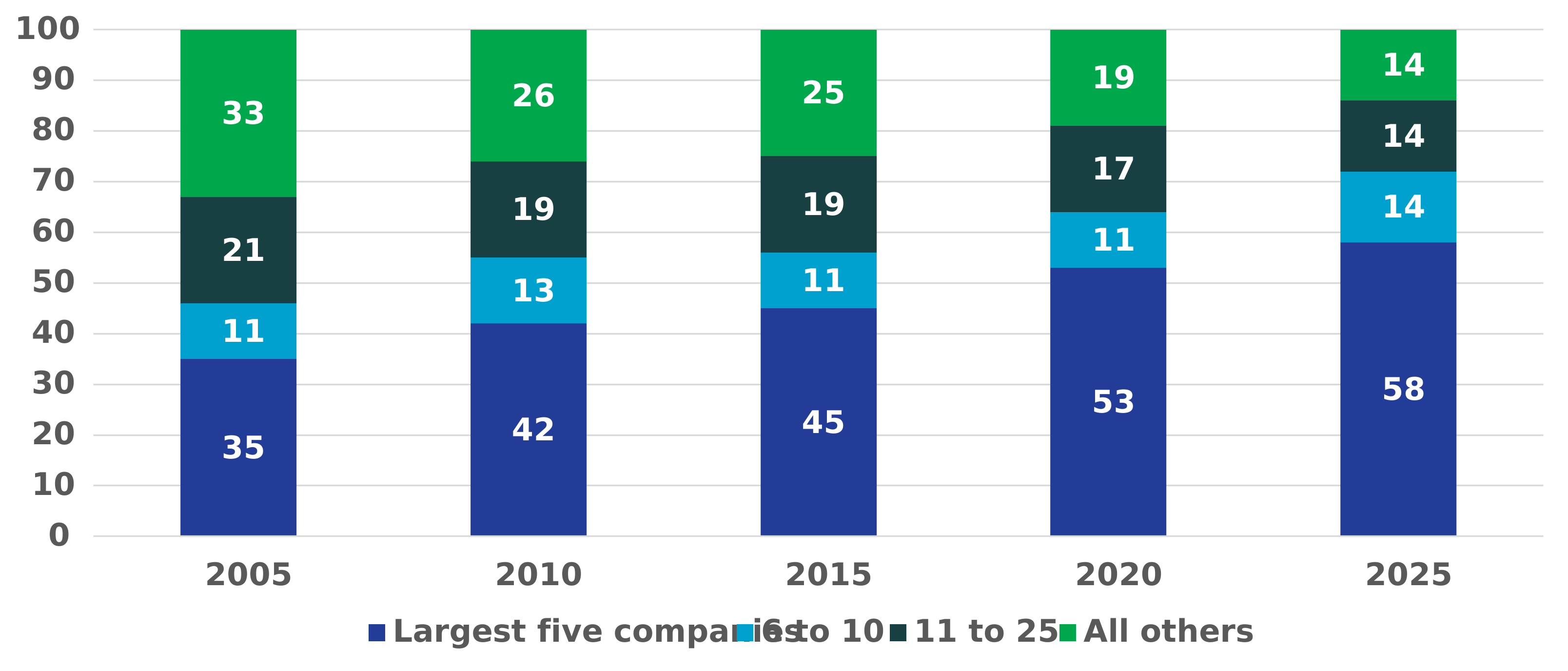
We have also seen an increase in the concentration of capital among large asset managers. The five largest fund complexes have grown their market share from roughly a third of all assets in the early 2000s to approximately 58% at the end of 2025. Why does this matter? These larger shops with aggregated capital cannot fish in the smaller company pond as they cannot take meaningful enough positions in these businesses in their portfolios.
Exhibit 2. Market Share for Largest Fund Complexes Has Risen (%)
Source: Investment Company Institute, data as of December 31, 2025 and a percentage of total net assets of mutual funds and ETFs, year-end. Data for ETFs exclude non-1940 Act ETFs.
A follow-on effect of the decrease in active capital, as well as the concentration of assets amongst the largest asset managers, has been a growing concentration of sell-side research coverage. Since 1999, the average number of analysts covering small-cap stocks has declined by 7% while coverage of the largest 200 Russell Index constituents has increased by nearly two analysts per company. While the decline in small-cap coverage may appear modest, the divergence highlights a broader trend: research resources and investor attention are increasingly directed toward the largest and most heavily owned companies. As capital has concentrated, so too have the economic incentives for sell-side firms which increasingly focus their resources on mega-cap stocks where client demand is greatest. This dynamic is also represented by the drastic difference in analysts per small company versus large.
Exhibit 3. Sell-Side Research Coverage
Source: FactSet, as of May 31, 2026.
No small potatoes—big opportunities
The combination of less capital, less active and fewer eyeballs has created an environment of diminished investor engagement and underappreciated businesses with distinct variances between the market price and intrinsic value—a pond rich with opportunity for those willing to roll up their sleeves and do the work themselves. However, we believe it also means that the levers historically in place to reverse valuation discrepancies are currently broken for small caps. No longer can we rely on a “cheap” valuation to be enough for an investment opportunity to have merit.
If we recall the last broad small-cap renaissance of the early 2000s, less than 20% of small-cap assets were passive, which is not the case today. Price discovery is sub-optimal. We must think like owners and take stakes in companies that both create value and where the long-term fundamentals are underappreciated. These scenarios will eventually demand investor attention and appreciation of their valuation.
We believe this is the perfect recipe for long-term, intrinsic value-based investors looking for underappreciated companies—those willing to take meaningful positions, think like owners and have the capacity discipline to remain nimble. A little over five years ago, we enhanced the resources behind this opportunity with a crew willing to roll up their sleeves to tirelessly turn over rocks and find underappreciated small company opportunities, such as Oil-Dri, US Lime & Mineral or UFP Technologies, to name a few. This effort has been a critical component in repositioning our small-cap portfolio from a weighted average market cap of $5.7 billion (December 31, 2021) to $2.8 billion today (May 31, 2026).
Our approach
We are searching for resilient businesses with underappreciated long-term opportunities. Being patient with an owner's mindset is a durable advantage in a market consistently focused on the next quarter. A few of our key tenets:
- Capacity to suffer. Look for resilient companies with a durable competitive advantage. These businesses are built to survive and be opportunistic during challenging times. They are in control of their outcomes and not beholden to the good graces of a creditor or the economy.
- Long-term opportunities. Seek companies making investments not just for tomorrow or next quarter but are genuinely laying the groundwork for the company to defend its competitive position and thrive in the decades to come.
- Ownership mindset. Look to partner with management teams that are strongly aligned with us as passive shareholders and think like owners themselves. These businesses tend to demonstrate a superior ability to execute, have prudent capital allocation priorities and are astute business operators.
- Use leverage wisely. When we find a company using leverage, it should be supported by hard assets, steady cash streams or a unique characteristic that provides stability.
We also construct the portfolio with a similar long-term business owner mindset. We seek to build a portfolio that is both convicted and resilient, looking to steadily compound wealth and preserve real spending power:
- Portfolio resilience. We build a collection of businesses with different sensitivities and cash flows, some even counter-correlated, and we support owning tangible assets that position the portfolio to sustain the shocks of inflationary movements for the companies we own and our clients' capital.
- Concentration. We deploy capital with conviction to focus the returns on the long-term business performance and company selection. We currently have over 45% in the top 10 holdings, 68% of the portfolio in the top 20 and 82% in the top 30 (as of May 31, 2026).
- A tail of the portfolio that matters. We maintain a collection of 40-100 basis-point positions within the portfolio that we typically view as the seeds of the future. These holdings tend to fall in one of three buckets: (1) Positions restrained due to daily liquidity; (2) opportunities we find interesting and continue to track their fundamentals and business prospects; or (3) successful investments where we still appreciate the business but are working out of the portfolio as the opportunity is not as attractive.
This is our framework for seeking to deliver excellent returns for our clients. No change in philosophy. No change in mindset, but clarity on implementation given the current investing paradigm within the small-cap universe.
Lastly, these secular industry trends do not seem to be abating. Passive continues to grow, asset accumulators continue to get bigger and we think the number of eyes on small companies will likely keep shrinking. However, this is the ideal recipe for us as it indicates that the opportunities we have found will be recurring and maybe even more plentiful. We believe it's an exciting time to be an investor in small companies, and we will continue to look for businesses with great potential.
As of May 31, 2026, Diamond Hill owned shares of Oil-Dri Corp. of America, United States Lime & Minerals, Inc. and UFP Technologies, Inc.
Index data source: Bloomberg Index Services Limited. See diamond-hill.com/disclosures for a full copy of the disclaimer.
The views expressed are those of the author as of July 2026 and are subject to change without notice. These opinions are not intended to be a forecast of future events, a guarantee of future results or investment advice. Investing involves risk, including the possible loss of principal. Past performance is not a guarantee of future results.