Rising Rates: Lessons from 2022
Growing concerns surrounding the fiscal state of the United States and ongoing Middle East tensions have pushed rates
higher across the curve since the beginning of the year. As broader fixed income performance turns negative on a
year-to-date basis (depending on overall duration and security selection), historical perspective may be useful.
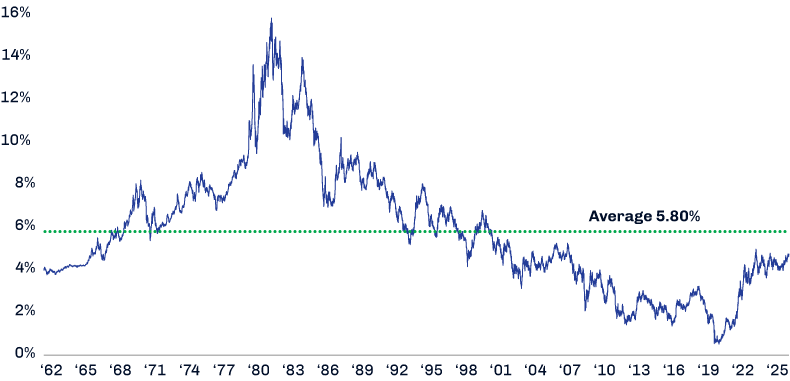
Using data from the Federal Reserve Bank of St. Louis (FRED), we can examine the 10-year Treasury yield going back to
1962 to put today’s market environment in historical context. As shown in Exhibit 1, the 10-year Treasury yield has
averaged approximately 5.80% since 1962, the earliest available data. Despite increasing 57 basis points since the
beginning of 2026 to 4.75%, the current yield remains below its long-term average.1
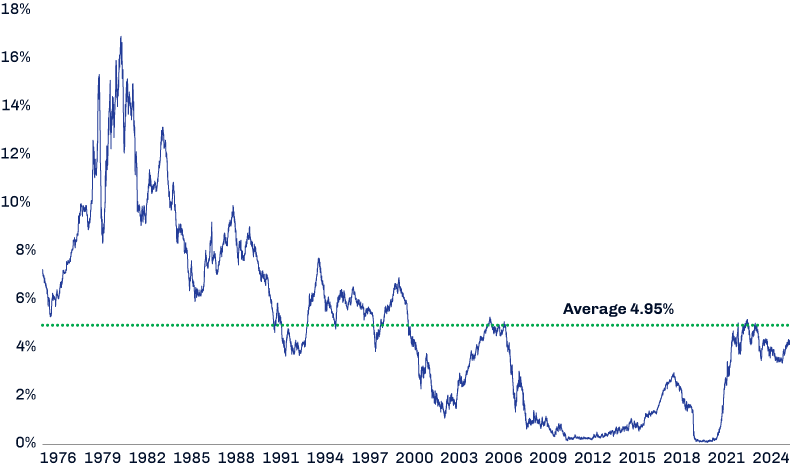
The shorter end of the curve tells a similar story. The 2-year Treasury yield has averaged 4.95% since 1976 and
currently stands at 4.34%, after increasing approximately 87 basis points in 2026 (Exhibit 2).1
Long-term averages, however, provide context rather than a roadmap. Every market environment presents distinct
economic and policy challenges, and historical comparisons alone cannot tell us where rates go from here. Rising rates
create near-term price pressure for fixed income securities with duration, a lesson investors experienced acutely
during the historically difficult market of 2022. The important distinction today is the starting point: higher yields
provide substantially more income to help offset potential price pressure.
Exhibit 1: 10-Year Treasury Since 1962
Source: Federal Reserve Bank of St. Louis; data as of August 31, 2026.
Exhibit 2: Two-Year Treasury Since 1962
Source: Federal Reserve Bank of St. Louis; data as of August 31, 2026.
A Look Back at 2022
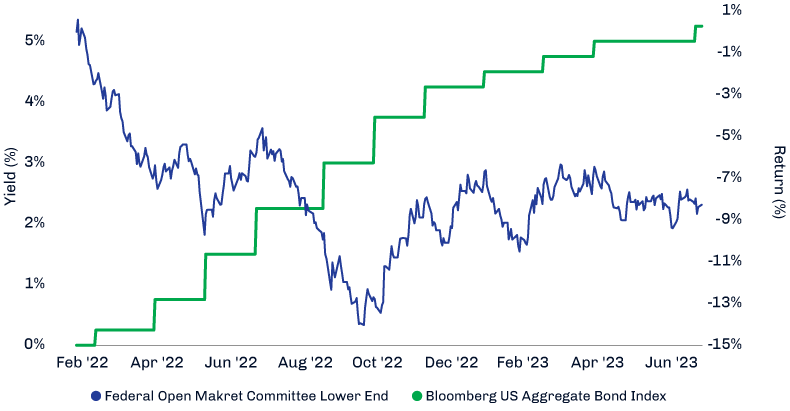
Calendar year 2022 will forever be etched into the memories of fixed income investors, as one of the Fed’s most
aggressive rate hiking cycles in history contributed to record-setting declines across bond markets. From March 2022
through July 2023, the Fed increased the federal funds target range from 0.25% to 5.25%, creating significant
headwinds for fixed income securities.2
Exhibit 3: 2022—An Aggressive Fed Hiking Cycle
Source: Bloomberg; data as of August 31, 2026.
Over those 18 months, the Bloomberg US Aggregate Bond Index declined 8.27% on a cumulative basis, or an annualized
loss of 5.90%. Additionally, the index delivered its worst calendar year performance on record in 2022, declining
13.01%.2
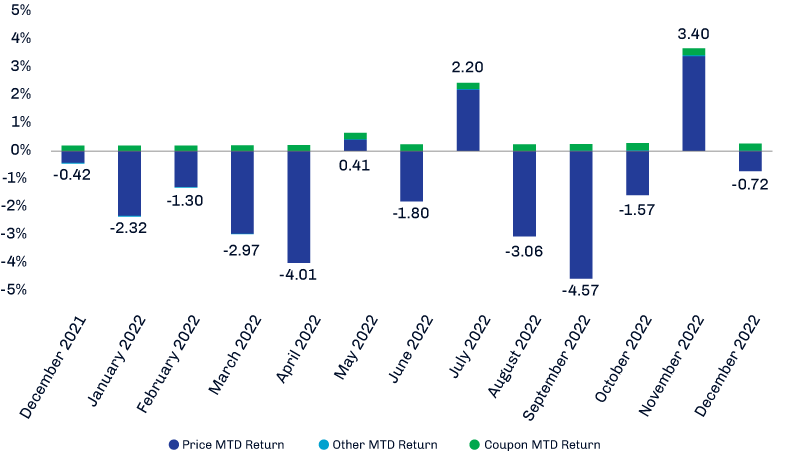
Breaking down the index’s components of return helps illustrate the impact of the low-rate environment leading into
the Fed’s hiking cycle. The yield to worst for the index at the beginning of 2022 was 1.75%, well below its 6.17%
average since the index’s inception in 1976. The result is that the yield associated with the fixed income portfolio
was not enough to offset the impact from the downward pressures on pricing as rates climbed (Exhibit 4).2
By the end of 2022, however, the index's yield to worst had risen to 4.68%. That higher level of income created a
substantially different starting point and helped set the stage for the index's 5.53% return in 2023.2
Exhibit 4: Bloomberg US Aggregate Bond Index Monthly Returns During 2022
Price Return Highlighted
Source: Bloomberg; data as of August 31, 2026.
Why Is This Time Different?
The Federal Reserve has been on hold since December 2025, when the Federal Open Market Committee ended its an easing
cycle that began in July 2024 and lowered the federal funds target range from 5.25%-5.50% to its current level of
3.50%-3.75%.2
The environment facing bond investors today differs from 2022 in two important respects.
First, investors entered the current period with considerably more yield. One year ago, the Bloomberg US Aggregate
Bond Index had a yield to worst of 4.44%, providing a higher starting income has helped offset some of the price
pressure created by rising interest rates this year.2
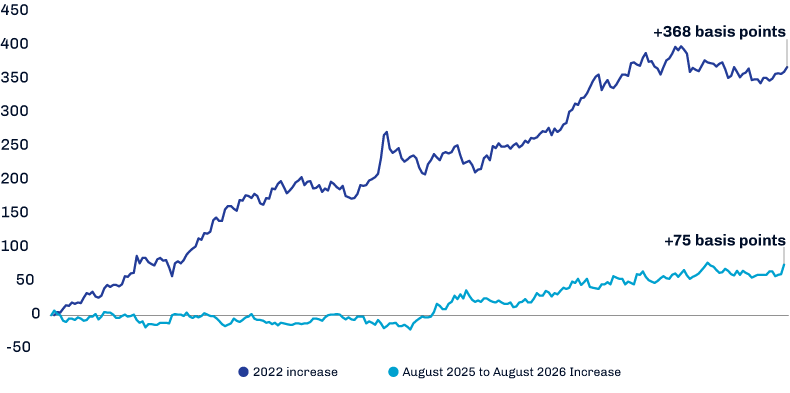
Second, rates have risen at a substantially slower pace than they did during the 2022 tightening cycle (Exhibit 5).
The combination of higher starting yields and a more gradual increase in rates has helped make the impact on total
returns considerably less severe.
Exhibit 5: Increase in Yield for Two-Year Treasury
Cumulative, August 31 2025 to August 31, 2026, in Basis Points
Source: Bloomberg; data as of August 31, 2026.
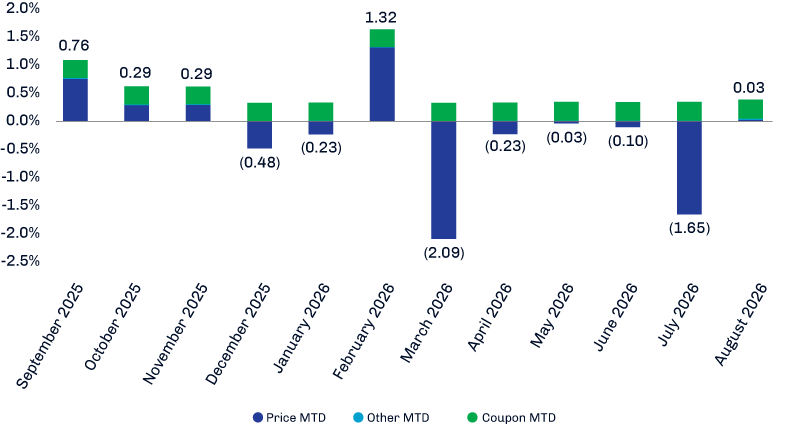
Monthly returns over the past year illustrate this dynamic. Higher yields have provided investors with more income to
help offset the negative price impact of rising rates. That income cushion does not eliminate interest-rate risk, but
it changes the total-return equation meaningfully.
Exhibit 6: Bloomberg US Aggregate Bond Index Monthly Returns from August 2025 to August 2026
Price Return Highlighted
Source: Bloomberg; data as of August 31, 2026.
What Higher Starting Yields Mean for Investors
With the Bloomberg US Aggregate Bond Index down 0.31% year to date, investors are once again seeing negative returns
across portions of their fixed income portfolios. Understandably, that may revive memories of 2022. However, the
differences between the two environments are significant.2
Higher starting yields can provide a meaningful cushion against the price impact of rising rates; however, they cannot
fully eliminate the impact and portfolios with duration will generally experience price pressure when rates rise.
Today, the amount of income available to offset those declines is substantially greater than it was entering 2022. The
slower pace of this year's rate increase provides another important distinction between the two periods.
Focus on What You Can Control
Uncertainty surrounding the path of interest rates reinforces why Diamond Hill’s emphasis on bottom-up security
selection rather than relying on interest-rate forecasts or sector rotation. In recent years, interest rates have
repeatedly defied consensus expectations, often moving significantly over relatively short periods.
Rather than attempting to predict each move in rates, we believe the more durable approach is to construct fixed
income portfolios security by security, emphasizing downside protection and attractive risk-adjusted return
opportunities. In an environment where the future path of rates remains uncertain, we believe that discipline can help
fixed income continue to serve its intended role as a stable component of a diversified portfolio.
1 Source: Federal Reserve Bank of St. Louis; data as of August 31, 2026.
2 Source: Bloomberg; data as of August 31, 2026.
The information contained in this material is provided by First Eagle Investment Management, LLC (“FEIM”) and its global subsidiaries (collectively, “First Eagle”). FEIM is an investment adviser registered with the US Securities and Exchange Commission (SEC). Registration with the SEC does not imply a certain level of skill or training.
This material is for informational purposes only and reflects prevailing conditions and the judgment of the author(s) as of the date of publication, all of which are subject to change. This material should not be relied upon as investment advice; it does not constitute a recommendation to buy or sell a security or other investment; and it is not intended to predict or depict the performance of any investment. This material is not being provided in a fiduciary capacity and is not intended to recommend any investment policy or investment strategy or consider the specific objectives or circumstances of any investor. We consider the information in this material to be accurate, but we do not represent that it is complete or should be relied upon as the sole source of appropriateness for investment.
Prospective investors should inform themselves and consult with an investment, tax or legal professional as to any applicable legal requirements, taxation and exchange control regulations in the countries of their citizenship, residence or domicile that may be relevant prior to investing.
THIS MATERIAL DOES NOT CONSTITUTE AN OFFER OR SOLICITATION IN ANY JURISDICTION WHERE OR TO ANY PERSON TO WHOM IT WOULD BE UNAUTHORIZED OR UNLAWFUL TO DO SO.
All investments involve the risk of loss of principal.
Past performance does not guarantee future results, which may vary. The value of investments and the income derived from investments will fluctuate and can go down as well as up. A loss of principal may occur.
Indexes are unmanaged and do not incur management fees or other operating expenses. One cannot invest directly in an index.
Yield to worst is a measure of the lowest possible yield that can be received on a bond without defaulting, assuming worst-case scenario or earliest redemption possible.
Bloomberg US Aggregate Bond Index (Gross/Total) measures the performance of the investment grade, US dollar-denominated, fixed-rate taxable bond market in the US, including Treasuries, government-related and corporate securities, fixed-rate agency MBS (agency fixed-rate and hybrid ARM passthroughs), ABS, and CMBS. A total-return index tracks price changes and reinvestment of distribution income.
The information presented does not reflect the performance of any fund, strategy or account managed or serviced by First Eagle, and there is no guarantee that investors will experience the type of performance reflected. There is no guarantee that any market forecast set forth in this material will be realized. There is no guarantee that any historical trend referenced herein will be repeated in the future, and there is no way to predict precisely when such a trend will begin. The mention of specific securities is not a recommendation or solicitation to buy, sell or hold any particular security and should not be relied upon as investment advice.
Availability of the products or services described may be restricted by law in certain jurisdictions. This material may not be distributed, published or used by any person or entity in any jurisdiction or country where such distribution or use would be contrary to local law or regulation.
United Kingdom
Napier Park Global Capital Ltd is authorised and regulated by the Financial Conduct Authority (FRN: 541427) in the United Kingdom.
Middle East
This material is for information purposes only and has not been, and will not be, registered with or reviewed or approved by any regulator located in the Middle East. It does not constitute or form part of any marketing initiative, any offer to issue or sell, or any solicitation of any offer to subscribe to or purchase, any products, strategies or other services, nor shall it, or the fact of its distribution, form the basis of, or be relied on in connection with, any contract resulting therefrom. In the event that the recipient of this material wishes to receive further information regarding any products, strategies or other services, it shall specifically request the same in writing from an authorized financial adviser.
Canada
Pursuant to the international adviser registration exemption in National Instrument 31-103, First Eagle Investment Management, LLC. is informing you that: (i) First Eagle Investment Management, LLC. is not registered in Canada and is advising you in reliance upon an exemption from the adviser registration under National Instrument 31-103; (ii) First Eagle Investment Management, LLC’s jurisdiction of residence is New York, USA; (iii) there may be difficulty enforcing legal rights against First Eagle Investment Management, LLC. because it is a resident outside of Canada and all or substantially all of its assets may be situated outside of Canada.
FEF Distributors, LLC (“FEFD”) (SIPC), a limited purpose broker-dealer, distributes certain First Eagle products. FEFD does not provide services to any investor but rather provides services to its First Eagle affiliates. As such, when FEFD presents a fund, strategy or other product to a prospective investor, FEFD and its representatives do not determine whether an investment in the fund, strategy or other product is in the best interests of, or is otherwise beneficial or suitable for, the investor. No statement by FEFD should be construed as a recommendation. Investors should exercise their own judgment and/or consult with a financial professional to determine whether it is advisable for the investor to invest in any First Eagle fund, strategy or product.
First Eagle Investments is the brand name for First Eagle Investment Management, LLC and its subsidiary investment advisers. Diamond Hill is the brand name for Diamond Hill Capital Management, LLC, an investment adviser.
© 2026 First Eagle Investment Management, LLC. All rights reserved.