Securitization in Focus — April 2026
Headlines
Consumer Asset-Backed Securities (ABS) Earnings: Resilient Credit, Selective Caution
- American Express (Prime Credit Card ABS): Credit performance remains strong, with delinquency and write-off rates still below 2019 levels. Management expects stable credit metrics through 2026, consistent with prime consumers’ relative ability to navigate uncertainty and persistent inflation.
- Bread Financial (Subprime/Near-Prime Credit Card ABS): Management expects average credit card and other loan growth in the low single digits, compared with 1.3% year-over-year growth in 2025. Consumers are budgeting more actively amid weaker sentiment, lower confidence and higher fuel costs, though tax refunds supported 1Q resilience.
- Capital One (Credit Card and Auto ABS): Management expects steady credit performance to continue in the near term. The firm is maintaining a conservative reserve stance to account for uncertainty rather than observed credit stress. Competition remains intense but manageable, particularly in auto relative to card.
- SLM Corporation (Private Student Loan ABS): Management is targeting 12% to 14% year-over-year growth in 2026, compared with 7% in 2025. Expected net charge-offs of 2.1% to 2.3% remain in line with 2025’s 2.15%. Changes to federal student loan programs could increase originations by up to 70% over the next several years.
- Synchrony Financial (Subprime/Near-Prime Credit Card ABS): Loan receivables growth is expected in the mid-single-digit range, with acceleration through the second half of 2026. The payment rate of 16.3% is up 50 basis points (bps) year over year and 110 bps versus the prepandemic five-year historical average. Management continues expanding financing partnerships with Walmart, Bob’s Discount Furniture and Lowe’s.
- Travel + Leisure (Timeshare ABS): The company’s owner base remains healthy, with owners continuing to prioritize travel. Management is not seeing meaningful behavioral changes, with bookings up year over year and average distance traveled slightly higher. Credit performance remains within expectations.
Tax Refunds Support Seasonal Consumer Strength
Consumer debt performance typically improves early in the year as tax refunds arrive. Bank of America’s Consumer Payment Priority Survey found 68% of respondents expected to receive a tax refund, while 32% did not.
Among respondents expecting refunds:
- 52% planned to pay down debt
- 13% planned to add to savings
- 14% planned to use refunds for everyday spending
- 15% planned to make a big-ticket purchase
According to the Internal Revenue Service, the average refund for the 2025 tax year was $3,397, up roughly 11.2%.
Spread Movement, Dec 31 2025–Apr 30 2026 (bps)
|
Corporate Credit ABS |
Auto ABS |
Non Agency CMBS |
Agency RMBS |
Investment Grade Corporates |
High Yield Corporates |
| Dec 31 2025 |
32.5 |
53.7 |
121.0 |
21.8 |
77.4 |
268.1 |
| Jan 31 2026 |
31.1 |
48.8 |
111.7 |
15.7 |
72.5 |
263.6 |
| Feb 28 2026 |
29.9 |
49.3 |
113.6 |
20.9 |
83.7 |
292.8 |
| Mar 31 2026 |
32.4 |
53.9 |
119.1 |
23.9 |
88.7 |
320.2 |
| Apr 30 2026 |
32.4 |
51.6 |
113.3 |
21.3 |
79.4 |
274.7 |
| Average |
31.5 |
51.2 |
115.0 |
19.5 |
79.3 |
279.8 |
Credit Scoring Broadens Beyond FICO
Government-sponsored enterprises (GSEs) are now ready to buy loans scored with VantageScore 4.0, with securitization expected to follow. Both GSEs accept VantageScore 4.0 loans, and according to Federal Housing Finance Agency (FHFA) Director Pulte, Freddie Mac has taken delivery of $10MM of VantageScore 4.0 loans as an initial operational test.
Implementation begins with a limited rollout across 21 approved lenders, mostly large originators, with Rocket and PennyMac referenced. The GSEs continue accepting lender applications, so the approved lender list may expand.
VantageScore 4.0 is effective immediately, while FICO 10T is approved for future use. Both GSEs will publish historical data for loans acquired from April 2013 through September 2025 for FICO 10T, along with additional VantageScore 4.0 data from April 2023 through September 2025.
The Federal Housing Administration (FHA) is expected to accept both VantageScore 4.0 and FICO 10T, though timing remains undecided.
Market implication: Adoption appears faster than expected and may create refinancing incentives, which could weigh on conventional low-FICO specified pools. The limited rollout to 21 lenders may help mitigate the near-term impact.
Asset-Backed Securities
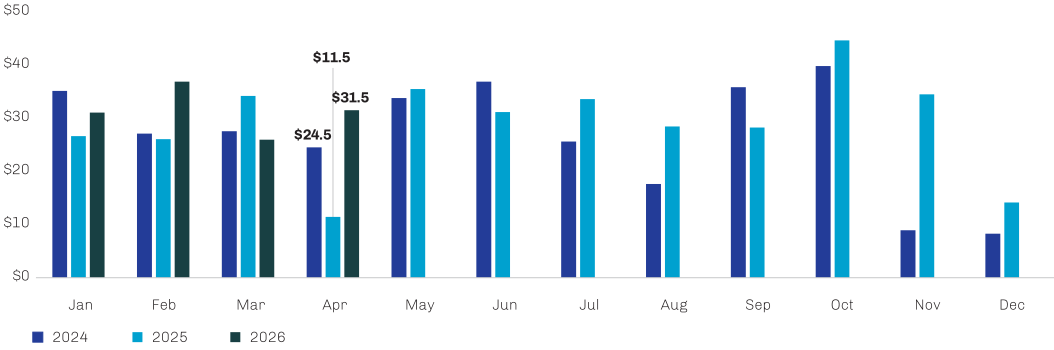
ABS issuance rebounded in April with $31.6B in new deals, recovering from the lowest non-December level since April 2025 and a notable March slowdown.
Credit card ABS returned to the market after early-year disruption tied to the proposed 10% cap on credit card interest rates, with $2.4B in new issuance in April.
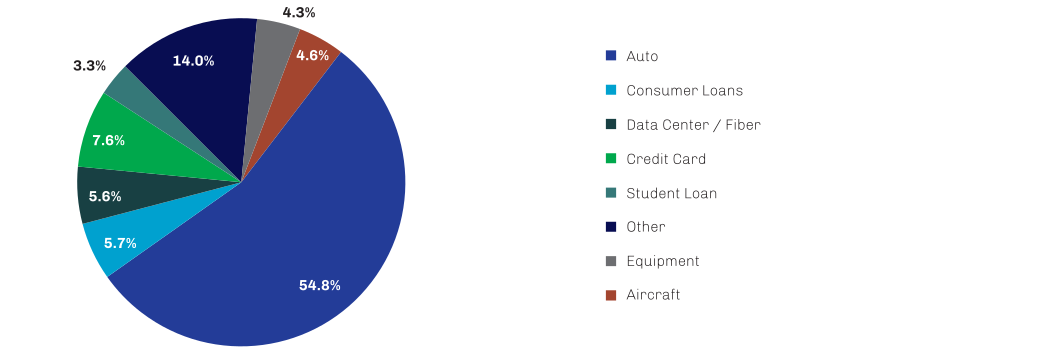
Year-to-date 2026 ABS issuance now stands at $125.5B, well ahead of the same period in 2025 ($98.4B) and 2024 ($114.3B). Auto ABS continues to lead, representing 54.8% of April issuance and 48.5% of year-to-date supply.
Monthly ABS Issuance (billions)
April ABS Issuance (%)
Commercial Mortgage-Backed Securities
The commercial mortgage-backed securities (CMBS) market recovery remains intact. Year-to-date 2026 production is nearly in line with 2025 at $53.2B vs. $52.2B, with both periods well ahead of 2024’s $26.5B.
April issuance slowed to $6.2B after 1Q averaged $15.7B per month. The pattern resembles April 2025, when issuance totaled $6.4B after 1Q averaged $15.3B per month.
CMBS Trends in April
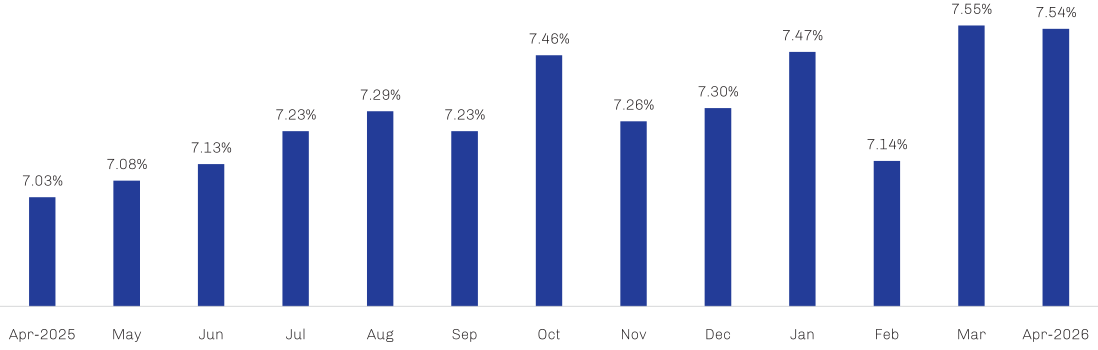
Overall CMBS delinquencies declined 1 bp in April to 7.54%, though the rate remains 51 bps higher year over year, up from 7.03%.
30+ Day CMBS Delinquencies (%)
New delinquencies were concentrated. The five largest newly delinquent loans accounted for more than half of roughly $2.63B in new delinquencies, including New York City and Houston office loans, San Francisco and New York City multifamily loans, and a national warehouse/distribution portfolio.
At the property-type level, two of the five major categories moved higher while three declined:
- Industrial: up 31 bps to 0.96%, driven by one portfolio loan moving 30 days delinquent
- Multifamily: up 56 bps to 7.71%, breaching the prior month’s high-water mark
- Lodging: down 79 bps to 6.52%, reversing March’s increase as two large loans moved to performing matured balloon status
- Retail: down 31 bps to 6.31%, as two premium outlet loans moved to performing matured balloon status
- Office: down 2 bps to 11.69%, broadly in line with March
Seriously delinquent loans—60+ days past due, in foreclosure, real estate owned (REO) or non-performing—declined to 7.27% from 7.29%.
Residential Mortgage-Backed Securities
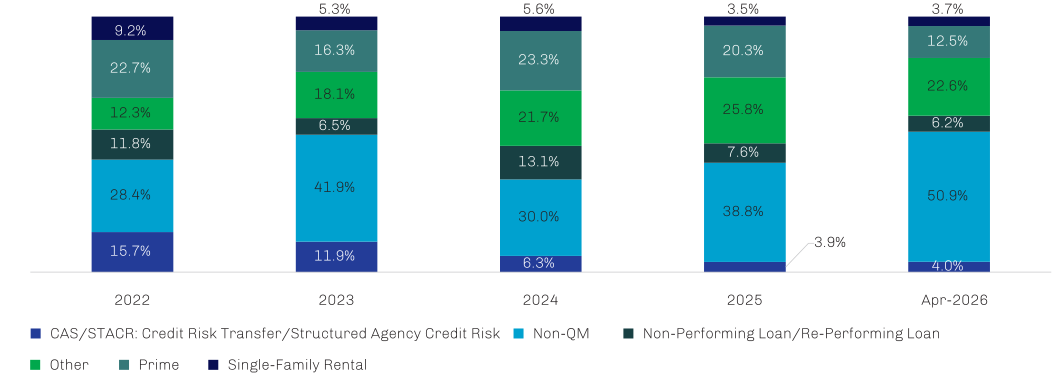
Non-Agency Residential Mortgage-Backed Securities (RMBS) issuance slowed from 1Q’s $19.2B monthly pace, with $15.6B in new deals in April.
Nonqualified mortgage (non-QM) RMBS continues to dominate, accounting for roughly 50% of April issuance. Non-QM RMBS do not meet qualified mortgage guidelines set by the Consumer Financial Protection Bureau and typically offer more flexibility in borrower eligibility and documentation criteria.
The “Other” category—which includes home-equity loans, home equity lines and reverse mortgages—produced $3.5B in April issuance, down from $4.5B in March.
Monthly Non-Agency RMBS Issuance (%)
Sources: Deutsche Bank, Bloomberg.
See diamond-hill.com/disclosures for a full copy of the disclaimer.
The views expressed are those of Diamond Hill as of May 2026 and are subject to change without notice. These opinions are not intended to be a forecast of future events, a guarantee of future results or investment advice. Investing involves risk, including the possible loss of principal. Past performance is not a guarantee of future results.