War, Inflation and a Market Shrug
Edwin Starr delivered the anti-Vietnam anthem “War” in early 1970, though the Temptations had recorded it a year earlier. Their version was withheld to avoid alienating more conservative fans, and over time, the song was covered and sampled by artists ranging from Frankie Goes to Hollywood to Bone Thugs-n-Harmony and even Jack Black. But one of the most iconic versions of the song was performed by Bruce Springsteen in the final shows of his Born in the U.S.A. Tour, later released on his legendary 1986 box set Live/1975-1985. The Boss brought his famous energy to the song, belting out, “War! What is it good for? Absolutely nothin’!” The song has stood the test of time and resonates wherever and whenever conflict arises. While the song condemns conflict unequivocally, financial markets have told a more complicated story. How can that be? To understand this, it’s worth examining how markets have digested the recent uncertainty in the Middle East.
The end of April signified two months since the start of the conflict in the Middle East, with no end in sight aside from a few tenuous ceasefires. The Strait of Hormuz remains effectively closed, both by the Iranian government and the US blockade. While consumers continue to feel the impact through higher gas prices and broader inflation, financial markets have largely absorbed the shock and returned to pre-conflict levels.
The Treasury market has been volatile since the start of the year, resembling a roller coaster. The shorter end of the curve—represented by the 2-year Treasury—is most sensitive to inflation expectations, a dynamic that became clear in the latter part of the period. The yield on the bellwether Treasury traded in a tight range leading up to the start of the conflict, with a low yield of 3.38% and a high of 3.61%, averaging roughly 3.50% through the end of February. Once hostilities commenced on February 28, short-end yields shot higher as the price of oil climbed, reflecting the potential longer-term impact on inflation. Contrary to the typical flight to quality narrative, longer-dated yields also moved higher, with the 10-year and 30-year increasing by 43 basis points and 36 basis points, respectively, from the start of the conflict to the end of April. In effect, inflation concerns outweighed traditional safe-haven demand, with the largest move occurring at the short end of the curve. The 2-year Treasury ended April at 3.87%, up 40 basis points from year-end 2025, as energy-driven inflation expectations remained elevated. As most of the move occurred in March, the Treasury market fell 1.74% for the month—its worst performance since October 2024 (down 2.38%). Year to date, the Bloomberg US Treasury Index declined 0.12% through April 30.
2-Year Treasury Yield
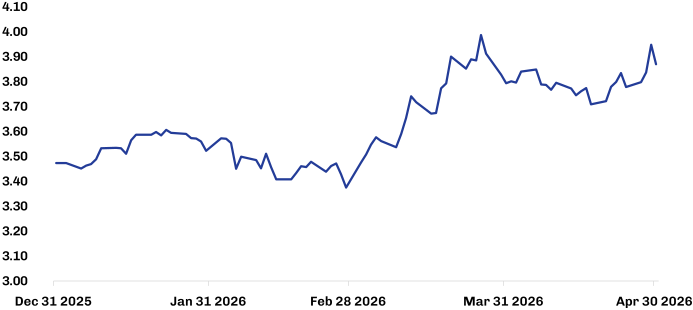
Source: Bloomberg.
While the Treasury market has been under pressure since the start of the war, the corporate debt market has worked through the initial stress and largely returned to pre-conflict levels. In the investment grade corporate sector (as measured by the Bloomberg US Corporate Index), spreads tightened to 72.9 basis points by month-end, reaching their lowest level in nearly 30 years and briefly dropping below 71 basis points in January. As geopolitical tensions escalated, spreads began to widen, peaking at 92.8 basis points in mid-March before stabilizing and retracing. By the end of April, spreads stood at 78.4 basis points, only 0.9 basis points higher than where they began the year. The high yield market, as measured by the Bloomberg US High Yield Index, followed a similar trajectory, ranging from 249.6 basis points to 334.9 basis points, with an average of 278.5 basis points. High yield spreads began the year at 266.4 basis points and ended April at 267.6 basis points, only 1.2 basis points higher. From January through April, the investment grade sector returned -0.09%, while high yield returned 1.19%. In effect, credit markets have largely looked through the conflict, suggesting investors expect limited spillover risk.
The securitized market followed a similar pattern to the corporate debt market, though sector-specific news drove some early- 2026 movement. Agency residential mortgage-backed securities (RMBS) spreads tightened briefly after news that the government-sponsored entities (GSEs) would begin buying agency RMBS. The drop in spreads from the low 20s to the mid-teens lasted until early March. Once the Middle East conflict ramped up, spread levels widened to nearly 27 basis points before rallying at the end of April to finish at 20.2 basis points, 1.6 basis points tighter than levels at the start of the year. Another key development in early 2026 was the pronouncement from the Trump administration of a 10% interest rate limit on all credit cards. This created some disruption in the market, with some credit card asset-backed securities (ABS) deals experiencing spread widening as markets digested the potential industry impacts. With little detailed information and strong pushback from the banking and credit card industry, this proposal quickly faded away, and spreads retraced to prior levels. The biggest impact was a cessation of credit card ABS issuance for the first two months of the year, which spilled into March before recovering in late March and throughout April. One area of the securitized market that performed well through the first four months of the year, with only a small window of volatility, was the non-agency commercial mortgage-backed securities (CMBS) market. Spread levels compressed from 121.0 basis points at the start of the year to 112.0 basis points by the end of April, reflecting the continued rebound in the sector that began in 2025. Issuance remained strong and investors continued to show interest in more complex areas of the market—single asset/single borrower (SASB) and commercial real estate collateralized loan obligation (CRE CLO) deals.
The message of “War” may be simple, but the way markets respond to conflict is rarely so simple. Despite ongoing tensions, investors have largely treated the current environment as manageable, not transformative. For now, inflation and interest rates remain the bigger drivers of market performance. As long as that holds, markets may continue to look through geopolitical uncertainty. However, that dynamic could shift if the conflict begins to have a more direct impact on energy prices and the broader economy.
Bloomberg US High Yield Index measures the USD-denominated, high yield, fixed-rate corporate bond market.
Index data source: Bloomberg Index Services Limited. See diamond-hill.com/disclosures for a full copy of the disclaimer.
The views expressed are those of the author as of May 2026 and are subject to change without notice. These opinions are not intended to be a forecast of future events, a guarantee of future results or investment advice. Investing involves risk, including the possible loss of principal. Past performance is not a guarantee of future results.