Taxable Fixed Income Markets Update: May 2026
Markets in May remained focused on geopolitical developments, evolving economic conditions and leadership changes at the Federal Reserve. Investors balanced signs of labor market resilience against mixed economic data while closely monitoring central bank independence and governance issues, which continued to influence sentiment and policy expectations.
Corporate credit. Investment grade corporate markets continue to rebound from one of the worst months in recent history (March’s loss of 1.98%) with another solid month in May (0.76%). Corporate spreads continued to tighten during May, reversing the widening seen earlier in the year amid geopolitical uncertainty and ending the month at 72 basis points. Despite tighter spreads, the yield-to-worst for the Bloomberg US Corporate Investment Grade Index remained attractive at 5.13%. Investor demand for yield stayed strong, supporting $163 billion of issuance in May and helping year-to-date issuance reach a record $993 billion, up 25% year over year.1,2
Securitized credit. The spread on the Bloomberg US Securitized Index was essentially flat during May, in contrast with the tightening trend seen across other risk sectors. Even so, spread levels remain near historically tight ranges, reflecting continued investor support for the asset class. The sector returned 0.29% during the month, outperforming Treasuries but trailing investment grade corporates. Securitized assets have generated positive returns during all but one month since August 2025, producing a cumulative return of 5.29%.1
Treasury and rates. Treasury yields were volatile throughout May as markets responded to developments surrounding the Middle East ceasefire and shifting economic data. The labor market showed continued improvement, marking three consecutive months of payroll growth above 100,000 and contributing to higher rates as expectations for a potential year-end rate hike increased.3 Inflation data released on May 12 cast a shadow on interest rate markets, with Treasury yields climbing across the curve on fears that inflation will remain more persistent. After trading between 4.35% and 4.67% during the month, the 10-year Treasury yield declined over the final seven trading days and ended May at 4.45%.1
Higher for Longer Starting to Take Shape as Market Pivots to Fed Hike by Year End
Implied Number of 25 Basis Point Rate Hikes by Federal Reserve Through December 2026
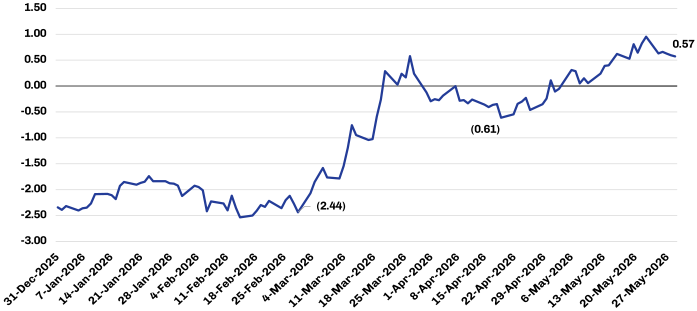
Source: Bloomberg; data as of May 29, 2026.
1 Source: Bloomberg; data as of May 29, 2026.
2 Source: JPMorgan; data as of May 29, 2026.
3 Source: Bureau of Labor Statistics; data as of May 29, 2026.
Investment Grade is a Bond Quality Rating of AAA, AA, A or BBB. Yield to Worst (“YTW”) is the lowest potential bond yield received without the issuer defaulting; it assumes the worst-case scenario, or earliest redemption possible under terms of the bond.
Index data source: Bloomberg Index Services Limited. See diamond-hill.com/disclosures for a full copy of the disclaimer.
The views expressed are those of the author as of June 2026 and are subject to change without notice. These opinions are not intended to be a forecast of future events, a guarantee of future results or investment advice. Investing involves risk, including the possible loss of principal. Past performance is not a guarantee of future results.