2021 Wrap-Up: Bond Markets
The final quarter of 2021 was witness to the long-expected taper announcement, the emergence of a new, more contagious strain of COVID-19, and a sharp rise in interest rates all along the shorter end of the yield curve. On November 3, the Federal Reserve announced that it would begin paring back monthly purchases of US Treasuries by $10 billion and agency mortgage-backed securities (MBS) by $5 billion. Almost directly on the heels of the tapering announcement, Federal Reserve members began talking openly about accelerating the tapering or increasing the amount of assets being purchased each month as employment continues to run hot and inflation shows no signs of slowing.
The market had a little over a month to digest the news that the tapering of purchases had begun before the Federal Reserve used its final meeting of the year to announce an acceleration of the reduction of its monthly purchases—$20 billion in US Treasuries and $10 billion in agency MBS. By moving its timeline for the cessation of asset purchases from July to March, the Fed accelerated market expectations for the first interest rate hike in the federal funds rate since 2006. With tapering fully operational and expected to conclude by the end of Q1 2022, the Fed is now hit with new balance sheet questions:
- Will it hold the balance sheet steady, reinvesting the proceeds of maturing securities into new ones as it did back in October 2014 (see “A Historical Look at Tapering and Quantitative Tightening”)?
- When does the Fed begin to think about quantitative tightening, or the process of reducing the balance sheet by opting not to reinvest maturing securities?
A Historical Look at Tapering and Quantitative Tightening
Following the conclusion of tapering in October 2014, the Fed held the balance sheet steady for three years by reinvesting maturing securities back into the market. In 2017, the Fed launched quantitative tightening, allowing $6 billion in US Treasuries and $4 billion in agency MBS to roll off or mature each month. The roll-off would increase each quarter until it reached $30 billion in US Treasuries and $20 billion in agency mortgages each month. But a massive liquidity crunch that began in September 2019–created by a perfect storm of quarterly corporate tax payments withdrawn from banks and money market funds combined with a large Treasury auction occurring at a time when the Fed was reducing the size of its balance sheet–resulted in reserves in the banking system declining by $120 billion in two business days. This created a supply-demand mismatch as there were more Treasury securities to be financed in the market with relatively less cash. This forced the Fed back into the business of supporting the markets but this time focused on the very short end of the curve. This crisis halted the Fed’s efforts in balance sheet reduction and led to a shift in the balance sheet composition as newly added securities were short T-bills. Six months later, the COVID pandemic would be in full swing, forcing the Fed’s hand once more and increasing the balance sheet at an exponential pace.
As families in America were sitting down to traditional Thanksgiving dinners and a slate of college and professional football games, concerns around a new variant of COVID-19 splashed across news outlets around the world. Though little was known at the time about the new variant, financial markets reacted violently. Despite ongoing Fed-speak laying the groundwork for an acceleration in tapering (and interest rate hikes), market expectations for the timing of rate hikes altered dramatically on the news of a more contagious variant of the disease that has altered life over the past two years.
Exhibit 1 outlines the markets’ calculated probability of interest rate hikes in the coming year using federal fund futures to analyze shifting expectations. Prior to the emergence of the Omicron variant, the market was pricing in a 100% chance of a 25 basis points (bps) rate hike by the June 15 meeting as well as an 8% chance of two hikes by the same meeting. By November 29, rate hike expectations pushed further out on the calendar (61.0% chance of an initial hike by mid-June, 83.6% by late-July) as the release of Fed Chair Jerome Powell’s prepared testimony to the Senate Committee on Banking, Housing and Urban Affairs indicated his concerns about the negative impact on the economic recovery due to the Omicron variant.
Overnight concerns from various executives from Moderna and Pfizer regarding the efficacy of current vaccines against Omicron and the timeline for developing Omicron-focused boosters created additional angst in the market on November 30. Offsetting the impact on the short end of the curve was Powell’s response to questions from the Senate Committee on Banking, Housing and Urban Affairs that created a shift in expectations as Powell offered an expectation on accelerating the balance sheet tapering schedule and the retirement of the notion of “transitory inflation.”
The FOMC has made it clear that rate hikes won’t occur until the tapering has been completed, and an increase in the amount of monthly tapering to bring the bond purchase program to a close sooner would indicate an acceleration in the timing of rate hikes. By the end of the quarter, society’s perceived ability to manage through a new variant and the Fed’s continued hawkish tilt pushed expectations for rate hikes well past where they were before the emergence of the Omicron variant. Specifically, the March 16 meeting of the FOMC is now considered a “live” meeting with regards to rate hikes (63.2% chance) and, as of the end of Q4, the market was pricing in nearly three rate hikes by the end of 2022.
EXHIBIT 1: RATE HIKE EXPECTATIONS
| FOMC Meeting |
24 Nov 2021 |
26 Nov 2021 |
29 Nov 2021 |
30 Nov 2021 |
31 Nov 2021 |
| 15 Dec 2021
|
0.0%
|
0.0%
|
0.0% |
0.0% |
N/A |
| 26 Jan 2022
|
0.0
|
1.6
|
0.6 |
-1.5 |
4.8% |
| 16 Mar 2022
|
27.5
|
18.4
|
16.8 |
27.0 |
63.2 |
| 4 May 2022
|
66.1
|
41.6
|
34.9 |
51.7 |
99.4 |
| 15 Jun 2022
|
108.3
|
77.8
|
61.0 |
87.0 |
149.5 |
| 27 Jul 2022
|
143.0
|
100.6
|
83.6 |
115.5 |
181.8 |
| 21 Sep 2022
|
197.9
|
148.4
|
125.2 |
159.2 |
228.6 |
| 2 Nov 2022
|
221.0
|
154.5
|
147.2 |
186.5 |
253.0 |
| 14 Dec 2022
|
280.0
|
211.6
|
201.6 |
236.5 |
295.8 |
| 1 Feb 2023
|
306.0
|
236.5
|
227.5 |
262.4 |
317.5 |
Source: Bloomberg (WIRP).
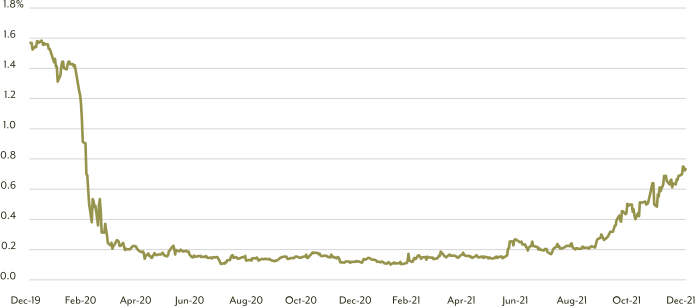
With the Fed tilting from dovish to hawkish as the quarter went on, the shorter end of the Treasury yield curve shifted to reflect this new outlook. In Q4, the 2-year Treasury climbed from 0.276% to 0.732%, its highest level since early March 2020. Since the beginning of the pandemic until the summer of 2021, the 2-year Treasury yield had been mired in a tight range with a low of 0.10% and a high of 0.27%, averaging roughly 0.15% over that time. But it was a steady climb higher during Q4, as outlined in Exhibit 2, with expectations of a lift-off in rates at the conclusion of the now-accelerated tapering program. Not even the emergence of the Omicron variant was enough to dissuade the Fed and the markets from adopting this new outlook for the future path of interest rates. With inflation running at a blistering pace (7.0% increase year over year reported in November), the Fed retiring the term “transitory” and potential supply/demand inspired pricing dislocations, it would seem the race is on to get rates off zero.
EXHIBIT 2: 2-YEAR TREASURY YIELD (%)
Source: Bloomberg.
The views expressed are those of Diamond Hill Capital Management as of January 2022 and are subject to change without notice. These opinions are not intended to be a forecast of future events, a guarantee of future results, or investment advice. Investing involves risk, including the possible loss of principal. Past performance is not a guarantee of future results.