Equity? Debt? Securitized? Understanding the Differences
Executive Summary
With our focus on the securitized market, we often get questions on how the issuing company’s financials can impact securitization deals. Volatility in the financial markets since the start of COVID provides a perfect example of how securitization deals are, for the most part, separate and distinct from the issuing company’s equity and debt, thereby providing an attractive risk/reward opportunity.
For the purposes of this case study, we’ve utilized real-world data for an existing company’s equity, debt and securitization deals.
Brief Intro — Company A
Company A is an online used car retailer focused on providing clients access to used cars virtually rather than through in-person car lots. Consumers use its website to buy used cars, obtain financing and arrange for vehicle delivery. Like other used car dealers (online or brick and mortar), Company A has been caught in a perfect storm of price volatility in the used car market, supply chain issues and persistent inflation.
Used car demand surged during the early days of the pandemic when new car production ground to a halt due to supply chain breakdowns and lockdowns, forcing consumers to pursue whatever cars were currently available. Once consumers slowly emerged from lockdown, production began to resume and supply chains became less congested, new vehicles came back to dealers and used car prices dropped sharply, squeezing margins for used car dealers. Additionally, high inflation combined with soaring interest rates and expectations for a potential recession turned consumers away from large purchases, putting a damper on consumer demand.
Company A — Equity Overview
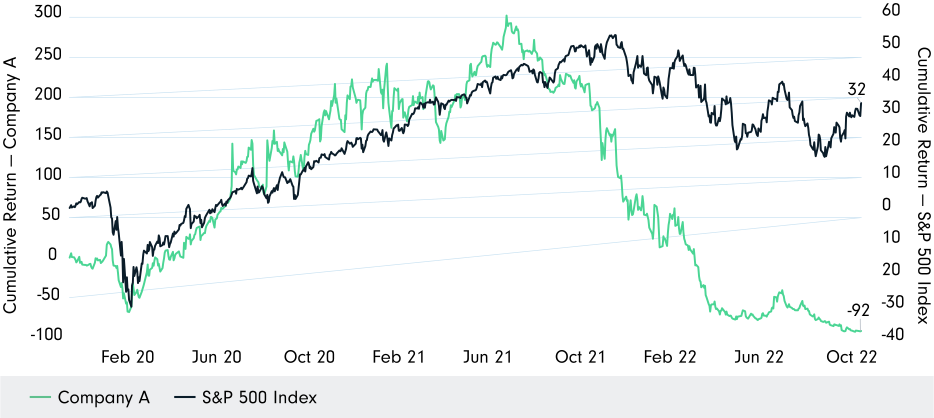
Exhibit 1 illustrates the reversal of fortune for Company A’s equity, as it benefited from the surge in used car pricing and demand, sending the stock price aggressively higher from the beginning of 2020 to August 2021 before plummeting as the impact of a re-opening economy took hold. Since the start of 2020, Company A’s equity has dropped roughly -92%, while the S&P 500 Index is up 32%.
Exhibit 1 — Cumulative Total Return, Company A vs S&P 500 Index (%)
Source: Bloomberg, Yahoo Finance.
Company A — Debt Overview
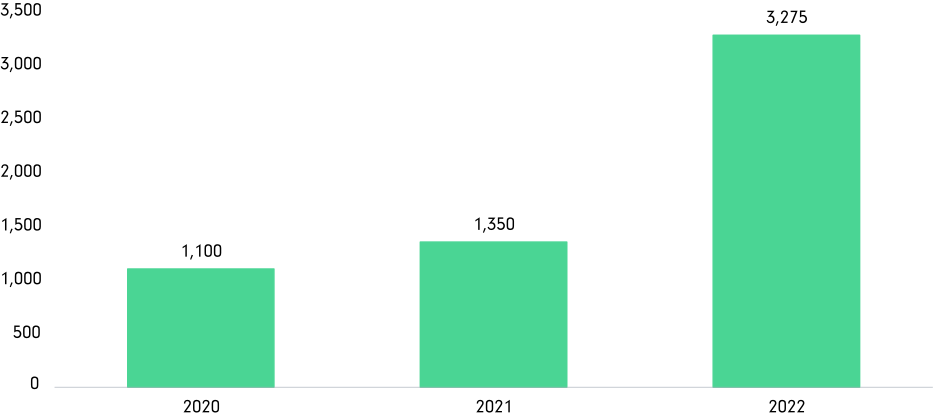
How has the debt for Company A held up in the face of economic challenges? The company ramped up issuance in early 2022, bringing $3.275 billion in new debt after issuing a combined $2.45 billion across four issues in 2020 and 2021 (Exhibit 2). The increased debt issuance, partially allocated to financing a $2.2 billion purchase, created a surplus of debt when investors were becoming hesitant about the viability of the company’s business.
To illustrate the impact of the rising cost of servicing that debt, as well as the growing concerns about Company A, the most recent issue came to market with a 10.25% coupon compared to debt issued in 2021 (5.5% and 4.875%) and 2020 (5.625% and 5.875%).
Exhibit 2 — Debt Issuance Accelerated in 2022 ($MM)
Source: Company A, 10Q Filing for Q3 2022.
It has been a challenging year for the high yield corporate debt market, with the Bloomberg US Corporate High Yield Index down -10.63% since the beginning of this year. But this is a shadow of the damage done to Company A’s bonds, which are down between -51% and -61% over the same period.
Another way of viewing the impact on the company’s debt is to examine the pricing on the bonds, which has followed the same trajectory as the equity. The most recent earnings release was a watershed moment for Company A. According to the Company’s 10-Q filing for Q3 2022, released on November 3, net sales and operating revenues declined by -3% and gross profit dropped by -31% compared with the same period for 2021, while net loss increased to $508 million from $68 million. The Company expects to incur additional losses in the future relating to its continued building of inspection and reconditioning centers.
Company A’s bonds had been experiencing a steady decline since the beginning of the year but that decline accelerated dramatically after the earnings announcement, as indicated in Exhibit 3. The combination of wider-than-expected losses as well as the announcement that the Company would be cutting part of its workforce (on top of significant cuts announced in May 2022) pushed the Company’s bonds below 50 cents on the dollar, a reflection that the market is expecting a high chance of default.
As of November 30, debt of the Company is priced between $34 and $47 (based on par value of $100), depending on the maturity of the bond.
Exhibit 3 — Company A’s Bond Pricing
|
Price |
| Maturity
|
31 Dec 2021 |
3 Nov 2022
(pre-10Q Filing) |
4 Nov 2022
(post-10Q Filing) |
30 Nov 2022 |
| 2025
|
100.308 |
63.494 |
44.000 |
47.08 |
| 2027
|
98.956 |
46.250 |
36.000 |
37.66 |
| 2028
|
100.177 |
44.300 |
35.233 |
35.89 |
| 2029
|
95.524 |
41.500 |
34.750 |
34.42 |
| 2030
|
N/A* |
57.800 |
45.875 |
43.44 |
Source: Barclays Live. *2030 maturity issued in late April 2022.
Company A — Securitized Deals
How has the damage wrought in the equity and the debt markets impacted the securitization deals issued by Company A? For the purposes of this exercise, we’ll look at an auto asset-backed securities (ABS) deal that came to the market in late 2019 (Company A 2019-4).
First, let’s start with the tale of tape, followed by a breakdown of the structure of the deal as well as the credit enhancements attached to the security.
Exhibit 4 — At Issuance (December 2019)
| Total securitized amount
|
$520,000,002
|
| Number of loans
|
28,475
|
| Average amount per loan
|
$18,261
|
|
|
|
|
|
|
|
| Reserve account
|
1.25% of balance ($6,500,000)
|
| Initial over-collateralization (O/C)
|
2.45%
|
| Excess Spread
|
8.22%
|
| Classes |
Moody’s Rating |
Amount ($MM) |
% of Assets |
Final Maturity |
Hard Credit
Enhancement (%) |
| A-1
|
N/R |
67.0 |
12.88 |
15 Dec 2020 |
88.37 |
| A-2
|
Aaa |
105.0 |
20.19 |
15 Jul 2022 |
48.85 |
| A-3
|
Aaa |
100.5 |
19.32 |
15 Sep 2023 |
48.85 |
| B
|
Aa2 |
85.0 |
16.35 |
15 Jul 2024 |
32.50 |
| C
|
A2 |
47.6 |
9.15 |
15 Jan 2025 |
23.35 |
| D
|
Baa3 |
58.0 |
11.15 |
15 Jul 2025 |
12.20 |
| E
|
B2 |
44.2 |
8.50 |
15 Oct 2026 |
3.70 |
| O/C
|
|
12.7 |
2.45 |
|
|
Source: Monthly service statement dated January 2020.
Once the securitization deal has been brought to the market, what is the exposure of the deal to the challenges faced by Company A? Once the deal has been closed, a multi-step sale process occurred, during which time:
- Company A (sponsor) transferred the pool of retail auto installment sales contracts to a limited liability corporation or LLC (the depositor), which is a wholly owned subsidiary of the sponsor.
- The depositor then sold the pool of auto loan contracts to the issuing entity (Company A Receivables Trust 2019-4), and
- The issuing entity transferred the receivables to the grantor trust in exchange for the grantor trust certificate. The issuing entity issued the notes and certificates listed in Exhibit 4 through the securitization trust.
The result of the machinations? The transfer of the assets is treated as a sale of receivables to the LLC by Company A, thereby removing the securitized deal from the control of Company A into a bankruptcy-remote trust. This means that if Company A experiences financial stress or eventual bankruptcy, the securitized deal is not part of the bankruptcy process.
The servicing company, we’ll refer to it as Company X, is tasked with processing payments, contacting borrowers to collect missed payments and repossessing vehicles in case of default.
Investors are protected from any potential issues with Company X through the establishment of a back-up servicer, Company Y. Therefore, even if Company X experiences significant distress or bankruptcy, Company Y can step in to continue servicing the loans in the trust.
Now that we’ve established the structure of a securitized deal issued by Company A, let’s see how the deal is performing, especially considering the difficulties experienced by the issuing entity.
Since its issuance in late 2019, the Company A 2019-4 deal has seen its outstanding balance reduced from $520 million to $143.5 million through consistent (and aggressive) monthly payments by borrowers. Four of the seven original tranches have paid off in full, well ahead of expected maturity, and the remaining three tranches (C, D, E) have all been upgraded from a credit quality standpoint as they move closer to final payoff. The reserve account remains static at $6.5 million but is now accounting for 4.52% of the outstanding balance, a significant increase from the initial level of 1.25%.
Exhibit 5 — As of 15 November 2022
| Reserve account
|
4.52% of balance ($6,500,000)
|
| Current over-collateralization (O/C)
|
5.20%
|
| Excess Spread
|
Approximately 7.0%
|
| Classes |
Moody’s Rating |
Amount ($MM) |
% of Assets |
Final Maturity |
Hard Credit
Enhancement (%) |
| A-1
|
|
|
Paid off |
|
|
| A-2
|
|
|
Paid off |
|
|
| A-3
|
|
|
Paid off |
|
|
| B
|
|
|
Paid off |
|
|
| C
|
Aaa |
14.3 |
10.0 |
15 Jan 2025 |
94.54 |
| D
|
Aaa |
58.0 |
40.4 |
15 Jul 2025 |
54.16 |
| E
|
Aa3 |
44.2 |
30.8 |
15 Oct 2026 |
23.36 |
| O/C
|
|
12.7 |
18.8 |
|
|
Source: Monthly service statement dated November 2022.
In pre-sale reports published in early December 2019, expectations were for cumulative net losses to be in the 11% range based on Company A’s limited origination history (2013), vintage performance history and the characteristics of the underlying collateral (100% used cars and an average FICO score of 634). Through the most recent remittance report (15 November 2022), we learned that the Company A 2019-4 securitization deal has experienced $21.1 million in losses since its inception, which is roughly 4.06% of the entire deal, so it has held up better than initial expectations. The original issuance contained 28,475 loans and the pool now holds 13,178 loans, reflecting the high rate of paydown the deal has experienced since its inception.
Despite the difficulties experienced by Company A’s equity and debt, the securitized bonds of the 2019 deal have held up quite well. The C tranche, which is close to being paid off, is pricing near par as it continues to receive all principal payments, while the remaining two tranches are potentially feeling some of the headline pressures of the parent company. The original final maturity for the C tranche is 15 January 2025, and it could potentially pay off in Q1 2023, well ahead of schedule.
Despite the distinctions between the parent company and the securitized bonds, there has been some price impact but nothing to tune of what has been seen in the equity and debt of the Company. The D tranche is trading near par while the E tranche is trading in the low 90s. Expectations are for the bonds to move even closer to par as the deal continues to pay down. As tranches continue to pay down, remaining tranches benefit from the increase in credit enhancement as they no longer share that support with tranches that have been paid off.
It is important to note that while the bankruptcy remote securitizations are insulated from financial issues at the parent company, there is always a degree of risk associated with investing. In the case of the auto ABS deal, the underlying loans to the end consumer are the main source of risk but steps taken in the structure of these deals (subordination, reserve account, over-collateralization, excess spread) can help mitigate those risks. No company is perfect in underwriting the loans that make up a securitized deal, as normal life events can happen to anyone (divorce, job loss, other financial hardship), but that is why there is a level of expected losses at the issuance of the deal. The structure of the deal allows for investors to choose the level of risk with which they are comfortable.
Our examination of Company A is not an endorsement nor a criticism but rather serves as an example of how the remote nature of the securitizations can insulate bonds from potential difficulties of the parent or issuing company. This is not to say that all securitization deals are structured the same - each has its own nuances and differences, and it takes a significant amount of work and diligence to understand the risk and opportunities associated with each specific deal. That said, the inefficient nature of the securitized market provides opportunities for investors looking to add value outside of macro decisions or allocation to more efficient sectors such as corporates, agency debt and Treasuries.
Bloomberg US Corporate High Yield Index measures the performance of publicly issued non-investment grade USD fixed-rate, taxable and corporate bonds. The index is unmanaged, includes net reinvested dividends, does not reflect fees or expenses (which would lower the return) and is not available for direct investment. Index data source: Bloomberg Index Services Limited. See diamond-hill.com/disclosures for a full copy of the disclaimer.
S&P 500 Index measures the performance of 500 large companies in the US.
Moody’s Bond Ratings are intended to characterize the risk of holding a bond. These ratings, or risk assessments, in part determine the interest that an issuer must pay to attract purchasers to the bonds. The ratings are expressed as a series of letters and digits. Investment Grade is a bond quality rating of AAA, AA, A or BBB.
Risk disclosure: In general, when interest rates rise, fixed income values fall. Mortgage- and asset-backed securities are influenced by factors affecting the housing market and the assets underlying such securities. The securities may decline in value, face valuation difficulties and become more volatile and/or illiquid. They are also subject to prepayment risk, which occurs when mortgage holders refinance or repay loans sooner than expected, creating an early return of principal to loan holders.
The views expressed are those of Diamond Hill as of December 2022 and are subject to change without notice. These opinions are not intended to be a forecast of future events, a guarantee of future results or investment advice. Investing involves risk, including the possible loss of principal. Past performance is not a guarantee of future results.
/sitefiles/live/documents/insights/Blog/A-493/2212_Fixed_Income_Monthly_Commentary.pdf