Ongoing Monetary Tightening Fallout
Global stocks notched yet another positive month in April, rising 1.5% in USD terms as measured by the MSCI ACWI Index, and adding to YTD gains of 9.0% — seemingly defying ongoing macroeconomic and geopolitical uncertainty. Regionally, Europe led in April, rising 4.3%. On an absolute basis, Poland and Hungary had the strongest month, rising 13.5% and 9.9%, respectively. Some of the region’s major economies also delivered solid returns, including Germany (3.5%), France (4.8%) and the UK (5.3%) — with the latter two rising despite strikes and protests against ongoing inflation and a growing cost of living crisis. Indeed, the Bank of England’s chief economist, Huw Pill, found himself in hot water over comments ostensibly recommending the Brits accept the fact that they’re worse off under inflation.
Though inflation (and particularly food inflation, in many countries) undoubtedly remains a sticky challenge, other economic data remain hopelessly mixed, making it challenging for central banks to steer a clear policy path. While Germany’s economy ground to an effective halt in Q1, weighing on EU growth, which was a paltry 0.1% in Q1 2023, business activity readings in the UK and EU simultaneously picked up in April. With the US Federal Reserve, Bank of England and European Central Bank still mulling additional rate hikes as we write, it seems investors will have to continue parsing the tea leaves for the foreseeable future.
The Asia and Pacific region was the lone negative performer in April, falling -1.0% and led down by China (-5.2%) and Taiwan (-4.2%). China’s economy has proven more resilient than initially feared since lifting zero-COVID policies to start the calendar year — though investors seemingly remain skeptical. Further, intensifying geopolitical tensions with the US, tied partly to Taiwan, are likely contributing to regional uncertainty.
Exhibit 1 — April and YTD Returns for Major Markets (USD) (%)
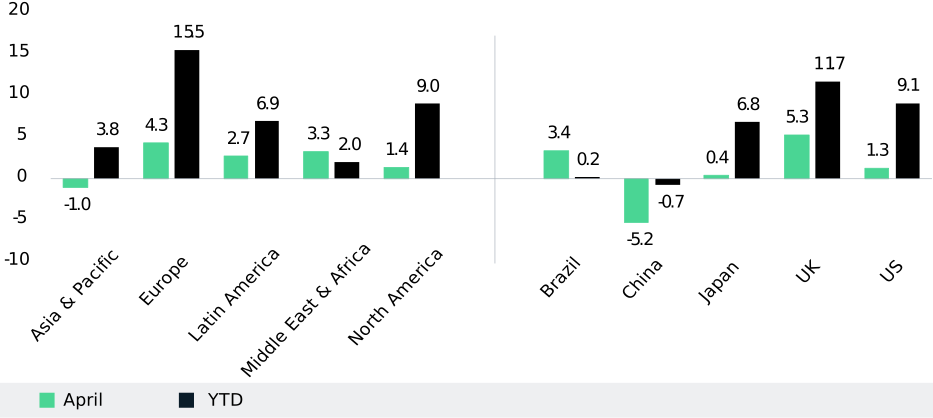
Source: FactSet, as of 30 April 2023.
The Middle East and Africa region was positive in April, too, on the back of OPEC+’s surprise announcement early in the month that it would slash oil production levels — which simultaneously contributed to a sharply positive month for energy (up 5.5%, leading the MSCI AC World ex USA Index from a sector perspective and accounting for effectively all the sector’s positive YTD return). Latin America had a positive April, too, led by Colombia (5.4%) and Brazil (3.4%), amid signs regional inflation may have peaked — and expectations, however ill-founded, the US may soon be done hiking rates.
In a reversal of the YTD trends, the technology (-4.1%), communication services (-1.4%) and consumer discretionary (-0.6%) sectors declined in April, while energy (+5.5%), health care (+5.0%), utilities (+4.6%) and consumer staples (+4.3%) were all nicely positive. Financials, too, bounced in the month, up 3.9%, even as the FDIC formally seized troubled First Republic as April concluded and sold it to JP Morgan Chase as May began.
As has been the case in 2023 to date, US news seems to dominate most investing-related headlines — from monetary policy and the (apparently) ongoing banking concerns to the debt ceiling, over which politicians are currently conducting their standard squabble. However, ample sources of uncertainty beyond the US’s borders pervade the investing landscape — including ongoing geopolitical tensions, not just with China, but between Russia and the Ukraine. Global interest rate hikes seem to be producing some cracks in various spots — but given the challenge posed by inflation (particularly in some emerging markets like Turkey), it’s hard to see rates reversing in the near future. Despite all the uncertainty, markets have climbed the proverbial wall of worry year to date — we wouldn’t be surprised if they continue doing largely the same, though probably not without the periodic spike in downward volatility.
MSCI ACWI Index measures the performance of large- and mid-cap stocks in developed and emerging markets. MSCI ACWI ex USA Index measures the performance of large- and mid-cap stocks in developed (excluding the US) and emerging markets. The indexes are unmanaged, market capitalization weighted, include net reinvested dividends, do not reflect fees or expenses (which would lower the return) and are not available for direct investment. Index data source: MSCI, Inc. See diamond-hill.com/disclosures for full disclaimers.
The views expressed are those of Diamond Hill as of May 2023 and are subject to change without notice. These opinions are not intended to be a forecast of future events, a guarantee of future results or investment advice. Investing involves risk, including the possible loss of principal. Past performance is not a guarantee of future results.
/sitefiles/live/documents/insights/IntlPersp/A-553/2305_International_Monthly_Commentary.pdf