Global Markets Muddle Along
Global stocks continued their year-to-date rise in July, adding 3.7% in USD terms as measured by the MSCI ACWI Index and bringing YTD gains to 18.5% — even as various developed countries continue battling inflation, interest rates globally remain high and geopolitical uncertainty has yet to abate.
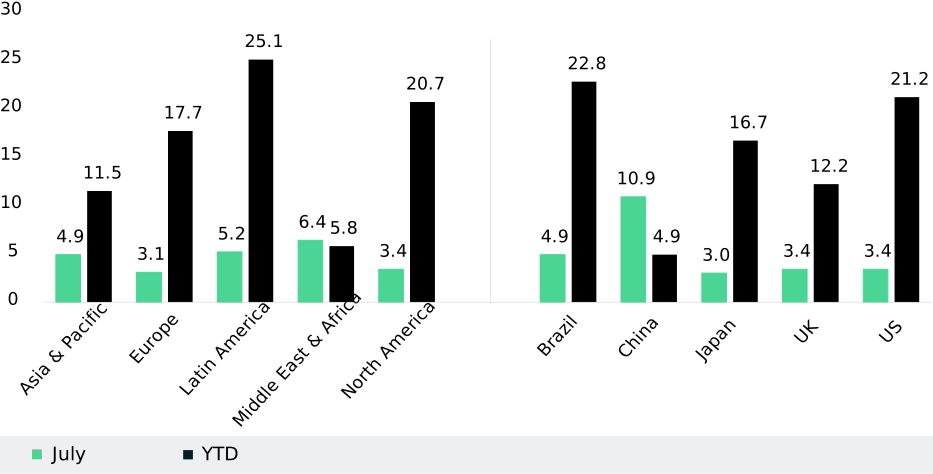
Regionally, the Middle East and Africa led in July, rising 6.4%. South Africa’s market gained 12.6%, rising alongside the central bank’s decision to pause its hike cycle at 8.25% as inflation has finally fallen within the country’s target. Latin America also delivered a positive month, rising 5.0%, led by Colombia, which rose 13.7%. Peru increased 6.2%, and Chile 5.9%. As the region has seemingly largely reined in inflation, expectations are growing that central banks there may be on the cusp of at least pausing further rate hikes, if not beginning to cut them.
Markets were also overall positive in the Asia and Pacific region in July, led by China (+11.7%), which rose despite myriad ongoing macroeconomic and geopolitical headwinds — including an overall economic malaise, which has persisted since the country’s highly anticipated lifting of its zero-COVID policy at 2023’s outset. Pressure seems to be mounting on President Xi to consider some form of fiscal stimulus to help the economy avoid impending deflation. Meanwhile, smaller economies in the region, including Malaysia (+9.7%), Singapore (+9.3%) and Thailand (+8.1%) delivered strong returns in July as countries globally reexamine their heavy reliance on China supply chains and, to varying extents, begin relocating some production to other economies.
Japan rose 3.0% in the month but garnered ample headlines as new Bank of Japan Governor Kazuo Ueda announced an end to the bank’s longstanding yield curve control policy — though within days of the announcement, the central bank again stepped in to buy Japanese government bonds as rates rose modestly above the prior threshold of 0.5%. Investors will undoubtedly watch with interest how monetary policy develops in Japan as it faces increasingly sticky inflation.
North America (+3.4%) and Europe (+3.2%) were also positive in July. The US market advanced 3.4% as anticipation mounts that the Federal Reserve may accomplish a soft landing for the economy — i.e., it is able to sufficiently tame inflation while avoiding meaningfully denting employment or economic activity.
In Europe, Turkey led on an absolute basis, rising over 19% following the country’s recent apparent about-face on interest rates: The central bank raised its benchmark rate another 250 basis points in July, following an increase of 650 basis points in June. Yet to be seen is whether President Erdogan is truly committed to returning the country to a more normal monetary policy, which would seemingly point to higher rates given still-high inflation.
Elsewhere in Europe, Poland and Norway each rose 8.8% in July, while the Czech Republic and Belgium each gained 7.6%. The region’s major economies — France (+2.2%), Germany (+3.1%) and the UK (+3.4%) — turned in more moderate gains as inflation remains a concern and central banks are still accordingly relatively hawkish. The European Central Bank raised its benchmark rate to 3.75%, its highest level since 2000, and the Bank of England is expected to increase its benchmark rate to 5.25% in early August.
Exhibit 1 — July and Year to Date Returns for Major Markets (USD) (%)
Source: FactSet, as of 31 July 2023.
Cooling from their meaningful YTD increase, the technology (+1.4%) and communication services (+4.7%) sectors delivered relatively moderate gains in July — though it’s noteworthy that no sector declined in the month. Materials (+6.2%), real estate (+6.2%) and consumer discretionary (+5.9%) led the way from a sector perspective in July.
Markets have notched solid gains in 2023 to date — which naturally is no guarantee they continue doing so in the months ahead, but seemingly speaks to their resilience. Ample sources of uncertainty are intact: the ongoing Russia – Ukraine war, potentially heightening trade and geopolitical tensions with China, inflation in some areas, and even concerns about deflation in others (notably, China). As we have noted elsewhere recently, much of the YTD gains can be attributed to some of the world’s largest companies — which means that despite overall higher index levels, there are still attractively priced, high-quality companies available to investors able to do the deep, fundamentally oriented research to uncover them.
MSCI ACWI Index measures the performance of large- and mid-cap stocks in developed and emerging markets. The index is unmanaged, market capitalization weighted, includes net reinvested dividends, does not reflect fees or expenses (which would lower the return) and is not available for direct investment. Index data source: MSCI, Inc. See diamond-hill.com/disclosures for a full copy of the disclaimer.
The views expressed are those of Diamond Hill as of August 2023 and are subject to change without notice. These opinions are not intended to be a forecast of future events, a guarantee of future results or investment advice. Investing involves risk, including the possible loss of principal. Past performance is not a guarantee of future results.
/sitefiles/live/documents/insights/IntlPersp/A-585/2308_International-Monthly-Commentary.pdf