Turning Over Rocks to Find Long-term Gems: Small Company Investing
It should not surprise investors that the market has become increasingly competitive and efficient over the past few decades, especially at the larger end of the market cap spectrum where mega-cap companies and passive ETFs are increasingly dominant. However, within the universe of small companies, we believe the market remains highly inefficient. With Wall Street sell-side coverage and investment manager attention increasingly focused on larger stocks (Exhibit 1), the opportunity to turn over rocks and discover hidden gems is abundant.
The small-cap area of the market requires us to look beyond statistical shortcuts and common misconceptions about the quality of companies to find unique ideas. While many investors are constrained by market cap limitations, intermittent or choppy liquidity, or less constant information flow, we are more than happy to put in the work necessary to find resilient companies that trade at solid discounts to intrinsic value.
Exhibit 1 — Wall Street Coverage of Small Companies
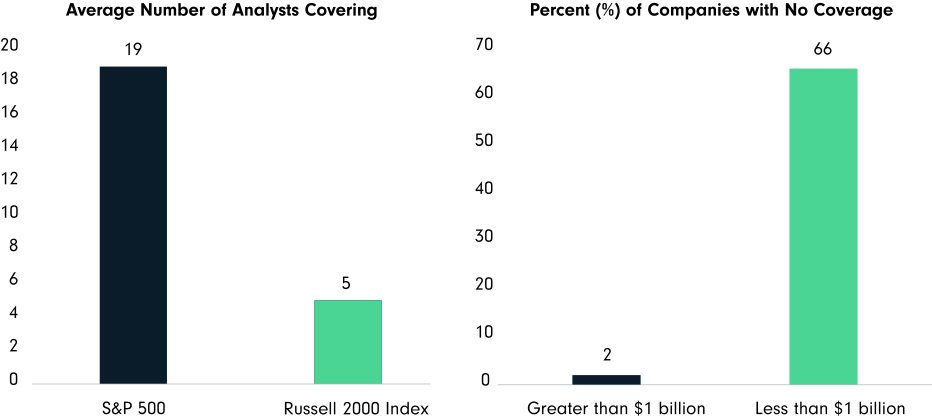
Source: FactSet, as of 30 Jun 2023.
The opportunity set is inherently broad, and long-term outcomes vary significantly. Small companies compete in the marketplace, and those that can grow and sustain a competitive advantage are rewarded mightily. However, rewards do not come without risks, and for a variety of reasons many individual small companies fail to deliver superior returns over long time horizons. This is why we consider small company investing a utopia for our long-term, disciplined, intrinsic value strategy — where business selection is paramount and outcome ranges are wide.
To put a little meat on this statement, we examined historical outcomes for what we consider the best representation of our opportunity set, the Russell 2000 Index.
As business owners, we are interested in long-term outcomes, so we focused on 10-year outcomes for the Russell 2000 Index constituents of the year-end 2012 vintage. We found data on 1,961 companies, of which 57% still existed at the end of 2022, 37% have been acquired, and 6% have been delisted or gone bankrupt (Exhibit 2). By these numbers, investors have a greater than 1-in-20 chance of owning an investment that goes to zero. A genuine risk, and one we try to avoid by finding resilient businesses.
Exhibit 2 — Small Company Outcomes, 2012 to 2022

Source: Morningstar. Based on 2012 year-end constituents.
For those companies offering results for the entire 10-year period, only 3% provided what we consider a truly exceptional outcome of compounding at an annual rate of 25% or better with another 6% compounding between 20% and 25% annually. This compares to 44% delivering poor results of below 5% annualized and nearly 2/3 of this total group offering negative annualized returns. Statistically speaking, even long-term investors have a 5X better chance of finding a business that produces an unsatisfactory outcome versus an excellent result over those 10 years.
What about businesses that were acquired — don’t they all deliver excellent results? Investors indeed have a better chance of a good outcome if a company is acquired, though it isn’t guaranteed and timing matters. Of the 738 companies acquired (as part of our analysis), 27% still delivered what we would classify as poor results (<5% annualized), but nearly a third offered exceptional outcomes. This is where timing comes into play. Of those delivering exceptional annualized returns, over half were acquired within a year or two. Identifying these businesses and being able to invest at the right time is not a strategy that one is likely to reproduce regularly. However, if we own a collection of good businesses at attractive valuations, we can hopefully find a few of these opportunities over time.
After aggregating the results — acquired, still active and delisted — we estimate investors in small companies still have 2:1 odds of selecting a poor-performing opportunity versus an excellent outcome (Exhibit 3). Just under 20% of businesses delivered above 20% annualized returns and 41% delivered below 5% annualized. In our view, this is well below satisfactory given the business risk for small companies — with an additional 39% sitting in mediocrity of somewhere in between.
Exhibit 3 — Range of Outcomes for Small Companies (%)
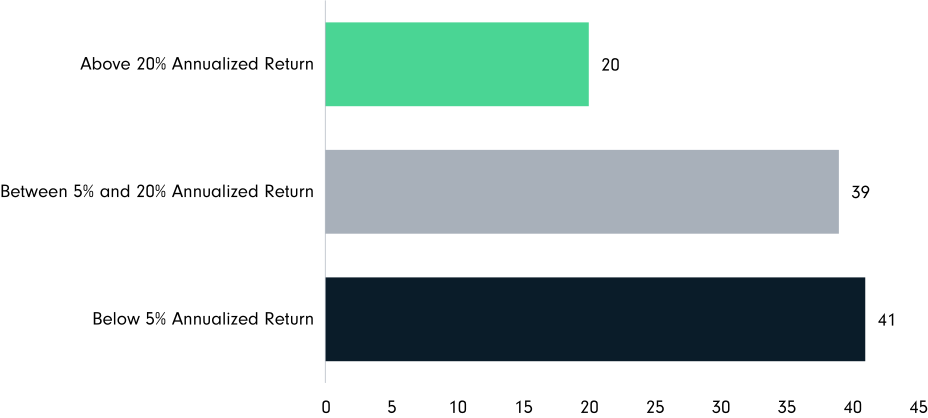
Source: FactSet.
Our analysis demonstrates the long-term opportunities within the small company universe but also highlights the very real risk of failure and mediocre results within this space. It is why we turn over many rocks, maintain our investment discipline, and search far and wide to uncover what we believe are the businesses with the potential to deliver an exceptional long-term return for our clients. Here are two companies we believe are promising that we uncovered over the past year.
United States Lime & Minerals Inc. (USLM), $1.1 billion market cap
US Lime & Minerals is a manufacturer of lime and limestone products. The limestone industry benefits from a limited radius of distribution range, thus creating regional oligopolies. The end markets for the company’s limestone products are large and varied, serving highway, road and building contractors, paper and glass manufacturers, steel producers, municipal sanitation and water treatment facilities, flue gas treatment processes, roof shingle manufacturers, poultry producers, and oil and gas services industries.
US Lime & Minerals has an excellent regional position along the I-35 corridor, supporting economic expansion and infrastructure development from Oklahoma City down into the Texas triangle of Dallas, Houston and San Antonio. This gives us confidence they can deliver above-industry growth and continue to support their 20%+ operating margins.
The company has a net cash balance sheet, a long-term focused insider owner, and a track record of solid execution and long-term decision making. Management, led by CEO Tim Byrne, is experienced in serving the company’s end markets and is active in the industry as Vice President of the National Lime Association.
We initiated a position in the latter part of 3Q 2022 and have been supportive of the position to date as it still trades around 10X EV/Trailing 12-month EBITDA, which we believe is attractive given the business’s durability.
Oil-Dri Corporation of America (ODC), $440 million market cap
Oil-Dri is a leading producer of sorbent mineral technology. Founded in 1941, the company is vertically integrated and controls hundreds of millions of tons of specialty mineral reserves (lightweight clay). Having been amassed over many decades, this physical asset base is very difficult to replicate today. The company’s products are used in pet care, fluid purification, animal health, agriculture, and industrial facilities. These industries may seem rudimentary, but Oil-Dri has a proud, long-term track record of innovation and value creation. Extracting value per ton sold over the long run has resulted from decision making that often occurs many years before opportunities present themselves in the marketplace, a testament to management’s long-term focus.
One fundamental hallmark of the company is its significant and consistent cash flow from operations, which has allowed it to continue investing in its business while increasing its dividend for the past 20 consecutive years. The company has a rock-solid balance sheet, in our view, and significant long-term family ownership, led by Chairman and CEO Dan Jaffee.
The Oil-Dri team continues to be excellent stewards of shareholder capital as they invest in future outcomes with novel product uses in areas such as renewable-diesel and antibiotic-free livestock care.
We initiated our position in November 2022 and have added to it in 2023 on weakness. With the stock still trading around 9X EV/Trailing 12-Month EBITDA, it seems attractively valued for any long-term investor.
As of 31 July 2023, Diamond Hill owned shares of United States Lime & Minerals, Inc. and Oil-Dri Corporation of America.
The views expressed are those of Diamond Hill as of August 2023 and are subject to change without notice. These opinions are not intended to be a forecast of future events, a guarantee of future results or investment advice. Investing involves risk, including the possible loss of principal. Past performance is not a guarantee of future results.
/sitefiles/live/documents/insights/Blog/2023/A-592/2308-Turning-Over-Rocks.pdf