Global Markets Roar Back
Markets rose dramatically in November, notching their best month in three years, rising 9.2% in USD terms as measured by the MSCI ACWI Index and bringing YTD gains to +16.6%. Many in the financial media credited investors’ increasing confidence major global central banks are largely done tightening and will begin lowering rates sometime in 2024 — despite direct quotes from central bank chiefs to the contrary. US Federal Reserve head Jerome Powell said, “The committee is not thinking about rate cuts right now at all.” European Central Bank president Christine Lagarde noted it was “too early to start declaring victory.” And Bank of England governor Andrew Bailey said UK monetary policy would have to remain restrictive for “quite some time yet.”
Nevertheless, markets seemed to respond to data pointing to slowing inflation in major developed economies — including the eurozone (importantly, Germany, one of the region’s largest economies), UK and the US. Jobs growth in the US also slowed and the unemployment rate ticked higher — seemingly boosting investors’ confidence the Fed wouldn’t raise rates further. However, the overall economic picture in many countries remains mixed. Consider this combination of data points from the UK as a sampling:
- UK corporate profitability dropped in Q2.
- Productivity has effectively been flat since the 2008 – 2009 global financial crisis.
- GDP growth was unchanged in Q3, down from 0.2% growth in Q2.
- Retail sales fell to a two-year low, even as shop price inflation slowed to its lowest rate in roughly a year.
- Meanwhile, business activity, as measured by the Purchasing Managers Index, grew modestly in November.
This is just a slice of the data available on a single country — factor in the world’s other major economies, and the macro picture remains fairly muddled. Meanwhile, China’s woes continue as the country struggles to lift itself out of economic malaise. Manufacturing activity contracted for a second consecutive month in November, while non-manufacturing activity remained modestly positive but is at its lowest level since December 2022. As the month concluded, the government announced it would unleash fiscal spending in a bid to boost economic activity — though whether such measures will prove effective remains to be seen.
Japan also seems to be in a tough economic spot as it attempts to balance a desire to wind down extremely loose monetary policy with a contracting economy and weak consumption. Elsewhere in Asia, major Korean battery makers laid off workers amid signs of slowing demand for electric vehicles and Vietnam raised its tax on multinational corporations, which will likely impact major companies like Samsung and Intel. While anecdotal, both stories contribute to a picture of a region that is not capitalizing as much as anticipated from many companies’ and countries’ so-called China plus-one strategy, whereby they sought to diversify beyond China amid an ongoing trend toward deglobalization. However, markets shrugged off most negative data in the month: Korea’s market was nicely positive, rising +16.2% and leading the Asia Pacific region in November. Taiwan also rose handily, up +13.2%, while China notched a more modest +2.8%.
Latin America was also up nicely in November, turning in a +14.1% gain. Mexico (+15.5%) led the way, followed by Brazil, (+14.2%) and Chile (+10.7%). Peru notched the region’s most modest gain, rising +3.4%. Another relative bright spot was Argentina, where voters elected political outsider and libertarian Javier Milei, who has promised to privatize the country’s nationalized oil company YPF, slash government spending and dollarize the economy. While time will naturally reveal his efficacy, his election provided a boost of investor enthusiasm, lifting the country’s market sharply.
Continuing the theme, markets were positive in the Middle East and Africa region, rising +7.0% in November even as geopolitical tensions remain high and the war between Israel and Hamas is ongoing. Egypt’s market rose +22.5%, while Israel’s was up +15.7%, followed by South Africa, up +7.7%. Another complicating factor in the global picture has been oil, for which prices have been understandably volatile. OPEC+ announced individual countries would make voluntary supply cuts — a decision ostensibly intended to bolster crude oil prices, though that has yet to bear out.
Exhibit 1 — November and YTD Returns for Major Markets (USD) (%)
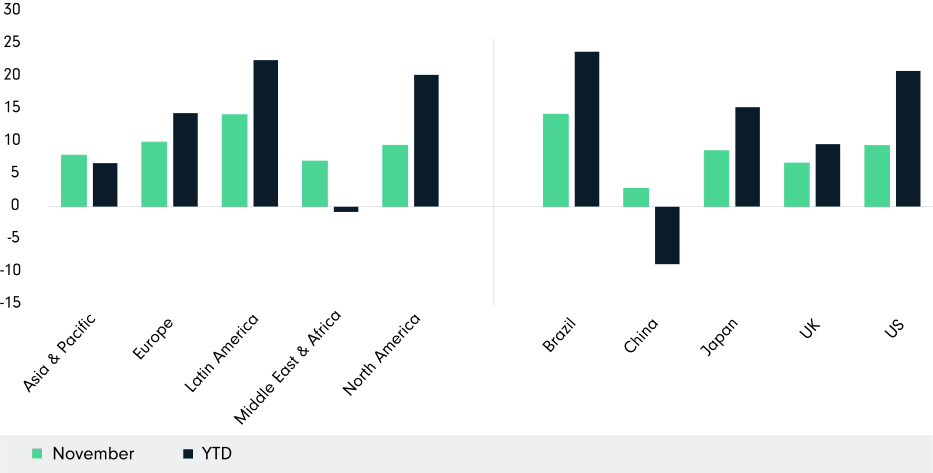
Source: FactSet/MSCI, as of 30 Nov 2023.
Given the sharply positive overall returns, it’s hardly surprising sector returns were likewise strong, with every sector turning in a positive November. Technology led the way, up +15.6% and taking YTD returns to just shy of +30.0%. Industrials (+11.5%), materials (+9.3%) and communication services (+9.3%) stocks were also positive. The energy sector delivered the most modest returns, rising +3.3%, while consumer staples stocks were up +5.0%.
Markets seemingly decided — at least for the month of November — the monetary policy outlook has definitively changed, assertions to the contrary from various global central bank officials notwithstanding. While time will tell which of the two camps is correct, we can’t help but contemplate the following words from the late Charlie Munger, whose longevity gave him an opportunity to witness more market cycles than most. In a 2005 interview in Kiplinger, Charlie said:
A lot of people with high IQs are terrible investors because they’ve got terrible temperaments. And that is why we say that having a certain kind of temperament is more important than brains. You need to keep raw irrational emotion under control. You need patience and discipline and an ability to take losses and adversity without going crazy. You need an ability to not be driven crazy by extreme success.
Nearly 20 years later, his words ring as true as ever — which is why regardless of how markets move from here, we will remain vigilant and committed to our value-oriented investment process, which is designed to help us navigate just such periods of simultaneously high emotion and high uncertainty.
As of 30 November 2023, Diamond Hill owned shares of Samsung Electronics Co Ltd.
MSCI ACWI Index measures the performance of large- and mid-cap stocks in developed and emerging markets. MSCI ACWI ex USA Index measures the performance of large- and mid-cap stocks in developed (excluding the US) and emerging markets. The indexes are unmanaged, market capitalization weighted, include net reinvested dividends, do not reflect fees or expenses (which would lower the return) and are not available for direct investment. Index data source: MSCI, Inc. See diamond-hill.com/disclosures for a full copy of the disclaimer.
The views expressed are those of Diamond Hill as of December 2023 and are subject to change without notice. These opinions are not intended to be a forecast of future events, a guarantee of future results or investment advice. Investing involves risk, including the possible loss of principal. Past performance is not a guarantee of future results.
/sitefiles/live/documents/insights/IntlPersp/A-623/2312-International-Monthly-Commentary.pdf