Strong Finish to a Puzzling Year
As Q3 wound down, fixed income markets were staring into the abyss, faced with the prospect of an unprecedented third consecutive year of negative returns. The Bloomberg US Aggregate Bond Index had lost -1.21% through September’s month-end, and market participants were anxious about the final quarter of the year, especially after the pain of 2022, when the index lost more than 13%.
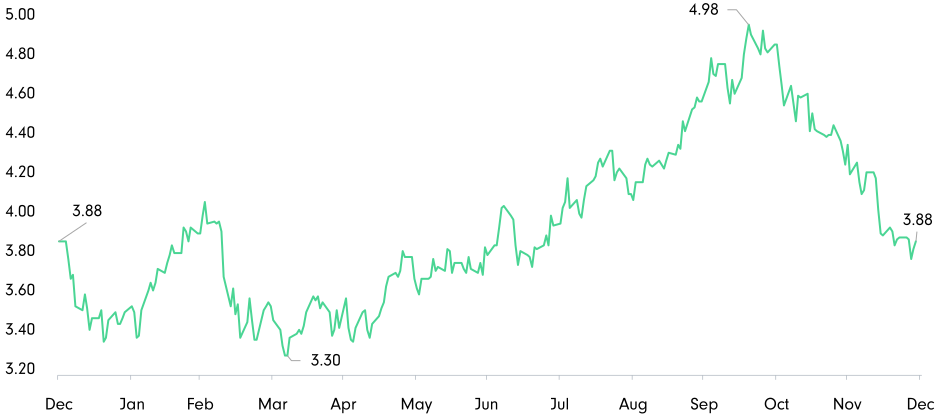
A shaky October, during which the index lost -1.58%, reinforced the angst felt around the halls of fixed income managers around the country. The 10-year Treasury breached the 5% level, if only on an intraday basis, in the middle of October after climbing steadily higher since the beginning of Q4, fueled by expectations of rates remaining “higher for longer” as well as geopolitical tensions. However, declining inflation in the year’s final months fueled the outlook for a soft landing and pushed rates lower as the market ramped up expectations for an aggressive easing cycle in 2024.
The final impetus for lower rates came from the Fed itself as the dot plot (released after each quarterly FOMC meeting) signaled an additional 25 basis point (bps) rate cut expected for 2024. Nevertheless, a substantial disconnect remains between market expectations and those of the FOMC, which we discuss later. Amazingly, the 10-year Treasury yield finished 2023 at nearly the same level as it began the year, 3.88%.
Exhibit 1 — 10-Year Yield Treasury Rollercoaster Ride in 2023 (%)
Source: Federal Reserve Economic Data (FRED).
While October’s performance was a setback for the overall fixed income market (as measured by the Bloomberg US Aggregate Bond Index), November and December delivered some of the best returns in decades. November generated the best monthly performance for the index (+4.53%) since May 1985 (+5.23%), and December’s +3.83% return was the best since February 1986 (+3.94%). The combined performance for November and December was the best two-month return for the Bloomberg US Aggregate Bond Index since October 1982 (+9.56%, during which the 10-year Treasury dropped from 12.81% to 10.71%).
Q4 2023 delivered the best quarterly performance for the index since Q2 1989 (+7.97%), generating a return of +6.82%. Coming into the final two months of the year, the index was down -2.77% but finished 2023 with a return of +5.53%, the best calendar year return since 2020 (+7.51%).
Federal Reserve vs the Markets
The most significant change at the final FOMC meeting of 2023 was the shift in the dot plot, which is a chart used to illustrate where each FOMC member believes interest rates will be by the end of the current year, two or three (depending on the time of year) consecutive years after, and the more ambiguous “longer run.” Each dot represents a member’s individual view and is updated quarterly.
After the September meeting, the Fed estimate was for two 25 basis point cuts per the dot plot by the end of 2024. The December dot plot reading revealed the Fed is now expecting three 25 basis point cuts in 2024 and an additional 100 basis points in cuts in 2025 (no change from September), indicating that it believes it is most likely at the end of this rate hiking cycle.
But this meeting’s shift was a close call. There are 19 participants that make up the dot plot, each providing their expectations for future rate movements. Two dots were the difference between an estimate of 75 bps of cuts versus 50 bps in 2024. Even with the inclusion of an additional 25 basis point rate hike sometime in 2024, the FOMC’s outlook differs quite a bit from how the market is pricing in the future path of interest rates.
Fed fund futures contracts are the best method for understanding how the market is viewing the future path of interest rates. The prices of fed funds futures expiring after upcoming FOMC meetings reflect the market’s expectations for the outcome of those meetings in terms of federal funds rate targets. Those market prices can be expressed as probabilities of rate hikes (or cuts) of a given size at those meetings, usually broken down in 25 basis point increments. These contracts are not meant to predict the future but rather communicate current market expectations for Fed action in upcoming meetings.
As expectations for a potential soft landing grew and inflation slowed in the final months of 2023, the fed funds futures market shifted to reflect an aggressive easing posture from the Fed. This shift occurred despite ongoing hawkish comments from various FOMC members and their own dot plot expectations. At the beginning of Q4, the futures market was pricing in roughly 62.5 basis points of interest rate cuts by year-end 2024, only slightly ahead of the FOMC’s projection of 50 basis points of cuts.
By the end of the quarter, the December 2024 contract indicated market expectations of 157 basis points in cuts, which is more than double the adjusted FOMC outlook of 75 basis points by year-end 2024. The shift in market expectations helps explain the massive rally across both Treasury and risk markets as an accommodating Fed and lower rates lift all boats.
“Don’t fight the Fed” is a long-standing mantra in the markets that has never been more appropriate than heading into 2024. Despite the most recent dot plot indicating 75 basis points of interest rate cuts by the end of 2024, the Federal Reserve kept interest rates steady at its December 13 meeting and stated it is not likely to raise rates further this cycle. However, Chairman Jerome Powell did say that the Fed is prepared to tighten further if needed. So, while the chances for one last rate hike have diminished substantially, the possibility cannot be discounted entirely.
Assuming the Fed is indeed finished with this tightening cycle, the next step is reconciling the difference between market expectations (extremely dovish) and the FOMC itself (holding the line and waiting for more information before acting). We’ll stick with not fighting the Fed.
Bloomberg US Aggregate Bond Index measures the performance of investment grade, fixed-rate taxable bond market and includes government and corporate bonds, agency mortgage-backed, asset-backed and commercial mortgage-backed securities (agency and non-agency). The index is unmanaged, includes net reinvested dividends, does not reflect fees or expenses (which would lower the return) and is not available for direct investment. Index data source: Bloomberg Index Services Limited. See diamond-hill.com/disclosures for a full copy of the disclaimer.
The views expressed are those of Diamond Hill as of January 2024 and are subject to change without notice. These opinions are not intended to be a forecast of future events, a guarantee of future results or investment advice. Investing involves risk, including the possible loss of principal. Past performance is not a guarantee of future results.
/sitefiles/live/documents/insights/FixedIncomePersp/A-634/2401-Fixed-Income-Monthly-Commentary.pdf