Global Markets Start 2024 With a Whimper
Markets moderated to start 2024, consolidating some of 2023’s gains while seemingly mulling over the diminishing likelihood central banks will move quickly to cut rates this year. In USD terms, the MSCI ACWI Index rose 0.6% as the monetary policy outlook shifted, and geopolitical tensions ratcheted up another notch as Iran-backed Houthis escalated their threats to Red Sea shipping lanes. The heightened conflict — which has also included Iran’s seizure of an oil tanker — helped push crude oil prices higher and snarl supply chains that had only recently recovered from the pandemic’s massive disruptions. Shipping costs already reflect the hostilities as companies turn to more expensive air travel or longer shipping routes around South Africa’s Cape of Good Hope to avoid the Red Sea and Suez Canal.
Meanwhile, the global macroeconomic picture remains mixed, leading many central bank heads to stand behind prior assertions that they would not rush to cut rates this year. For example, though the eurozone economy stagnated in Q4 as Germany contracted and France was flat, inflation rose again in both countries at the end of 2023 before moderating some at the end of January. In the UK, while shop price inflation dropped markedly, overall inflation rose, leading the Bank of England to leave rates unchanged in January and contributing to conclusions a rate cut is not in the immediate offing. As the month concluded, Federal Reserve head Jerome Powell stated that a March rate cut is not the base case — particularly as the US shows both economic and labor market resilience.
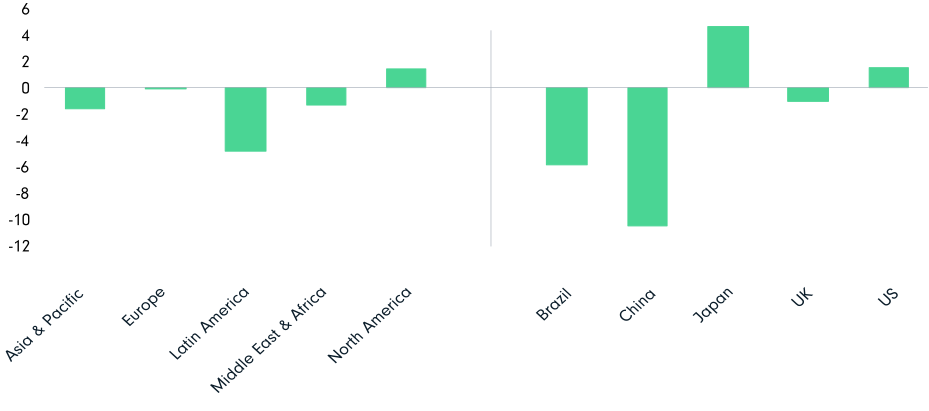
From a regional market perspective, Europe held up best, declining a modest -0.1% in January. The UK and Germany declined -1.1% and -1.0%, respectively, while France was effectively flat at 0.1%. Smaller countries delivered more extreme returns, with Turkey up a solid 10.3% as it signaled its rate-hike cycle might be at an end, and its government has launched a series of economic reforms aimed at rebuilding the central bank’s foreign currency reserves and cooling consumer demand which helped push prices higher. Portugal was the region’s worst performer, declining -8.7% in January.
Despite the ongoing hot conflict in the Middle East and Africa region, markets declined only -1.3%, though with wide divergence across countries. Egypt was up nearly +20.0%, as hopes of moderating developed world interest rates increase investors’ appetite for emerging markets debt, which would help debt-distressed Egypt. Conversely, South Africa fell -5.7% and Qatar declined -4.9%. Likewise, results were mixed across the Asia and Pacific region, which overall fell -1.6% and ranged from Japan’s +4.6% rise to China’s -10.5% fall. China’s officials continue wrestling with ways to boost economic growth as consumer prices continue falling, manufacturing activity remains muted, and its economy grew at one of its lowest rates in decades, expanding just 5.2% in 2023. Officials cut the bank reserve ratio in January to spur lending and goose economic activity. Latin America was the worst performing region in January, falling -4.8% and led down by Chile, which dropped -11.1% as the country remains politically gridlocked. Brazil fell a more moderate -5.9%, and Colombia was the region’s best performing, rising +1.9%.
Exhibit 1 — January Returns for Major Markets (USD) (%)
Source: FactSet, as of 31 Jan 2024.
Results were mixed at the sector level, with health care leading the way, +1.1%, followed by technology stocks up +0.8% — the only two positive sectors. Materials (-6.2%), real estate (-4.6%) and utilities (-2.9%) were the month’s bottom performers — which, given the indications of interest rates’ near-term trajectory, is not particularly surprising. The most modest decline came from energy, -0.2%, as global energy prices remain robust against a fraught geopolitical backdrop.
As has been the case over much of the last year, the market’s return (or at least market sentiment) seems heavily predicated on the monetary policy outlook. In contrast to the past, when investors seemed to draw their own conclusions about when global central bankers would start cutting rates, perhaps they’re beginning to take central bank heads more at their word. While we have no unique ability to predict with much accuracy where the rates cycle — or markets or economies more broadly — will go from here, we maintain confidence in our rigorous, fundamental approach to bottom-up research and remain committed to our value-oriented investment process, which we believe positions us well to navigate whatever market environment comes our way.
MSCI ACWI Index measures the performance of large- and mid-cap stocks in developed and emerging markets. The index is unmanaged, market capitalization weighted, includes net reinvested dividends, does not reflect fees or expenses (which would lower the return) and is not available for direct investment. Index data source: MSCI, Inc. See diamond-hill.com/disclosures for a full copy of the disclaimer.
The views expressed are those of Diamond Hill as of February 2024 and are subject to change without notice. These opinions are not intended to be a forecast of future events, a guarantee of future results or investment advice. Investing involves risk, including the possible loss of principal. Past performance is not a guarantee of future results.
/sitefiles/live/documents/insights/IntlPersp/2024/A-639/2402_International_Monthly_Commentary.pdf