Global Markets Bounce Back in May
Markets rebounded in May amid signs global monetary policy may imminently diverge in major developed economies and heightening trade tensions between China and parts of the developed West. In USD terms, the MSCI ACWI Index rose 4.1% as economic data from major global economies remain robust — even as inflation likewise remains stickier than hoped.
Early in the month, Federal Reserve head Jerome Powell announced US interest rates would remain higher for longer as inflation has failed to approach the Fed’s 2% target. The announcement precipitates a likely divergence in global monetary policy. The European Central Bank lowered interest rates by a quarter point in early June (its first cut in almost five years) — even as recent inflation data paint a somewhat muddled picture across the economic bloc, with wages rising in bellwether economy Germany and eurozone inflation rising for the first time this calendar year. Meanwhile, the Bank of England may indeed hold off on its anticipated June cut in the wake of higher-than-expected inflation data, particularly as its economy technically exited recession after notching a positive quarter of GDP growth.
That the US is likely to leave rates higher for longer is not a major surprise — though it may induce further challenges for Japan, which has struggled mightily to support the yen. The currency is at 34-year lows, pressuring the Bank of Japan to consider rate hikes sooner than it would like, given consumption and economic activity remain relatively sluggish. Given the country’s decades-long battle to raise inflation and restore economic resilience, the BoJ undoubtedly faces a delicate needle to thread in the months and quarters ahead.
Further complicating the global monetary policy picture are ongoing supply chain disruptions fueled by continued Red Sea attacks, which have raised shipping rates precipitously sooner than is typical ahead of the end-of-year holiday season. Compounding this issue are a drought in Central America, which has forced authorities to limit the size of ships passing through the Panama Canal, and already overcrowded European ports, which face a surplus of car imports from China. Ongoing supply chain challenges are likely to maintain at least some pressure on prices globally, which, as we alluded to earlier, likely complicates the global monetary policy picture.
Similarly, heightening trade tensions with China may add to global prices confusion. In May, the US revoked export licenses allowing US companies Qualcomm and Intel to provide semiconductors to Huawei; the US also raised tariffs on a range of imports, including electric vehicles (EVs) and semiconductors. Europe has already begun an anti-subsidy investigation into Chinese EVs as the region faces the aforementioned oversupply of EVs at its ports. The EU has also been investigating China’s solar panel industry for potentially unfair advantages tied to government subsidies. In response to these moves from the West, China’s President Xi announced the country would launch its own anti-dumping investigation into US and European chemical makers — specifically, imports of polyoxymethylene copolymer, which is an input in consumer electronics and autos. While this trade tiff is hardly new, it seems likely to primarily complicate an already fraught global trade market which faces a spate of inflationary pressures.
In addition to global complications, ratcheting trade tensions likely serve to complicate China’s domestic macroeconomic situation, which remains sluggish amid an ongoing property sector malaise and a consumer base which has yet to fully recover following the pandemic. Among the mixed data in May were modestly higher consumer inflation, lower factory prices, recovering industrial profits, rising exports and falling manufacturing activity. While the government announced measures intended to boost its flagging property sector in May, it seems hesitant to enact policies that might help consumers — which could prolong the country’s slow economic recovery.
Regionally, stocks in Europe and North America led the way, with the former rising +4.8% and the latter +4.7%. At the individual country level, Greece declined in May, falling a modest -0.8%, while Norway (+8.8%), Austria (+8.5%), the Czech Republic (+8.5%), Portugal (+8.1%) and Switzerland (+8.1%) led on an absolute basis. Major economies Germany (+4.3%), the UK (+3.6%) and France (+3.0%) gained more modestly. The US rose a solid +4.7% in May and Canada was up +3.4%.
The Asia & Pacific region was also positive in May, up +1.7% and led by Taiwan (+5.3%), New Zealand (+4.5%), Singapore (+3.8%) and Australia (+3.6%). China rose +2.4%, while Japan notched a more modest +1.3% gain. Indonesia (-6.4%) and the Philippines (-6.1%) were the region’s biggest decliners in the month.
In contrast, the Middle East & Africa and Latin America regions were in the red, each region falling -3.2%. In the Middle East, Egypt led the way, bouncing +11.5%, while Saudi Arabia (-7.6%) led the way down. In Latin America, Brazil fell -5.0%, and Mexico declined -2.5% as it elected a new president, Claudia Sheinbaum, who is broadly expected to continue outgoing President Andres Manuel Lopez Obrador’s left-leaning policies. Colombia rose most, up +7.1%, followed by Chile (+5.3%) and Peru (+5.1%).
Exhibit 1 — May Returns for Major Markets (USD) (%)
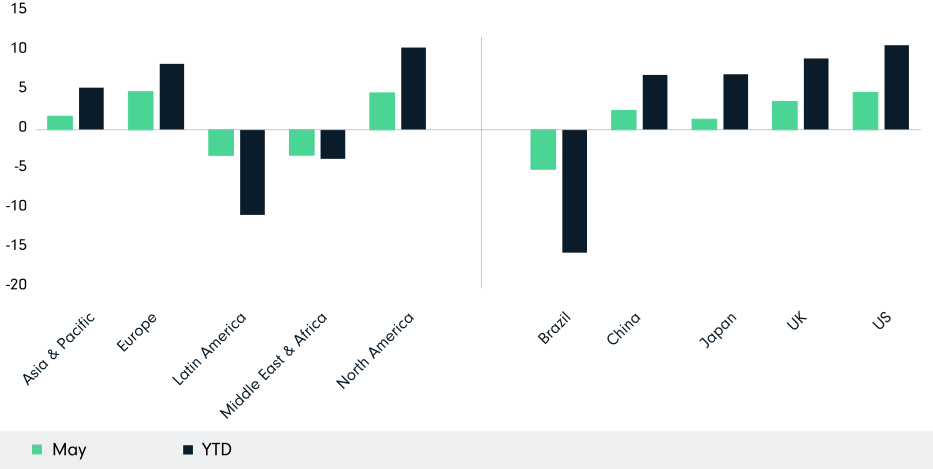
Source: FactSet, as of 31 May 2024.
At the sector level across non-US markets, utilities (+4.7%), financials (+4.6%) and industrials (+4.1%) rose most, followed by health care (+3.0%), communication services (+2.9%) and information technology (+2.7%). No sectors were in the red in May, though consumer discretionary (+0.5%), real estate (+0.6%) and energy (+0.9%) notched the most modest gains.
Following April’s decline, markets rebounded in May, continuing to climb the wall of worry that has shifted relatively little over the past several quarters. The global monetary policy outlook seems to top investors’ list of concerns, but, at least for May, was insufficiently concerning to dent stocks’ returns much. Nor does the prospect of diverging policies across Europe and the US seem to weigh much on investors’ mindset for the time being. Of course, whether the reality plays out differently remains to be seen.
Across global markets, there's a wealth of opportunities. As bottom-up, value-oriented investors, we thrive in times of volatility and disruption. It's during these periods that great businesses often become mispriced, presenting us with exceptional investment prospects. Our excitement lies in continuously searching for and uncovering the best ideas amidst change.
MSCI ACWI Index measures the performance of large- and mid-cap stocks in developed and emerging markets. The index is unmanaged, market capitalization weighted, includes net reinvested dividends, does not reflect fees or expenses (which would lower the return) and is not available for direct investment. Index data source: MSCI, Inc. See diamond-hill.com/disclosures for a full copy of the disclaimer.
The views expressed are those of Diamond Hill as of June 2024 and are subject to change without notice. These opinions are not intended to be a forecast of future events, a guarantee of future results or investment advice. Investing involves risk, including the possible loss of principal. Past performance is not a guarantee of future results.
/sitefiles/live/documents/insights/Blog/A-683/2406_International_Monthly_Commentary.pdf