Living in a Post-Cuts World
Markets declined in October — in USD terms, the MSCI ACWI Index fell -2.2% as global markets digested major central banks’ recent decisions to cut interest rates and as global politics and geopolitics dominated headlines. Developed markets led emerging markets, but both regions were in the red.
Unlike August’s sharp early month decline, October’s fall was more gradual as mixed economic news trickled in over the course of the month. In Europe, September eurozone inflation fell below the bloc’s 2.0% target for the first time in three years – though it rose in October — giving the European Central Bank sufficient breathing room to lower interest rates by another 25 basis points (bps) to 3.25%. Bolstering the ECB’s rate-cut case were tepid economic growth figures which missed already-low expectations. Germany, the region’s largest economy, has been particularly concerning, with growth stagnating to +0.2% in the quarter ending in September but shrinking -0.3% in the quarter ending in June. In contrast, Spain has been the regional economic powerhouse, notching +3.4% year-over-year in the third quarter, up from +3.2% in the prior quarter and putting the country on track to lead the developed world in economic growth this year.
In the UK, August economic growth was also a lukewarm +0.2%,while inflation fell below the Bank of England’s +2.0% target to +1.7% in September, leading some to speculate the BoE will cut rates again at its upcoming November meeting. Similarly, US economic growth was a respectable +2.8% in Q3 (though missed expectations for +3.0% growth), while inflation came in a touch higher than expected at +2.4% — down from the prior month but hotter than generally hoped for. Potentially one of the main headlines early in the month was the aversion of a longer strike at major East Coast and Gulf ports, which some predicted could cripple supply chains and threaten economic growth.
Elsewhere, the Bank of Canada cut rates by a surprising 50 bps in October — the fourth consecutive cut, though the prior three had been more modest 25 bps cuts. The country’s economy has stagnated, while inflation finally dipped below +2.0% in the month, ostensibly giving the central bank room for a larger cut.
In Japan, which has been moving in the opposite direction of most developed world central banks, the Bank of Japan held rates in October but signaled rate hikes were likely still ahead, particularly if wages and prices continue rising. This decision followed a striking political development a few days prior: In a snap election called by recently elevated Prime Minister Shigeru Ishiba, voters stripped the Liberal Democratic party (LDP) of its parliamentary majority for the first time in 15 years. The shocking result followed a political scandal which angered voters and now leaves the LDP scrambling to reassemble a coalition, while PM Ishiba faces growing calls to step aside.
China, whose market took off as September concluded against the backdrop of announced fiscal and monetary stimulus, grew a disappointing +4.6% in the third quarter, and its market declined sharply (-5.9%) as investors awaited details of the promised stimulus. Though leadership has announced some monetary measures — like increasing lending to its staggering property sector — it has remained vague on its fiscal plans, generally failing to attach numbers to intentions such as recapitalizing local governments and state banks. As the economy struggles to find its footing, the People’s Bank of China announced another rate cut in October, taking rates down to +3.10% from +3.35%.
All told, the markets’ reaction to the initial round of interest-rate cuts in September has been something of a mixed bag. Though it seems unlikely the major central banks will sharply reverse course in the months ahead, it will be interesting to see how they navigate an undoubtedly complex macroeconomic environment.
Meanwhile, the geopolitical environment only ratcheted up in October: Israel intensified its military campaign against Hezbollah and Hamas, eliminating leaders of both groups while launching new strikes against Iran itself. And in Ukraine, North Korean soldiers seem poised to join the Russians, which would mark the first instance of foreign soldiers’ involvement in the regional conflict.
Regionally, North American stocks held up best in October, declining -0.8%. US stocks (as measured by the MSCI USA) fell -0.8%. The Middle East and Africa also generally held up slightly better than other regions, declining -1.5%. Israel was the region’s sole positive performer, rising +1.3% against the backdrop of war. Egypt declined -4.4%, leading the region down, and South Africa’s market fell -2.5%.
The Asia and Pacific region declined -4.6% in October, with Japan (-3.9%), China (-5.9%) and India (-8.3%) having the largest impact. Conversely, Taiwan led (+3.7%) and was the region’s sole country in the black. Latin America was down -5.1%, with Brazil (-5.5%), Chile (-5.3%) and Mexico (-5.0%) delivering the worst returns. Peru was the sole positive performer, adding +0.6% in October.
Europe was at the bottom regionally in October, falling -5.9% and without any countries providing positive returns. Leading the way down were Portugal (-12.3%), the Netherlands (-11.3%) and Turkey (-9.7%). The Czech Republic (-0.9%), Austria (-1.5%) and Italy (-2.1%) fell the least.
October Returns for Major Markets (USD) (%)
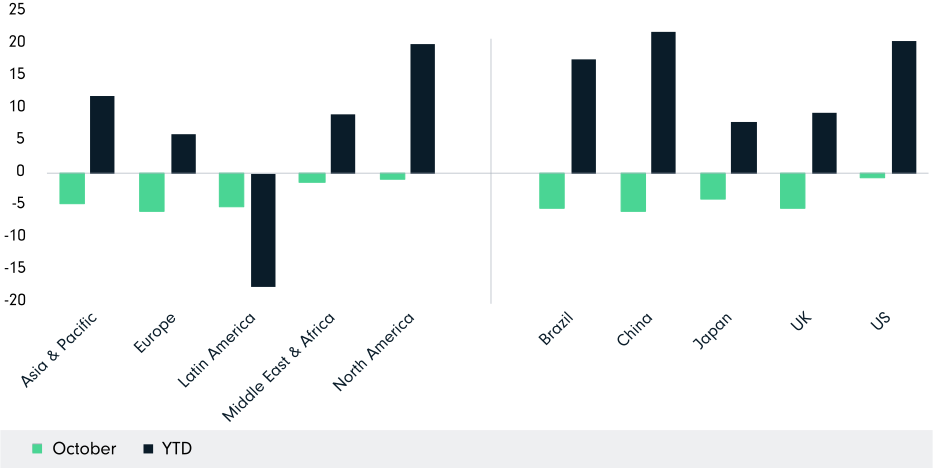
Source: FactSet, as of 31 October 2024.
All sectors were likewise negative in October, with consumer staples (-7.9%), materials (-7.6%) and consumer discretionary (-6.9%) providing the worst returns. Information technology (-2.4%), financials (-2.8%) and energy (-4.0%), while down less, also fell fairly sharply in October.
October seemed to be the first month in which investors contemplated the possibility central banks couldn’t quite so smoothly affect a soft landing — i.e., cutting rates without reigniting inflation and before stamping out too much economic growth. As ever, only hindsight will reveal how well they did. While we await the data to come to such a conclusion, expect the headlines to only get noisier, with the US heading to the polls in early November and few signs global tensions are likely to ease — on the contrary, they could intensify in the months ahead.
Challenging though it may feel to keep a cool head amid such market conditions, we remain convinced investors who are willing to sift the news from the noise and take a sufficiently long-term view can identify high-quality companies that will weather the current environment sufficiently well to deliver solid long-term returns. As such, we will stay true to our disciplined, rigorous, bottom-up, fundamentally-oriented research process in the months and quarters ahead — come what may.
MSCI ACWI Index measures the performance of large- and mid-cap stocks in developed and emerging markets. The index is unmanaged, market capitalization weighted, includes net reinvested dividends, does not reflect fees or expenses (which would lower the return) and is not available for direct investment. Index data source: MSCI, Inc. See diamond-hill.com/disclosures for a full copy of the disclaimer.
The views expressed are those of the author as of November 2024 and are subject to change without notice. These opinions are not intended to be a forecast of future events, a guarantee of future results or investment advice. Investing involves risk, including the possible loss of principal. Past performance is not a guarantee of future results.
/sitefiles/live/documents/insights/Blog/A-732/2411-international-monthly-commentary.pdf