Election Aftermath
Markets rose in November as a major source of uncertainty — the US election — finally lifted. In USD terms, the MSCI ACWI Index rose +3.7%, but there was meaningful divergence regionally, with Europe declining -1.7% and emerging markets -3.6%, while the US rose a sturdy +6.2%. Following an initial post-election bounce in early November, markets gave back some gains, only to retrace and ultimately surpass their monthly highs.
The US election inarguably captured most of the headlines in November, with ample speculation as to what a second term for President-elect Trump will look like. Top of mind for many is trade — with the incoming president vowing to sharply increase tariffs, citing specifically China, Canada and Mexico. Though whether and to what degree the next Trump administration follows through remain to be seen, some countries seemed to brace themselves ahead of the possibility — for example, Korea cut interest rates to 3.0% ahead of what it expects to be larger-than-anticipated “downward economic risks,” given the country’s heavy reliance on exports.
The US Federal Reserve cut rates by 25 basis points (bps) in November, as did the Bank of England, despite higher inflation in both countries. However, higher prices were mostly attributed to energy costs — while core inflation remained steadier, giving the central banks room to enact cuts. Simultaneously, both Federal Reserve Chairman Jerome Powell and Bank of England Governor Andrew Bailey indicated further rate cuts would be gradual.
The macroeconomic backdrops in the US, UK and Europe undoubtedly remain mixed: Q3 GDP in the UK was barely positive (+0.1% q/q), while euro zone manufacturing activity signaled contraction in November, prompting some speculation the European Central Bank (ECB) may contemplate another 50 bps rate cut at its next meeting. Meanwhile, eurozone inflation increased — though many attributed the increase to base effects (i.e., lower energy prices a year ago made this year’s price levels look higher than they otherwise would) and don’t expect the ECB to change its mind about cutting rates. Further complicating the inflation picture are global food prices, which reached an 18-month high and show few signs of abating in the near term.
In China, which is broadly expected to be a major target of the new US administration’s trade policy, the government made quick moves to signal support for exporters, including promising to direct banks to provide more credit to export-oriented companies and help companies hedge foreign currency risk. Simultaneously, China’s ambassador to the US has been attempting to make connections with the Trump administration in the hope he can influence a more lenient tariff stance. Meanwhile, China’s government also announced a new $1.4 trillion package aimed at shoring up local governments, which continue struggling with the country’s property-sector woes. Some investors were disappointed more funds weren’t directed to flagging consumer spending, though the finance minister indicated the government was contemplating potential next steps, which could include recapitalizing big banks, buying unfinished properties and shoring up consumption. Though retail sales rose +4.8% y/y in October, the property sector continued declining — indicating even the hefty government support measures have yet to stem the fall.
In Japan, new Prime Minister Shigeru Ishiba approved a $250 billion stimulus package, including support for the artificial intelligence (AI) and semiconductor industries, as well as cash and energy subsidies for lower-income houses. The most controversial piece of the package is an increase in the minimum salary threshold for income tax from $6,640 — the level at which it has been for 29 years — to $11,500. Proponents (notably, the Democratic Party for the People (DPP), which is a new member of Ishiba’s coalition following recent snap elections which weakened his prior position) note the higher threshold will encourage more people who currently tailor their schedules and earnings to fall below the limit to work more. Opponents cite the anticipated loss of some $45 billion in tax revenues. Complicating the picture and the likely outcome of such a policy, should it be enacted, is a still-weak yen — which weakened further against the US dollar following the US election. The weak currency is pressuring energy and food costs higher in Japan — though many still expect the Bank of Japan to raise interest rates at its next meeting. Only time will tell whether these measures can pave the way for sustainable economic growth, but they represent a critical step in addressing Japan’s long-standing challenges.
While the US election mitigated some uncertainty, the geopolitical outlook became arguably less clear in November. The conflict between Russia and Ukraine escalated as Ukraine fired longer-range missiles provided by the US and UK into Russian territory, and Russia launched its first intercontinental ballistic missile (which did not carry a nuclear warhead). However, Russia also altered its nuclear doctrine, lowering the threshold for using a nuclear weapon, as the US authorized Ukraine’s use of longer-range missiles. In the Middle East, the US helped broker a ceasefire between Israel and Hezbollah in Lebanon late in November — though as we write, the nascent agreement faces strain from recently exchanged fire between the two sides. And conflict is being renewed in Syria, where rebels — with at least implicit support from Turkey — took Aleppo and are pressuring Russia-backed Syrian President Bashar al-Assad. In early December political news, France’s parliament passed a vote of no confidence in Prime Minister Michel Barnier, and Korea’s President Yoon Suk Yeol faced tremendous pressure to step down following his failed attempt to impose martial law.
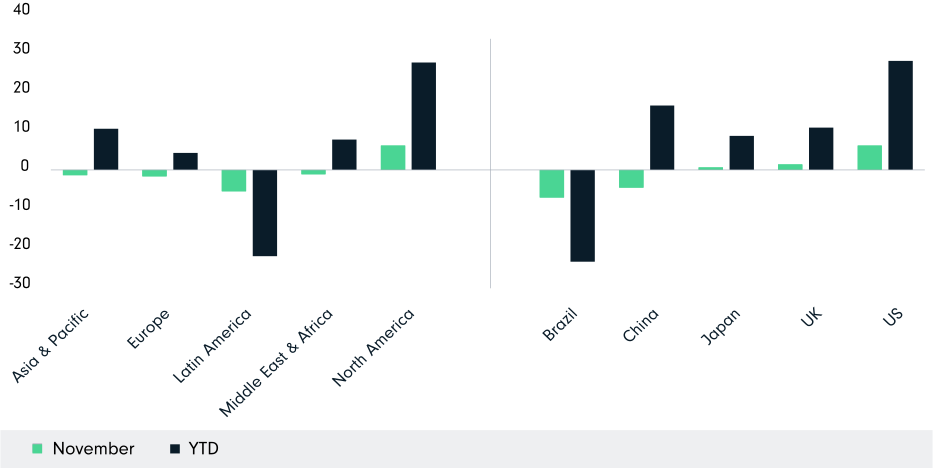
Regionally, North American stocks rose most in November, rising +6.2% — the US rose +6.2% and Canada was up +6.6%. All other regions were in the red, with the Middle East & Africa (-1.2%) and Asia & Pacific (-1.3%) holding up the best. In the Middle East, Israel was up +5.9%, the United Arab Emirates rose +1.8% and Kuwait +1.6%. Conversely, South Africa was the region’s worst performing, falling -4.5%. In Asia, Singapore rose a robust +8.0%, with New Zealand (+4.2%) and Australia (+3.5%) also nicely positive. The Philippines fell -8.2%, and Indonesia (-7.9%), Korea (-5.7%), Thailand (-4.5%), China (-4.5%) and Taiwan (-4.5%) were also in the red amid rising trade tensions.
Europe fell -1.6%, led down by Portugal (-5.9%), Finland (-5.6%) and Ireland (-5.3%) — the latter as it went to the polls and faces potential complications should the US attempt to match its strong position as a corporate tax haven. Among the major economies, France (-4.2%) fell the most, while Germany was down a more modest -0.3% and the UK rose +1.4%. In Latin America, which declined -5.5% in November, Brazil fell the most (-7.1%), with Mexico declining -3.1% and Chile down -1.6%. Colombia was the region’s sole positive performer, just in the black (+0.4%).
Exhibit 1 — November Returns for Major Markets (USD) (%)
Source: FactSet, as of 30 November 2024.
From a sector perspective, financials (+1.7%), communication services (+0.7%) and industrials (+0.1%) all notched small gains following October’s declines. The materials (-4.6%), health care (-3.7%) and consumer discretionary sectors (-3.0%) were the worst performers.
Markets seemed to overall react positively to the end of election season in the US. Naturally, much remains to be seen and settled. Though President-elect Trump has talked tough about trade — both leading up to and since the election — whether he will be able to effect meaningful trade-policy changes (and whether they have the intended effects or create unintended knock-on effects) will play out over the quarters and possibly years to come. It isn’t historically surprising to see markets bounce in the wake of a Republican victory, given the party’s reputation for being more business-friendly. However, it also isn’t historically surprising to see relatively muted returns once the new administration takes office, as it inevitably turns out that politics remains a challenging business — even with both houses of Congress in one party’s hands.
What remains certain in our eyes is the potential for experienced, disciplined investors deploying a rigorous, bottom-up approach to identifying high-quality companies well-positioned to benefit from whatever economic environment prevails to deliver positive, above-market long-term returns. As such, we will keep our eyes attuned to such investing opportunities and look forward to communicating with you about our findings in the months and quarters ahead.
MSCI ACWI Index measures the performance of large- and mid-cap stocks in developed and emerging markets. The index is unmanaged, market capitalization weighted, includes net reinvested dividends, does not reflect fees or expenses (which would lower the return) and is not available for direct investment. Index data source: MSCI, Inc. See diamond-hill.com/disclosures for a full copy of the disclaimer.
The views expressed are those of Diamond Hill as of December 2024 and are subject to change without notice. These opinions are not intended to be a forecast of future events, a guarantee of future results or investment advice. Investing involves risk, including the possible loss of principal. Past performance is not a guarantee of future results.
/sitefiles/live/documents/insights/IntlPersp/2024/A-739/2412_International_Monthly_Commentary.pdf