Bond Market Performance Update
While the year is not over yet, the securitized market has held up well in 2024, trailing only the corporate sector on a year-to-date basis. Within securitized, non-agency commercial mortgage-backed securities (CMBS) have led the investment grade market, with index-eligible non-agency CMBS returning 6.83% through the end of November, fueled by a strong Q1 relative to the rest of the market and steady returns in Q2 and Q3.
Total Return (%)

Asset-backed Securities
ABS market issuance in 2024 has surged to $325 billion, outpacing 2023’s full-year total of $259 billion. This growth has been driven by strong activity in the consumer space, led by device payment plans and student loans, while in the commercial sector, much of the expansion comes from the market’s "Other" category.
ABS Issuance ($B)
|
Nov 2024 YTD |
Nov 2023 YTD |
Change (%) |
| Prime Auto |
79 |
74 |
7 |
| Auto Lease |
30 |
23 |
31 |
| Subprime Auto |
41 |
35 |
17 |
| Student Loans |
9 |
7 |
42 |
| Credit Card |
19 |
19 |
1 |
| Unsecured Consumer |
20 |
14 |
37 |
| Rate Reduction |
4 |
7 |
-51 |
| Solar |
5 |
4 |
16 |
| Device Payment Plan |
8 |
4 |
79 |
| Consumer ABS |
215 |
188 |
14 |
| Commercial Auto |
22 |
19 |
18 |
| Equipment |
27 |
22 |
22 |
| Digital Infrastructure |
15 |
11 |
36 |
| Other Commercial |
46 |
20 |
133 |
| Commercial ABS |
110 |
72 |
54 |
| Total ABS |
325 |
259 |
25 |
How is the consumer doing?
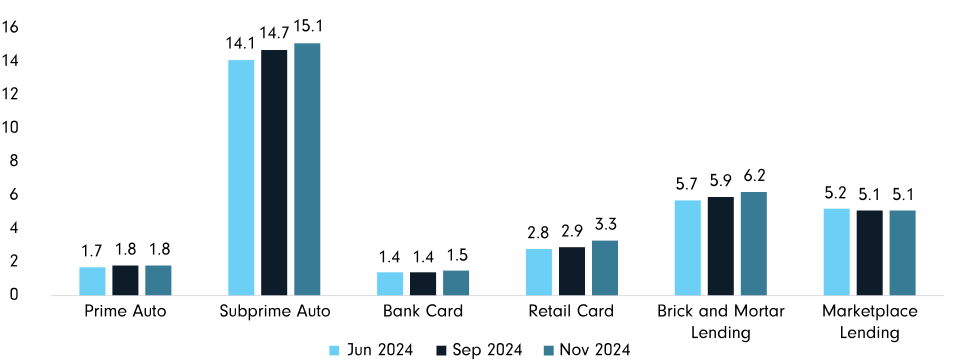
This seems to be one of the most common questions we hear. While delinquency rates have increased in some areas of the market (subprime auto, retail card and brick-and-mortar consumer lending), other areas have improved or stabilized over the past six months.
Delinquency Rates (%)
Commercial Mortgage-backed Securities
CMBS Issuance ($B)

CMBS private label issuance in 2024 has surged past $100 billion year-to-date, more than doubling 2023’s total of $46 billion, with a full month left in the year. This year’s private label issuance of $101 billion has also surpassed 2022’s $99 billion.
Finding Value in CMBS Markets
Non-agency CMBS spreads may have tightened throughout the year, but attractive opportunities remain when compared to both investment-grade and high-yield corporate debt. Achieving the right risk/reward balance demands thorough research, yet investors who truly understand their holdings can uncover rewarding prospects in the commercial sector.

Source: Wells Fargo, Bloomberg. CRE/CLO — Commercial Real Estate/Collateralized Loan Obligation. SASB — Single Asset, Single Borrower.
Monitoring Market Health Through Special Servicing
Special servicing plays a vital role in the CMBS market, where third-party managers step in to handle loans for borrowers facing payment difficulties. The special servicing rate is a key indicator of the commercial real estate (CRE) market’s condition, helping to identify emerging risks. Over the past month, special servicing rates have risen across most CMBS sectors, with the exception of Industrial and Lodging. Multifamily experienced the most significant increase, climbing from 6.21% to 7.37%.
Special Servicing Rates (%)

Residential Mortgage-backed Securities
Non-Agency RMBS issuance remains robust, showing a 92% increase compared to the prior year.
RMBS Issuance ($B)

Key
Non-QM — Non-qualified mortgages
RPL/NPL — Re-Performing Loans / Non-Performing Loans
CRT — Charitable Remainder Trust
SFR — Single-family rentals
HELOC/CES — Home Equity Line of Credit/Closed-End Second Mortgage
Tracking Trends in the Housing Market
- Existing home sales rose slightly in October, increasing from 3.83 million to 3.96 million, while new home sales declined month-over-month from 738,000 to 610,000.
- Housing starts also fell, dropping from 1.35 million to 1.31 million, alongside a slight decrease in the months' supply of existing homes, which ticked down from 4.1 to 4.0.
- Elevated mortgage rates have dampened overall housing activity, pushing many key metrics to historic lows.
- Existing home sales hit a 14-year low, dropping to 3.83 million units.
- New home sales, meanwhile, reached approximately 738,000, marking a 6% year-over-year increase.
- Home affordability remains a major challenge, with record-high home prices and elevated mortgage rates keeping it near all-time lows.
- Lower sales activity and owners steadfastly holding onto low locked-in rates have reduced mortgage demand. While refinance and mortgage applications are up year-over-year, they remain far below levels seen between 2019 and 2022.
Sources: Bloomberg, Citi, Barclays, Deutsche Bank, Wells Fargo and Trepp.
Investment Grade is a Bond Quality Rating of AAA, AA, A or BBB.
Bloomberg US Aggregate Bond Index measures the performance of investment grade, fixed-rate taxable bond market and includes government and corporate bonds, agency mortgage-backed, asset-backed and commercial mortgage-backed securities (agency and non-agency). Bloomberg US Corporate Index measures the performance of the US investment grade fixed-rate taxable corporate bond market. Bloomberg Treasury Bond Index measures US dollar-denominated, fixed-rate, nominal debt issued by the US Treasury. Bloomberg US Securitized Index measures the performance of the securitized sector of the Bloomberg US Aggregate Bond Index. Bloomberg US ABS Index measures the investment grade, US dollar-denominated, fixed-rate taxable bond market. Bloomberg US Mortgage-Backed Securities Index measures the performance of fixed-rate agency mortgage-backed pass-through securities guaranteed by Ginnie Mae (GNMA), Fannie Mae (FNMA), and Freddie Mac (FHLMC). Bloomberg US Non-Agency CMBS Index measures the market of US Non-Agency conduit and fusion CMBS deals with a minimum current deal size of $300mn. The indexes are unmanaged, include net reinvested dividends, do not reflect fees or expenses (which would lower the return) and are not available for direct investment. Index data source: Bloomberg Index Services Limited. See diamond-hill.com/disclosures for a full copy of the disclaimer.
The views expressed are those of Diamond Hill as of December 2024 and are subject to change without notice. These opinions are not intended to be a forecast of future events, a guarantee of future results or investment advice. Investing involves risk, including the possible loss of principal. Past performance is not a guarantee of future results.