Q4 in Review: What Shaped US Fixed Income Markets?
Fueled by a shift higher in rates, US fixed income markets were in the red in Q4, with the Bloomberg US Aggregate Bond Index down -3.06%. The pullback in the year’s final quarter brought the year-to-date performance for the index to +1.25%, the second consecutive year of positive performance after two years of negative performance. The 1.25% return marked the index’s third lowest positive annual return, ahead of only 2018’s +0.01% and 2015’s +0.55%.
Q4’s performance was the result of pullbacks in both October (-2.44%) and December (-1.61%), with a positive month in November (+1.00%) sandwiched between the two. The performance dynamics were directly in sync with the movements of the interest rate market as rates climbed in October and December and essentially held the line in November, finishing the quarter significantly higher.
The Federal Reserve followed up its big September splash of a 50-bps reduction in the Fed funds rate with more pedestrian 25-bps reductions at its November and December meetings, directly in line with market expectations. December’s hawkishly-dovish meeting saw the updated Summary of Economic Projections (or SEP) communicate that the Federal Reserve had reduced its estimated rate cut projections for calendar year 2025 from 100 bps (end target of 3.375%) to 50 bps (3.875%) from the current level of 4.375%. Continued stubborn inflation and the labor market recovery have shifted expectations that the ever-elusive soft-landing has been achieved and the economy doesn’t need an overly accommodative Federal Reserve.
The disappointment in the non-farm payroll (NFP) in October (+12,000 jobs, likely heavily impacted by two major hurricanes and the Boeing strike) was quickly overshadowed by November and December data that exceeded market expectations to varying degrees. The November report (+227,000 jobs added) outpaced market expectations by 7,000 jobs and the revision to October (from 12,000 to 43,000) set the stage for a strong finish to the year. December’s NFP report of 256,000 (compared to expectations of 165,000) renewed calls for a less accommodating Federal R, aeserve. In the final labor report of the year, the unemployment number decreased from 4.2% to 4.1%, higher than the beginning of the year (3.7%) but well below the historic average (6.1% since 1980).
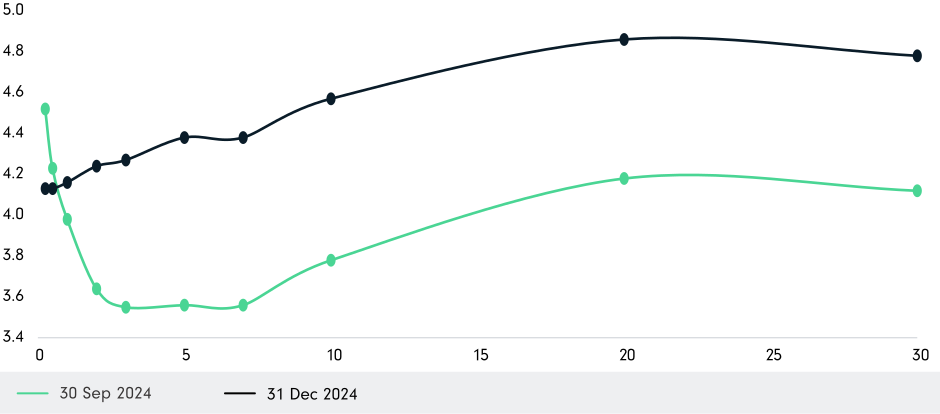
Rates moved higher in Q4, with the biggest shifts occurring in October and December — election uncertainty in October gave way to clarity in early November, and the Fed’s shift drove moves in December. As shown in Exhibit 1, both the long and the short end moved higher in October as concerns around a highly contested election raised volatility levels throughout the markets. A quick resolution to the election in early November, which dispelled concerns about potential legal proceedings and uncertainty, as well as the Federal Reserve’s unanimous decision to reduce the Fed fund’s rate by an additional 25 bps, helped stabilize fixed income markets. The November labor report, released in early December, combined with inflation holding the line in the 2.6% to 2.7% range, helped push rates higher on the longer end while the shorter end remained fairly stable.
Exhibit 1 — Treasury Yield Changes (%)
|
Monthly change in yield |
Quarterly |
|
October |
November |
December |
|
| 2Y Treasury |
0.53 |
-0.02 |
0.09 |
0.60 |
| 10Y Treasury |
0.50 |
-0.12 |
0.40 |
0.79 |
| 30Y Treasury |
0.36 |
-0.11 |
0.42 |
0.66 |
Source: FRED.
Exhibit 2 — Shift in Yield Curve (%)
Source: Bloomberg.
The fourth quarter of 2024 reflected a dynamic interplay of rising interest rates, Federal Reserve policy adjustments and stronger-than-expected labor market data, culminating in a challenging period for US fixed income markets. With the Bloomberg US Aggregate Bond Index posting a decline in Q4, the broader market showed sensitivity to rate increases in both October and December, partially tempered by stability in November. These factors collectively highlight the complexities of a market navigating evolving economic conditions. Looking ahead, labor market conditions, monetary policy and economic resilience will continue to play a pivotal role.
Bloomberg US Aggregate Bond Index measures the performance of investment grade, fixed-rate taxable bond market and includes government and corporate bonds, agency mortgage-backed, asset-backed and commercial mortgage-backed securities (agency and non-agency). The index is unmanaged, includes net reinvested dividends, does not reflect fees or expenses (which would lower the return) and is not available for direct investment. Index data source: Bloomberg Index Services Limited. See diamond-hill.com/disclosures for a full copy of the disclaimer.
The views expressed are those of the author as of January 2025 and are subject to change without notice. These opinions are not intended to be a forecast of future events, a guarantee of future results or investment advice. Investing involves risk, including the possible loss of principal. Past performance is not a guarantee of future results.
/sitefiles/live/documents/insights/FixedIncomePersp/2025/A-759/2501_Fixed_Income_Monthly_Commentary.pdf