Trump 2.0 Takes Shape
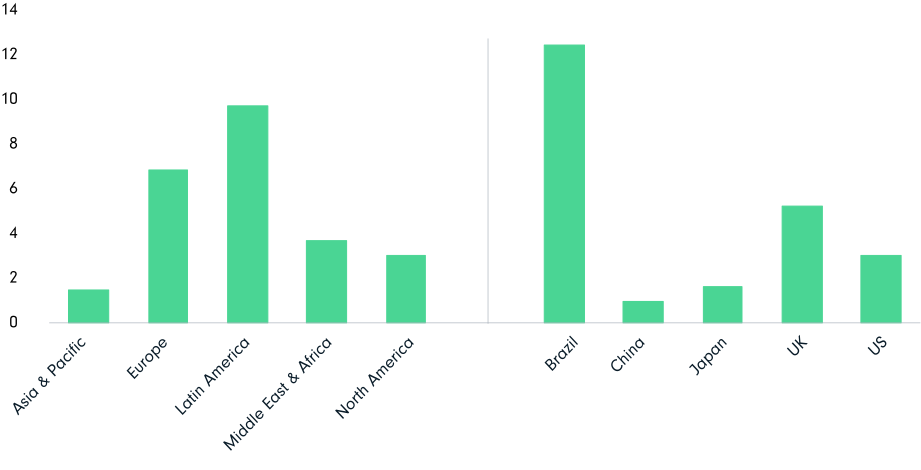
Markets started the year in the black, rising in January as President Trump officially took office and some of his policy stances became clearer. In USD terms, the MSCI ACWI Index rose +3.4%, with all major regions positive: Latin America and Europe rose robustly (+9.7% and +6.8%, respectively), while the Middle East and Africa was up +3.7%, North America rose +3.0% and Asia Pacific rose +1.5%.
President Trump’s 20 January 2025 inauguration kicked off a slew of policy changes, many of which markets are still digesting. One policy area that quickly became clear, however, was trade — namely, the president’s clear intention to use tariffs to effect policy changes that align with his agenda. Colombia was the first to face — and avert — a US tariff following a standoff over the country’s policy regarding allowing US airplanes carrying deportees to land there. Canada, Mexico and China were close behind, though, with Trump threatening 25% tariffs on Canada and Mexico and a 10% tariff on China should they fail to take action aimed at stopping the flow of illegal drugs across the US border. As we write, however, the president has paused tariffs, set to take effect in early February, on Canada and Mexico for a month after each agreed to send 10,000 troops to their borders with the US. Thus far, China has taken a more combative stance, threatening to file a lawsuit against the US with the World Trade Organization and issuing its own set of tariffs on certain US goods.
For now, the US seems focused primarily on its geographically closest trade partners, but the president has also indicated his intention to consider tariffs on the EU. And concerns about potential tariffs — whether they materialize or not — seem to be spurring other countries to reach trade agreements with partners. For example, the EU has recently inked new or updated deals with Mercosur and Mexico and has restarted negotiations with Malaysia which had languished for over 10 years. The US, too, seems likelier to enter more bilateral trade agreements — as it did during Trump’s first term — than agreements with large trade blocs.
On the economic front, recent data seem to point to an increasingly bifurcated world, with the US sustaining solid growth while other countries and regions slow or even turn down. In Q4, the US economy grew at a 2.3% annualized rate — which was slower than economists’ forecasted 2.6%. For the calendar year, the US economy grew 2.8%. The job market, meanwhile, added 256,000 jobs in December, well above expectations for just 160,000, and data showed there were 8.1 million vacancies in November — more than the 7.7 million expected and indicating strong demand for workers. Given the strong data, it’s hardly surprising the Federal Reserve held rates steady in January, a decision which pushed Treasury rates higher and likely contributed to worries about emerging markets’ economies and markets this year should the US’s interest rates and currency both remain robust.
Outside the US, the EU saw growth grind to a halt in Q4, missing expectations for modest 0.1% quarter-over-quarter growth. For the calendar year, the EU’s economy grew a modest 0.7%. Germany’s economy, meanwhile, faces an ongoing manufacturing downturn and consequently contracted for a second consecutive calendar year, shrinking -0.2% in 2024 and -0.3% in 2023. The European Central Bank cut interest rates in January to 2.75%, its lowest level since early 2023, despite data earlier in the month showing a third consecutive monthly increase in inflation to 2.4%. Across the Channel, the UK’s economy likewise remains relatively stagnant, with UK businesses cutting jobs at their fastest pace since 2009 (outside the pandemic). Positively, though, inflation did moderate some to 2.5% in December, providing what may prove some temporary relief to economic policymakers as prices are broadly expected to increase again in the months ahead.
Likewise, China’s economy faces the threat of stagnation — despite official reports of on-target 5% growth in 2024 on the back of strong manufacturing numbers. Contrary to the government data, many consumers report skepticism about such robust growth — and declining corporate profits and stagnant consumer prices would seem to belie a strong economic growth story. With trade tensions between China and the US likeliest to ratchet further from here, it seems Chinese policymakers will continue facing a challenging environment as they seek to spur economic activity.
Of note elsewhere were other monetary policy moves, including the Bank of Japan’s interest rate hike to approximately 0.5% — the country’s highest rate in some 17 years. Many expect the country’s central bank to continue raising rates this year (barring unforeseen developments which would cause them to pause). The policy shift is contributing to a strengthening yen relative to the dollar. Singapore, in contrast, cut rates for the first time in four years, citing slower domestic inflation and the likelihood of increased trade volatility with the US. Indonesia also cut rates, highlighting slowing economic growth as a primary motivation, despite a weakening rupiah relative to the US dollar. The country also cut its 2025 growth forecast, pointing to weaker exports, consumption and private investment.
On the geopolitical front, many of the same storylines remain intact — though there has seemingly been positive progress in the Israel-Hamas war, where the two sides reached a ceasefire deal which also allowed for a significant exchange of hostages. Whether and how long the truce holds remains to be seen. To date, the Russia-Ukraine war continues apace, as does political upheaval in Korea, where the president was arrested in January following a stand-off with police. Several days later, some of his supporters breached the courthouse after a judge extended his detention. Political uncertainty has also enveloped Canada following Prime Minister Justin Trudeau’s announced resignation, which will trigger an election by 20 October this year at the latest. In the meantime, Canada’s Parliament is in recess until 24 March to give the currently ruling Liberal Party time to name a new leader, who would then also become prime minister until the election could be held.
Regionally, Latin America led (+9.7%), with all countries delivering positive returns. Brazilian stocks were up 12% and equities in Mexico were up just over 3%. Europe also delivered solid returns in January, rising +6.8% and led by France, Germany and Switzerland, which all saw stocks rise high single digits. Stocks in the UK advanced just over 5%. The only negative performers were Portugal and Denmark, where stocks fell less than 2%.
The Middle East and Africa rose +3.7% in January, led by South Africa (+5.3%) and Saudi Arabia (2.6%). Egypt and Qatar were the only countries whose markets declined modestly in the month. In North America (+3.0%), the US rose +3.0% and Canada added +2.8%.
The Asia Pacific region was the most modest gainer in January, adding +1.5%. Australian stocks advanced 5%, while stocks in Japan, Taiwan and South Korea advanced 1.6%, 3.3% and 6.3%, respectively. Stocks in India (-3.5%) and Hong Kong (-2.3%) hampered the region’s results.
Exhibit 1 – January Returns for Major Markets (USD) (%)
Source: FactSet, as of 31 Jan 2025.
From a sector perspective, all sectors advanced in January, with technology (+5.1%), financials (+5.0%) and health care (+4.7%) all notching solid January gains. Consumer staples (+1.4%), real estate (+1.4%) and utilities (+0.5%) rose most modestly in the month.
“Uncertainty” seems like it could contend for the theme of 2025. Though the US election certainly pointed in a relatively clear, general policy direction, thereby alleviating at least some uncertainty, how that policy specifically plays out and its downstream effects are likely to create a fair few surprises in the year ahead. Then, too, with global economies and monetary policies remaining, at least for now, on different tracks, the macroeconomic backdrop will remain complex as ever — as will, certainly, the geopolitical backdrop. Absent a crystal ball, we believe the best approach to investing in any market environment, but particularly one with so few known variables, is deploying a rigorous, fundamentally oriented, bottom-up approach which seeks to identify high-quality individual companies likeliest to benefit from whatever developments come. We believe such investors are better positioned to deliver above-average returns over the long term — and as such, we will remain diligent in deploying our approach to finding undervalued investment opportunities in the period ahead.
MSCI ACWI Index measures the performance of large- and mid-cap stocks in developed and emerging markets. MSCI ACWI ex USA Index measures the performance of large- and mid-cap stocks in developed (excluding the US) and emerging markets. The indexes are unmanaged, market capitalization weighted, include net reinvested dividends, do not reflect fees or expenses (which would lower the return) and are not available for direct investment. Index data source: MSCI, Inc. See diamond-hill.com/disclosures for a full copy of the disclaimer.
The views expressed are those of Diamond Hill as of February 2025 and are subject to change without notice. These opinions are not intended to be a forecast of future events, a guarantee of future results or investment advice. Investing involves risk, including the possible loss of principal. Past performance is not a guarantee of future results.
/sitefiles/live/documents/insights/Blog/2025/A-764/2502-International-Monthly-Commentary.pdf