Data, Decisions and Discord: How Inflation Could Shape the Fed's Next Moves
We’re only one month into the new year and already seeing bouts of volatility and significant shifts in the economic outlook. The world came into 2025 with concerns around the continued stubbornness of inflation, the potential for a conflict between the Federal Reserve and the executive branch of the US government, day-to-day volatility in the fixed income markets fueled by news clips and economic data, and ambiguity around the implications of the newly formed Department of Government Efficiency’s (DOGE) efforts to streamline and reduce government spending.
Inflation just won’t go away…
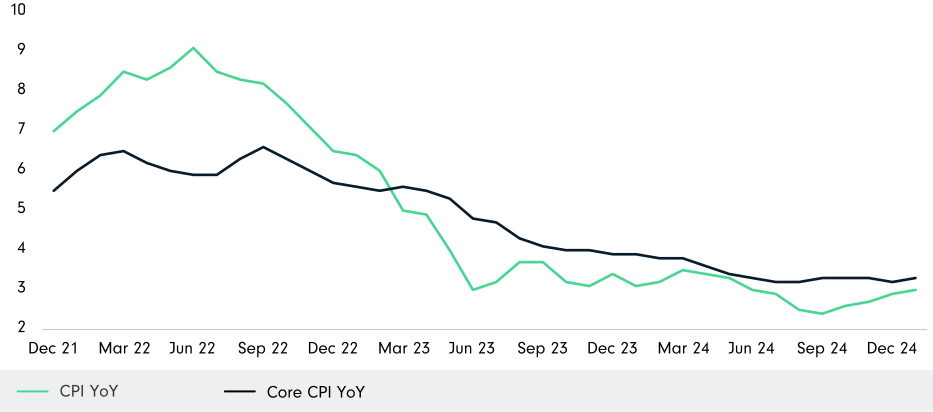
Since peaking in the summer of 2022, inflation has been on a steady move lower, though the pace at which inflation declined slowed as we moved into the final quarter of 2024. One must recall that there are two methods of measuring inflation: the headline measurement, which includes the more volatile components of energy and food, and core inflation, which excludes the aforementioned segments. Both measures have followed the same trajectory (Exhibit 1) since peaking in the summer of 2022.
Still, overall inflation began to push higher in the fall of 2024, fueled by increasing food prices, such as the much-reported surge in egg prices due to avian flu. Core inflation has essentially held the line since the start of Q3 2024, fluctuating between 3.2% and 3.3% year over year from June 2024 through January 2025. But it is a different story with headline inflation, as the surge in the price of groceries and, more recently, in oil has pushed the full measure of inflation from a low point of 2.4% year over year in September 2024 to its highest level (3.0%) since June of that same year.
The most recent inflation report showed price increases were broad-based, hitting insurance, used cars and trucks, airline fares, medical care, haircuts, daycare, sporting events, cable television and more. Due to the volatility associated with energy and food, the inclusive headline number will be volatile. However, some would argue it is the most accurate measure of actual inflation since people still must account for those daily expenditures.
Despite the perceived success in bringing inflation down, combined with the resiliency of the labor market, the Federal Reserve has shifted towards a wait-and-see, data-dependent approach regarding the future path of rates, which has put the Fed in the crosshairs of the new administration.
Exhibit 1 — Two Measures of Inflation … Similar Paths (%)
Source: Bloomberg.
The Federal Reserve vs the Executive Branch
Outside of a barrage of executive actions issued in the first 30 days of the new administration, the continued call for lower rates has echoed through the halls of Washington, DC. From a strictly academic standpoint, persistent inflation above the Federal Reserve’s target level combined with a stronger-than-expected labor market means that the Fed should be cautious regarding the future path of interest rates. Some would argue that the next step by the Fed should be higher to calm inflation and the labor market. While this market segment is in the minority, the idea of a rate hike has moved from inconceivable to a distinct possibility if inflation remains stubborn.
But after reducing the Fed Funds rate by 100 basis points (bps) in the final months of 2024, the hurdle for the next step higher is significant. The more likely scenario is that the Fed will remain on hold for the foreseeable future, focusing on incoming economic data to shape its expectations (data dependency). One would think that the unintended consequences of last year’s rate hikes, wherein the longer end of the curve pushed higher despite the Fed’s actions, created some hesitancy at the Federal Reserve.
Adding to the potential for a holding pattern in the future path of rates is the uncertainty around the impact from ramped-up deportations (inflationary?), implications of proposed and enacted tariffs, as well as retaliatory responses and pressure (perceived or real) from the Executive branch to move more aggressively on rates.
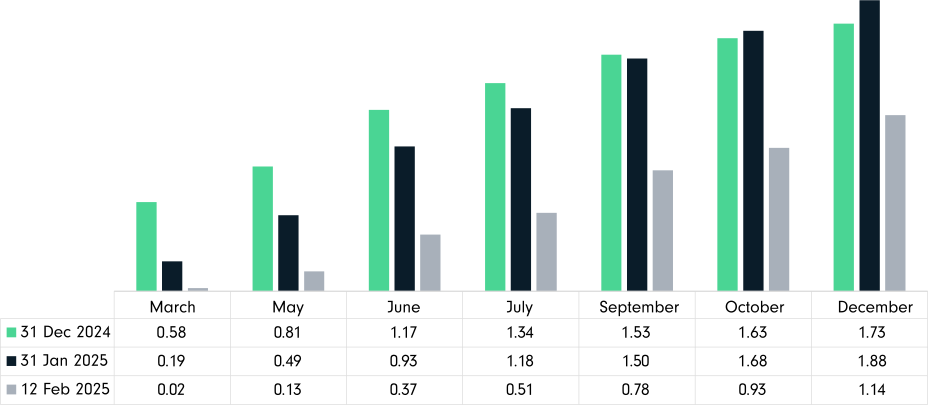
Market expectations for Fed action on interest rates have shifted considerably since the beginning of the year, with expectations for the first 25 bps rate cut originally expected to occur in June, now pricing for October (Exhibit 2). The markets and the Fed were nearly in line with expectations for 50 bps in easing at the beginning of the year, but the market has shifted to roughly 28.5 bps in reductions by year-end.
We won’t have a clear picture from the Fed until the publication of the next dot plot (after the March FOMC meeting), but various interviews and Powell’s testimony to Congress point to a much more patient Federal Reserve. Meanwhile, President Trump has been clear in his desire for lower rates, pushing for them on the same day as the most recent inflation report, which showed both headline and core inflation surprisingly pushed higher.
Exhibit 2 — Number of Expected 25 bps Cuts
Source: Bloomberg.
Market volatility dominates
From the start to the end of January, the fixed income market and interest rates ended roughly where they started, giving the impression of a calm month. However, markets have been highly sensitive this year, reacting sharply to economic data and news.
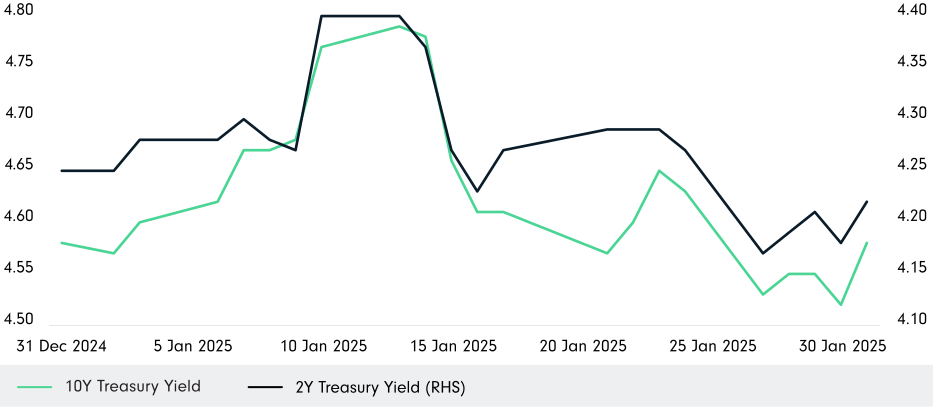
- 10 January — Rates across the curve jumped on the release of December’s non-farm payroll report, with the 2-year Treasury yield climbing from 4.27% to 4.40% and the 10-year Treasury yield moving from 4.68% to 4.77%. It was the month's biggest single-day move for the 2-year Treasury and the biggest one-day move since 25 November.
- 15 January — The next big move came just a few days later as a lower-than-expected core inflation report for December (3.2% year over year, down from 3.3% in the prior month) fueled a rally across the curve. The 2-year Treasury moved lower by 10 bps in a single day while the 10-year Treasury dropped by 12 bps, its biggest move during the month.
- 27 January — Near the end of the month, news about Chinese AI company DeepSeek sent the equity market into a tailspin, and investors sought the safety of Treasuries, pushing both the 2-year and 10-year Treasury yields down 10 bps.
- When all was said and done in January, the 2-year Treasury ended the month 3 bps lower (4.25% to 4.22%), and the 10-year finished unchanged from the start of the month at 4.58%. This belies the intra-month volatility that saw the 2-year reach as high as 4.40% and as low as 4.17%, and the 10-year ranged from a low of 4.52% to a high of 4.79%.
Exhibit 3 — Day-to-Day Volatility (%)
Source: FRED, Federal Reserve Bank of St. Louis
Issuance through the first month of the year
Despite the deluge of varying economic news and a short-term rout in equity markets, issuance in the fixed income markets enjoyed a strong start to the year. In the securitized markets, there was roughly $33B in asset-backed securities (ABS) issued in the first month of the year, trailing last January's record issuance level ($35B).
Auto ABS led the way, comprising roughly 69% of new issuance. At the same time, credit cards lagged the previous January level, only bringing $200MM of new bonds to the market, compared to $4B last year. Commercial mortgage-backed securities (CMBS) continued their resurgence as the market has potentially found a bottom. Private label issuance nearly doubled the production from a year earlier, delivering $12B in bonds compared to last year’s start to the year of $6.8B. Agency CMBS issuance increased from $800MM to $3.1B year over year. Non-Agency residential mortgage-backed securities (RMBS) closely matched the production from the CMBS market, with $12.5B in new issues coming to market in January. This was a slight improvement over the same period in 2024 ($10.1B) and a significant improvement over 2023 ($5.9B).
In the corporate space, investment grade and high-yield issuance fell from the pace set in January 2024. Investment-grade corporate debt saw $188B, the eighth most active issuance month on record but still behind last year’s $194B in January. Maturities were roughly $88B, so the net new issuance in the investment-grade corporate market was $100B. In the high-yield market, issuance totaled $23B, $8B net of refinancing, nearly in line with the 2024 monthly average of $24.1B gross ($5.9B net).
Outlook and opportunity
Economic news and political uncertainty were the main drivers of the fixed income markets in the first month of the year, and there’s no reason to expect that to change anytime soon. The obvious economic data, such as inflation and the labor market, will provide some fuel. Still, the ongoing uncertainty around implementing tariffs, as well as their levels and targets, will be a huge factor in the coming months.
There’s also the potential for political gridlock in Washington as the next potential government shutdown looms on the horizon (14 March). Democrats are looking at a potential shutdown to address the Trump administration’s continued attempts to reshape federal agencies and programs. Initial attempts to shut down the US Agency for International Development (USAID) and the Department of Education have been met with incredulity from the other side of the aisle. Democrats may see an overall government shutdown as the only way to address these issues.
Add the potential conflict between the Fed (data dependency) and the executive branch (demands lower rates), and you have a recipe for ongoing volatility. And with this volatility comes opportunity as the ongoing and uncertain shifts in rates and spreads will give investors a chance to capture value. Investors were active throughout January, keeping the overall issuance machine chugging and the appetite for yield driving the market.
The views expressed are those of the author as of February 2025 and are subject to change without notice. These opinions are not intended to be a forecast of future events, a guarantee of future results or investment advice. Investing involves risk, including the possible loss of principal. Past performance is not a guarantee of future results.
/sitefiles/live/documents/insights/FixedIncomePersp/2025/A-772/2502-Fixed-Income-Monthly-Commentary.pdf