Word of the Month: Tariffs
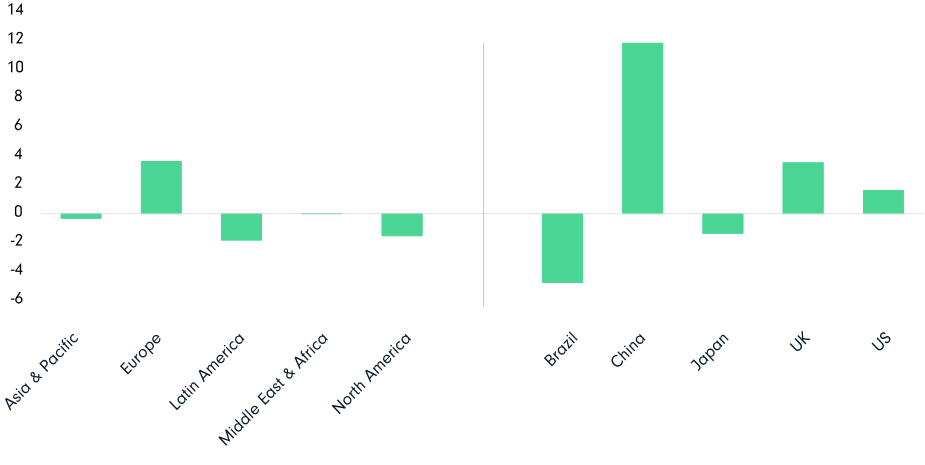
In a more volatile month, global markets tempered early year gains in February, falling -0.6% in the month in USD terms (as measured by the MSCI ACWI Index). However, returns differed meaningfully by region, with European stocks gaining over +3%, while US stocks fell more than -1%. Emerging markets were modestly positive, up nearly +0.5%, led by China which rebounded nearly +12% in the month.
What started practically on day one of President Trump’s administration has continued apace — even picked up steam — in February, with trade talk and tariffs dominating major global economic headlines. Following Trump’s imposition of a 10% tariff on China imports — an attempt to encourage the country to stop the export of chemicals used to make fentanyl — China announced retaliatory tariffs on roughly $14 billion of US goods, including liquefied natural gas, coal, crude oil, farm equipment and some automotive goods. China also launched an antitrust investigation into Google and US biotechnology company Illumina and blacklisted the holding company of US brands Calvin Klein and Tommy Hilfiger. Finally, China announced it would limit exports to the US of critical rare earths metals used in the manufacture of solar panels, electric vehicle batteries and defense industry products. As the month concluded, Trump announced he would in turn increase tariffs on Chinese goods by an additional 10%. To date, the two countries have yet to engage in any meaningful trade talks — and so the tit-for-tat seems likely to continue, at least for now.
The US president also turned his attention to Europe in February, starting with a broad tariff on any US imports of aluminum and steel — to which the EU quickly responded by proposing retaliatory levies of up to 50% on US goods including bourbon, Harley-Davidson motorcycles, motorboats, and some steel and aluminum. However, the EU also preemptively announced its willingness to consider lowering its tariffs on US cars from 10% to closer to 2.5% — the rate the US currently imposes on European car imports. Key car-manufacturing countries, notably Germany, were not expected to oppose the plan, signaling support for measures aimed at lowering trade tensions before they have a chance to materially increase. Nevertheless, President Trump subsequently announced he is considering 25% tariffs on cars, drugs and semiconductor chips — as well as a broad 25% tariff against all EU goods.
In other sweeping moves, Trump also directed administration officials to begin working on a broad plan for reciprocal tariffs against all US trade partners — ostensibly an effort aimed at evening out the rates charged by other countries relative to those charged by the US.
Positively, though, the US and EU are conducting trade talks — as are the US and UK. And it seems the US’s heightened trade rhetoric has encouraged other countries to seek their own bilateral deals — with India and the EU aiming to sign a deal sometime this year and India and the UK pledging to restart talks which were sidelined amid elections in both countries last year. Whether these efforts bear fruit — which in the EU’s case has been many years in the making — remains to be seen, naturally. Taiwan also announced preemptive moves aimed at averting US semiconductor chip tariffs, pledging to increase investments in the US and purchase more goods from the US in an effort to balance bilateral trade numbers.
While some remain skeptical of President Trump’s intention to actually see all these announced tariffs through, markets certainly seemed receptive to the possibility he very well may make good on his word. The US market was especially impacted, falling behind developed world counterparts in February, and as we write, we’ve seen increased market volatility in the early days of March as trade tensions amplified.
On the economic front, inflation remained the headline concern, with many major countries seeing accelerating prices in January, including the UK, where inflation rose to 3.0% following the Bank of England’s 25 basis-point rate cut to 4.5% in early February. In the EU, inflation increased to 2.5% in January, with other economic readings likewise pointing to higher prices and complicating the monetary policy picture for the European Central Bank. US inflation likewise outpaced expectations, coming in at 3.0% in January — with much of the rise attributable to skyrocketing egg prices amid an ongoing avian flu epidemic.
Some countries, though, were likely glad to see some signs of inflation in February, including China — where prices hit five-month highs amid higher demand during Chinese New Year celebrations. Japan is likewise probably relieved to see signs markets expect its inflation to continue as it seeks to finally exit a decades-long period of economic stagnation and deflation.
Geopolitically, the Israel–Hamas ceasefire largely held, with both sides exchanging prisoners as promised. Israel, however, is seeking an extension of the first phase of the ceasefire, rather than proceeding with the second phase, which would ostensibly lay groundwork for a longer-term peace deal. Specifically, Israeli prime minister Benjamin Netanyahu has cited four aims in any further negotiations: the return of all Israeli hostages, the removal of Hamas from power in Gaza, dismantling Hamas’s fighting force and demilitarizing Gaza. To date, Hamas seems unlikely to agree to such terms — leaving the future as uncertain as ever.
Likewise, there has been little substantive progress in the war between Russia and Ukraine — particularly in the wake of the recent collapse of a minerals deal between the US and Ukraine which would potentially have begun paving the way toward broader ceasefire and potentially peace talks between the warring countries. Since the deal’s crumbling as the month ended, Ukraine has pursued further talks with European countries seeking another path forward — whether renewed discussions with the US or a more European-centric route remains to be seen.
Regionally, Europe led (+3.6%), with UK stocks providing the region’s biggest boost, rising more than +3%. German stocks rose +4%, and French stocks were up more than +2%, likewise contributing nicely to the region’s positive returns in the month. The Netherlands and Tukey were the only countries in the red, but returns were relatively modest — stocks in the Netherlands fell less than -1%, and in Turkey, they declined less than -5%. No other regions were in the black in February — the Middle East & Africa was flat in the month, with Kuwait the primary positive contributor, up just shy of +5%. Saudi Arabia, Egypt and Israel modestly declined, each less than -2%.
The Asia Pacific region declined -0.3% in February, an overall return which masked robust performance from Chinese stocks, which were up just under +12%. Conversely, Indian stocks were down -8%, and Taiwan (-4%), Australia (-4%) and Japan (-1%) also contributed to dragging the region into the red. Likewise, North America stocks were negative in the month, led down by US stocks, which fell less than -2%. Latin American stocks were the bottom performers on a regional basis, falling -1.8% in February and led down by Brazil, where stocks declined nearly -5%.
Exhibit 1 — February Returns for Major Markets (USD) (%)
Source: FactSet, as of 28 Feb 2025.
From a sector perspective, financials (+3%), consumer discretionary (+4%) and communication services (+6%) drove gains in February (+6.4%). Technology stocks declined most, falling -3.4% in the month, while energy and materials were down modestly.
Escalating trade tussles undoubtedly roiled markets in February, reversing some longstanding leaders and laggards — for example, European stocks outpaced US in the month, which has been a rarer occurrence in this ongoing bull market. As we noted in January, uncertainty looks likely to be here for the foreseeable future, and whether and how countries will face and negotiate the new trade reality being presented by the US remains to be seen. One thing is certain: There will undoubtedly be winners and losers — though who falls into which camp could take months if not years to unfold. These times strengthen our confidence in our investment philosophy. Rather than trying to predict macroeconomic and geopolitical winners and losers, we focus on identifying high-quality, undervalued companies with a compelling investment outlook over the next three to five years. We believe that by sticking with this approach, we can add value for long-term investors, whatever the prevailing macroeconomic and geopolitical environment proves to be.
MSCI ACWI Index measures the performance of large- and mid-cap stocks in developed and emerging markets. MSCI ACWI ex USA Index measures the performance of large- and mid-cap stocks in developed (excluding the US) and emerging markets. The indexes are unmanaged, market capitalization weighted, include net reinvested dividends, do not reflect fees or expenses (which would lower the return) and are not available for direct investment. Index data source: MSCI, Inc. See diamond-hill.com/disclosures for a full copy of the disclaimer.
The views expressed are those of Diamond Hill as of March 2025 and are subject to change without notice. These opinions are not intended to be a forecast of future events, a guarantee of future results or investment advice. Investing involves risk, including the possible loss of principal. Past performance is not a guarantee of future results.
/sitefiles/live/documents/insights/IntlPersp/2025/A-778/2503-International-Monthly-Commentary.pdf