Market Volatility in 2025: Tariffs, Inflation and the Consumer Impact
Market volatility was a dominant theme in January, with dramatic swings driven by inflation readings, tariff announcements and labor market updates. One might have expected the knee-jerk reactions in equity markets to ease after the first month of the year, as the new administration settled in and economic data began to flow. However, another month of sharp market swings suggests that uncertainty and volatility may define 2025.
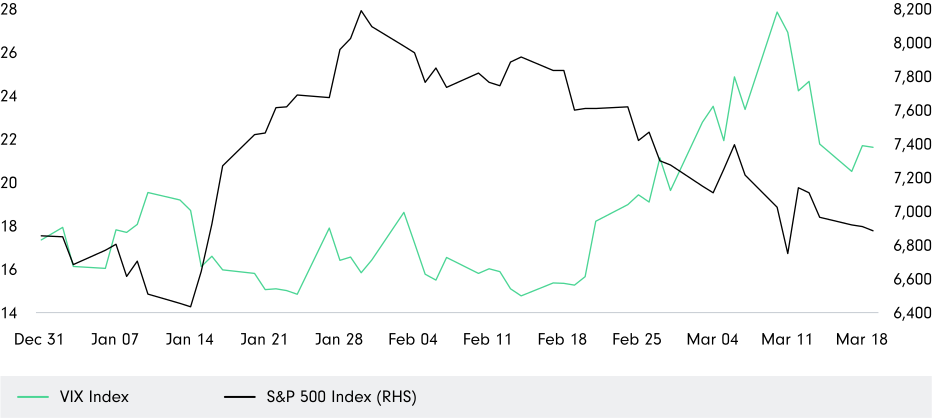
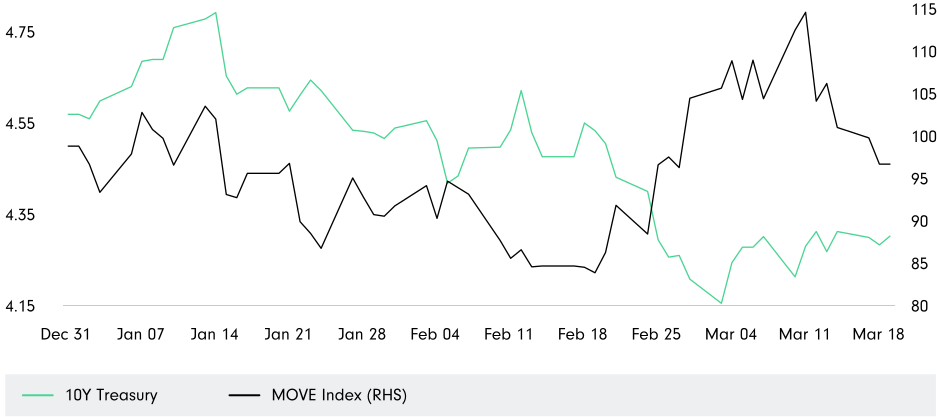
Similar to the VIX Index, which measures equity market volatility, the Merrill Lynch MOVE Index measures volatility expectations in fixed income markets. Exhibits 1 and 2 illustrate the shifts since the beginning of the year, the S&P 500 and the 10-year Treasury yield. Given the uncertainty around geopolitical events (Ukraine-Russia war, resumption of fighting between Hamas and Israel, Houthi rebel attacks in the Red Sea), domestic political events (DOGE, deportations) and the economy (trade war saber rattling, softening labor market, stagflation concerns), it would seem that volatility may be here to stay.
Exhibit 1 — Volatility Is the Name of the Game
Source: Bloomberg.
Exhibit 2 — Treasury Yields and Volatility
Source: Bloomberg.
Soft landing spoiled?
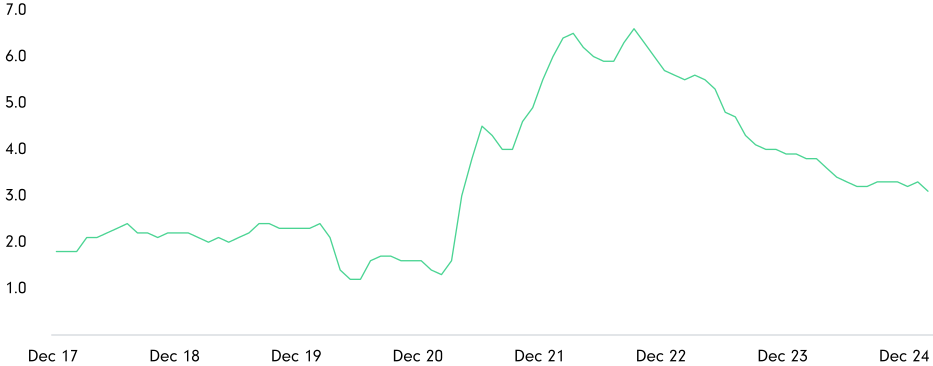
Despite decent economic data, consumer sentiment has soured. The labor market remains strong, with 125,000 jobs added in January (revised) and 151,000 in February, while unemployment held steady at 4.1%. Inflation resumed its downward trend after January's unexpected rise, where core inflation (excluding food and energy) increased by 0.4% month over month and 3.3% year over year. The February report, released mid-March, showed a slight month-over-month decline to 0.2%, with the year over year rate easing to 3.1%. Although inflation remains above the Federal Reserve’s 2% target, it is trending downward. Typically, this and the labor market’s stability would signal a positive economic outlook. However, uncertainty about the effects of tariffs on consumers and the economy continues to cast a shadow.
Exhibit 3 — Inflation Trends Lower but Remains Elevated (%)
Source: Bloomberg.
As we learned in 2019, tariffs represent an economic shock that can impact an economy’s ability to supply goods or services, pushing prices higher while weakening economic growth. What is the difference between 2019 and now? In 2018 and 2019, core inflation was in line with Fed targets, ranging from 1.8% to 2.4%, with an average of 2.2%, while current inflation is still north of 3%. As the 2018 trade war continued into 2019, the Fed was able to lower rates in response to the stress placed on the market. In today’s environment, the Fed is hesitant to accelerate the easing cycle, which began in the latter part of 2024, as inflation remains stubborn and the labor market remains strong.
The latest round of tariffs (actual and proposed) marks a notable change in both scale and scope compared to those in 2018 and 2019. For instance, a possible 200% tariff on European alcohol highlights the expanded reach of these measures. The steel and aluminum industries provide another example, with 2018 tariffs set at 25% on steel and 10% on aluminum imports, compared to 2024, where both categories started with 25% tariffs. Additionally, there is a proposal to implement reciprocal tariffs on all US trading partners, with plans for an official announcement on 1 April and implementation the following day. These tariff plans have rattled consumers, as shown by recent sentiment surveys.
Tariffs and consumer sentiment
The specter of tariffs and the potential impact on inflation is starting to show in consumer behavior and outlook. The University of Michigan consumer sentiment survey focuses on three areas: prospects for the personal financial situation, prospects for the economy over the near term and prospects for the economy over the long term.
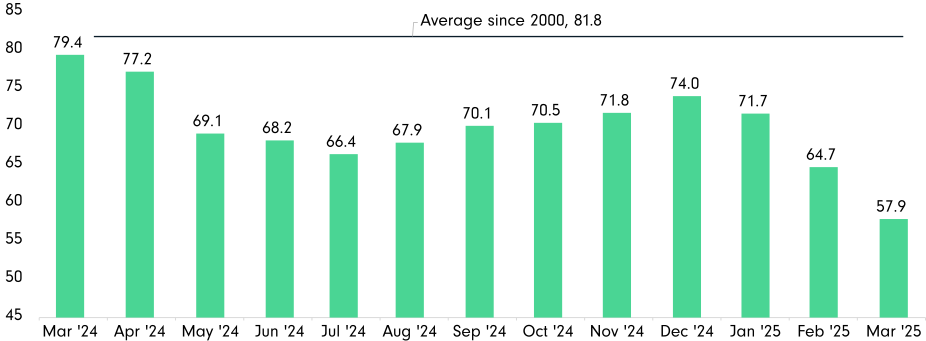
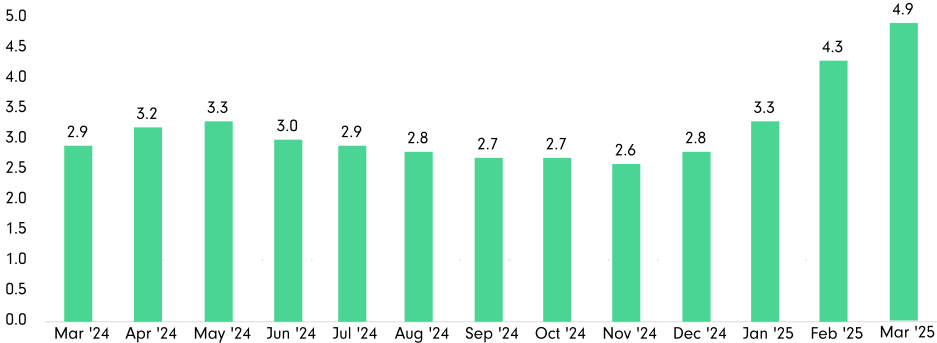
The February survey, released in March, revealed a sharp decline in sentiment, falling from 64.7 to 57.9. This marks the lowest level since November 2022 and falls short of the forecasted 63.2. It also marks the third consecutive decline in the survey, with many consumers expressing concerns about policy uncertainty and other economic factors. Inflation expectations also surged, with the year-ahead sentiment rising to 4.9% from 4.3%, the fourth consecutive monthly increase since December and the highest reading since November 2022. Over the past four months, the year-ahead measure has climbed steadily from 2.8% in December to the current 4.9% (Exhibit 5). Meanwhile, long-term inflation expectations for the next five years jumped to 3.9% from 3.5% in February, the largest month-over-month increase since 1993.
Exhibit 4 — University of Michigan Consumer Sentiment
Source: University of Michigan.
Exhibit 5 — 1Y Forward Consumer Inflation Expectations Surge (%)
Source: University of Michigan.
From consumer sentiment to consumer (in)action
An old economist colleague once told me, “It’s not about what the consumer says (referring to sentiment and surveys) but rather what the consumer does.” That is especially true today as sentiment craters on the uncertain economic outlook. If you’re a purveyor of financial news, you’ve undoubtedly seen the headlines on your monitors or devices: “Consumer Angst is Striking All Income Levels” or “Consumers Keep Bailing Out the Economy. Now They Might Be Maxed Out.” — both appearing recently in the Wall Street Journal. And it’s not all clickbait; we’re starting to see the consumer shift in spending habits and debt management.
According to the Federal Bank of New York’s most recent Household Debt and Credit report, total household debt increased by $93 billion to $18.04 trillion in Q4 2024. Aggregate delinquencies increased by 0.1% from the prior quarter and finished at 3.6% of outstanding debt in some stage of delinquency. Loans that have moved into serious delinquency (90 days or more past due) climbed higher for auto loans, credit cards and home equity loans while holding steady for mortgages.
Additionally, companies are providing insight into consumer behavior through CEO interviews or earnings calls. For instance, Walmart CEO Doug McMillon shared that consumers are showing stressed behavior, indicated by shifting to smaller purchases at month-end as their money is running out sooner than in prior months. Sales to low-income guests at McDonald’s were down double-digits in Q4 compared to a year earlier, and the fast-food industry overall has seen a sluggish start to the year. And it’s not just the lower end of the economic spectrum that is tightening the belt. The luxury market is feeling the pinch, with sales falling 9.3% in February from a year earlier, accelerating from the 5.9% decline in January.
Insight into the consumer’s state of mind can also be seen through the increase in Google search activity for the term “recession.” According to Google Trends, the term recession ramped up in early March before exploding on 11 March after US Treasury Secretary Scott Bessent said there were “no guarantees” that the US would avoid a recession during Donald Trump’s second term. That outlook is correct; no one can accurately predict what may happen in the coming months or years. However, it didn’t help that Bessent’s comments were followed by Commerce Secretary Howard Lutnick’s statement that Americans should “absolutely not” brace for a recession. The uncertainty about the future path of the US economy is weighing on the consumer and shifting spending habits across the economic spectrum.
Managing consumer exposures in fixed income portfolios
At Diamond Hill, we continuously reassess our positions across our strategies, considering both individual issues and sector dynamics. With signs of potential weakening in consumers’ financial health, we make adjustments to our portfolios to better withstand possible disruptions in the capital markets. While it’s impossible to predict where or when the next black swan event might occur, emerging economic uncertainties and their impact on consumers underscore the importance of positioning portfolios to align with current risk metrics. Predicting the direction or speed of market and economic changes is inherently challenging and risky. Instead, we focus on managing portfolios day by day, seizing market dislocations as opportunities to make adjustments while keeping broader economic concerns in view.
Quick Federal Reserve update
The Federal Reserve’s latest meeting on 19 March maintained interest rates amid persistent inflation and increasing market uncertainty. The Federal Open Market Committee kept the federal funds rate in the 4.25%–4.50% range, marking the second consecutive meeting without a rate adjustment after cutting rates by 75 basis points during the final meetings of 2024.
The updated dot plot remained unchanged, anticipating two quarter-point rate cuts by year-end, consistent with the previous projection. The most notable announcement was the Fed's decision to reduce the monthly cap on the amount of Treasuries allowed to mature without reinvestment. Starting 1 April, the cap will drop from $25 billion to $5 billion, while the monthly $35 billion limit for mortgage-backed securities will remain unchanged.
S&P 500 Index measures the performance of 500 large companies in the US.
CBOE Volatility Index (VIX) measures the expected volatility of the US stock market. ICE BAML MOVE Index is a measure of US interest rate volatility that tracks the movement in US Treasury yield volatility implied by current prices of one-month over-the-counter options on 2-year, 5-year, 10-year and 30-year Treasurys.
The views expressed are those of the author as of March 2025 and are subject to change without notice. These opinions are not intended to be a forecast of future events, a guarantee of future results or investment advice. Investing involves risk, including the possible loss of principal. Past performance is not a guarantee of future results.
/sitefiles/live/documents/insights/FixedIncomePersp/2025/A-780/2503_Fixed_Income_Monthly_Commentary.pdf