Q1 2025: How Tariffs and Treasury Yields Shaped Fixed Income Markets
The Bloomberg US Aggregate Bond Index returned +2.78% in Q1 2025. This performance marks the best start to a calendar year since 2023 and was characterized by a strong start that faded as more news emerged about tariffs. The January momentum was quickly derailed by a combination of the release of DeepSeek’s AI model, questioning the sustainability of the tech market run over the past two years, and the beginning of what would become the most disruptive impact to the financial markets since the global financial crisis, tariffs.
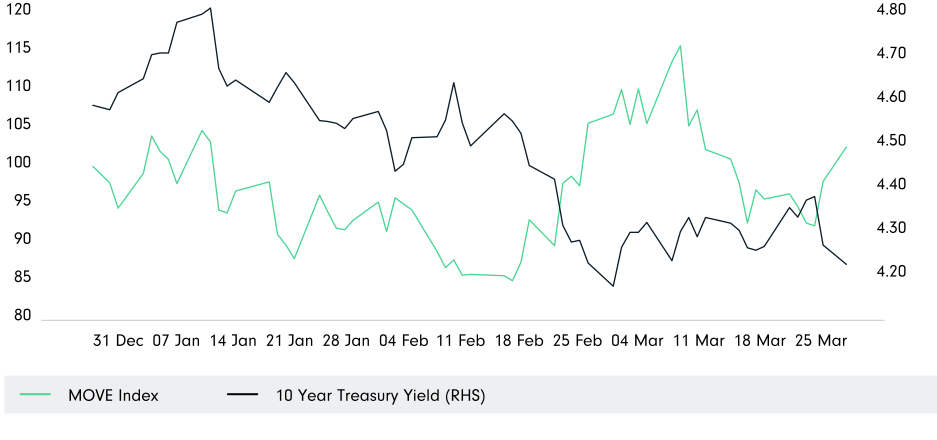
As the quarter progressed, volatility in the Treasury market became the name of the game as the markets reacted to economic news about inflation, consumer sentiment and the labor market, and the implementation/cancellation/reintroduction of tariffs. Consider that the 10-year Treasury yield moved higher or lower by seven basis points (bps) or more on roughly 22% of the trading days in the first quarter, compared to roughly 17% for all of 2024. The 10-year Treasury yield finished only slightly lower in January, while February saw the yield compress from 4.54% to 4.21% as the aforementioned concerns grew and investors sought the safety of the Treasury market. March experienced some intra-month volatility but finished the month at nearly the same level as it began.
The Merrill Lynch Option Volatility Estimate (MOVE Index) tracks volatility in the US Treasury market to provide insight into the fixed income markets. The MOVE Index utilizes options-pricing models based on a weighted average of option probabilities to reflect expectations for future volatility. Exhibit 1 illustrates the shifts in the MOVE Index and the 10-year US Treasury yield since the beginning of the year.
Exhibit 1 — Volatility Is the Name of the Game (%)
Source: Bloomberg.
The Federal Reserve remained squarely on the sidelines as inflation proved stubborn during the quarter and the labor market continued to show strength, adding an average of 152,000 jobs per month during the quartering Q1. The federal funds rate remained in the 4.25%-4.50% range, and the Fed used the two meetings in Q1 to reinforce its data dependency approach. The second meeting on 19 March saw the release of the most recent dot plot, and while there were some slight shifts in projections, expectations for the future path of rates remained at two 25-bps reductions by year-end. Fed Chair Jerome Powell cited the uncertainty surrounding the implementation and impact of tariffs on the US and global economy as one of the reasons for holding the line on rates. Fed fund futures were a bit ahead of the Federal Reserve by the end of the quarter, pricing in roughly three 25-bps reductions by the end of the year.
And what of the two main focuses of the Federal Reserve, inflation and the labor market? Core inflation reports during the quarter were a bit of a rollercoaster, starting the year at 3.2%, peaking at 3.3% in January before reversing course in February (3.1%) and March (2.8%). It should be noted that the backward-looking inflation report has yet to account for the potential impact of tariffs, and the recent slowdown could just be a bump in the road.
The labor market began 2025 on a slower note compared to the strong finish of 2024, which saw 323,000 jobs added in December. In January, 111,000 jobs were added, followed by 117,000 in February and 228,000 in March. This brought the first quarter's total to nearly 500,000 jobs, with an average monthly gain of 152,000. The uncertainty around the impact of tariffs appears to be keeping the Fed in pause mode for the foreseeable future, reserving the right to adjust as the markets require.
While concerns about tariffs gripped the financial markets, data regarding the consumer moved to the forefront with historically poor readings on everything from consumer confidence to inflation expectations. The University of Michigan Consumer Sentiment Index, which collects consumer attitudes and expectations data, spent the first part of 2025 in a downward trend. After starting the year at 74.0, which is slightly below the average level of 81.7 since 2000, each subsequent reading pushed lower as concerns about the impact of tariffs and the stubbornness of inflation grew. The index finished the quarter at 57.0, with a considerable drop in April’s report to 50.8, its lowest reading since 2022 and the second lowest on record. Consumer inflation expectations for the next year grew throughout the quarter, from 2.8% at the end of 2024 to 5.0% in March and 6.7% in April.
The first quarter of 2025 underscored the complex and dynamic nature of today’s markets. Market volatility, driven by the disruptive effects of tariffs and shifting Treasury yields, remained a core theme. The Federal Reserve’s current stance, influenced by persistent inflation and a resilient labor market, highlighted its data-driven approach amid economic uncertainty. Meanwhile, weakening consumer sentiment and uncertain inflation expectations added further complexity. For fixed income investors, these developments underscore the importance of vigilance and adaptability as the market navigates evolving economic conditions. Looking ahead, the interplay between inflation trends, labor market shifts and tariff implications will likely set the tone for opportunities and challenges in the months to come.
Bloomberg US Aggregate Bond Index measures the performance of investment grade, fixed-rate taxable bond market and includes government and corporate bonds, agency mortgage-backed, asset-backed and commercial mortgage-backed securities (agency and non-agency). The index is unmanaged, includes net reinvested dividends, does not reflect fees or expenses (which would lower the return) and is not available for direct investment. Index data source: Bloomberg Index Services Limited. See diamond-hill.com/disclosures for a full copy of the disclaimer.
ICE BAML MOVE Index is a measure of US interest rate volatility that tracks the movement in US Treasury yield volatility implied by current prices of one-month over-the-counter options on 2-year, 5-year, 10-year and 30-year Treasurys.
The views expressed are those of the author as of April 2025 and are subject to change without notice. These opinions are not intended to be a forecast of future events, a guarantee of future results or investment advice. Investing involves risk, including the possible loss of principal. Past performance is not a guarantee of future results.
/sitefiles/live/documents/insights/Blog/A-789/2504_Fixed_Income_Monthly_Commentary.pdf