Markets Stage a Comeback
Markets were solidly in the black in May — a sharp turnaround from April’s downward volatility — up +5.7% in USD terms (as measured by the MSCI ACWI Index). Further, returns were positive across all major regions, with most major individual countries likewise positive. Though global trade uncertainty remains high, there were ample headlines in May which seemingly spoke to progress toward new agreements among many major trade partners.
Among the biggest trade-related developments was something of a détente between the US and China, with both sides agreeing to cut tariffs on each other for the next 90 days — the US tariffs reduced to 30% and China’s to 10%. China and the US also expressed their intention to maintain open communication as they continue negotiating. Stocks were up sharply following the news, presumably breathing a sigh of relief. However, the situation is far from fully resolved: Within weeks of the trade ceasefire, Chinese President Xi Jinping called for greater self-reliance among China’s manufacturing sector, while US President Donald Trump told US companies offering semiconductor design software to stop selling to Chinese groups. As May concluded, talks seem to have stalled, with Trump accusing China of violating the agreed truce — though he stopped short of threatening to reinstate the prior, sky-high tariffs.
Trade partners made progress on other fronts, too: In early May, the US and UK reached a deal whereby the US would cut its 27.5% tariff on cars to 10% for the first 100,000 vehicles exported from the UK and its 25% tariff on UK steel and aluminum exports to 0%. In return, the UK promised greater US market access for its beef, ethanol and industrial products. However, when the deal will be implemented has yet to be determined. As we write, the UK’s Business Secretary Jonathan Reynolds is set to meet with US trade representative Jamieson Greer to hammer out a timeline.
In another potential breakthrough, the UK and EU agreed to reset post-Brexit relations, with the UK conceding EU access to its fishing grounds for another 12 years. For its part, the EU conceded open-ended provisions to make it easier for UK food products to enter the EU.
The UK and India inked a trade deal nearly three years in the negotiating in early May, which included UK concessions on access to UK employment markets in exchange for big cuts to Indian tariffs on UK whisky and car exports. Meanwhile, India continues negotiating with the US, offering as May closed to deeply cut tariffs on a range of goods while maintaining them on sensitive, core agricultural commodities like grains and dairy. India is seeking US tariff cuts on goods like gems and jewelry, textiles, footwear and leather.
The US and the EU, meanwhile, while initially seeming to break an impasse in mid-May, have since stalled. Shortly after talks started, President Trump threatened to reinstate 50% tariffs on June 1, following which European Commission president Ursula von der Leyen requested and received an extension on trade negotiations until July 9. One challenge the EU faces is differing views and preferred approaches among its constituent countries — for example, Italy, France, Spain, Ireland and Belgium have all expressed an interest in accelerating the negotiating pace, while bloc-level officials like von der Leyen and European Commission chief trade negotiator Maroš Šefcovic have emphasized they will not be rushed into a deal. As the month closed, EU officials acknowledged they may need to accept some level of tariffs and make deeper concessions than they would prefer in order to avert a trade war with the US.
As the month closed, the US Court of International Trade cast a potential cloud over all the trade-related negotiation, ruling President Trump lacks the authority to use the emergency economic powers legislation he cited when first imposing the tariffs in April. As we write, the ruling’s impact is unclear: The administration indicated it would appeal, but negotiations with most trade partners seem to have continued apace, at least for now. Nor has the president’s pace slowed, announcing as May ended that he would double tariffs on steel and aluminum imports from 25% to 50%.
Against the feverish negotiating backdrop, US economic data spoke to the varying impacts Trump’s April tariff announcements, with US imports falling nearly 20% in April, wholesale prices falling the most they have in five years and profit margins falling, suggesting many businesses have yet to pass along higher tariff costs to consumers. US inflation also fell to 2.3% in April, seemingly indicating tariff impacts have yet to be reflected broadly across the US market. The Federal Reserve held rates steady again in May, citing the risks of higher unemployment and inflation since its March meeting and indicating it needed to assess the potential impact of aggressive tariffs.
Economic data in other countries were equally mixed, with UK inflation jumping to 3.5% in April, even as the Bank of England cut rates to 4.25%. Japan’s inflation rate rose at its fastest pace in over two years, climbing 3.5% year over year, prompting questions about whether and when the Bank of Japan might cut interest rates as the country seeks to continue its progress toward escaping the economic malaise it’s experienced over the last couple decades.
Tariffs’ uncertain impact also prompted some unexpected markets perceived as relatively safer havens to deliver solid gains. For example, Poland’s market has notched sharply positive returns year-to-date as most of its trade is conducted with the EU, insulating it to some degree from the threat of US tariffs. Likewise, Hong Kong stocks have outperformed mainland China peers for the year by the most since 2008 as investors are enthusiastic about Hong Kong tech stocks and wary of China’s economic prospects.
Regionally, every area was positive in May. North America led (up over +6%), with US stocks rising more than +6%, their biggest monthly rally since 2023. The Asia and Pacific region rose just shy of +5%, with Taiwan the biggest positive contributor, up +12%. Japan’s market also rose nicely, up +4%, while Chinese stocks were up nearly +3%.
European stocks were also positive (up over +4%), with the biggest positive contributions provided by the UK (up over +4%) and Germany (up nearly +6%). Turkey was the region’s sole decliner, falling nearly -1% as its economy struggles to regain its footing in the face of runaway inflation. The Middle East and Africa gained shy of +2%, with Israel’s market up nearly +9% and South African stocks gaining +5%. And Latin American stocks were likewise positive, up over +1% and led by Mexico (+4%) and Peru (+10%).
Exhibit 1 – May Returns for Major Markets (USD) (%)
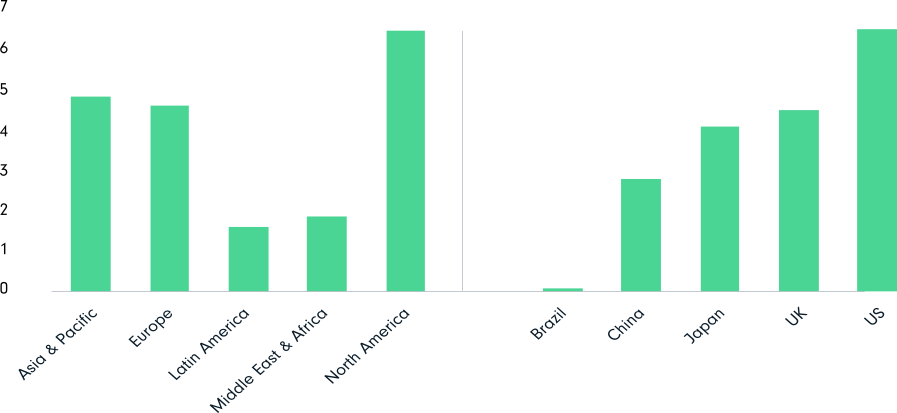
Source: FactSet, as of 31 May 2025.
From a sector perspective, financials (+6%), industrials (+7%) and information technology (+8%) were the primary drivers of positive returns in May. No sectors were in the red, though health care delivered a relatively flat return.
May marked a sharp turnaround from April’s downward volatility, though the level of uncertainty arguably remains relatively consistent, given the number of unanswered questions hasn’t meaningfully decreased. For example, can President Trump enact tariffs in the manner he’s attempting, or will US courts successfully stop him? Will the current pace of negotiations prove sustainable, and will meaningful progress be made? Importantly, how will the US-China talks proceed — productively, or with a reversion to previously heated, antagonistic rhetoric? Nor are the uncertainties solely on the trade front: The Russia-Ukraine war seems further than it has been from a negotiated settlement as both sides escalate attacks, and hot war likewise continues in the Middle East.
As we have noted before, such uncertainty lends itself nicely to a long-term, patient investment philosophy which seeks to identify attractively priced, high-quality companies who, though they may be impacted by near-term uncertainty, are well-positioned over the next three to five years. Such is our approach, and we look forward to maintaining our rigorous adherence to it in the period ahead, regardless of how events unfold.
MSCI ACWI Index measures the performance of large- and mid-cap stocks in developed and emerging markets.
MSCI ACWI ex USA Index measures the performance of large- and mid-cap stocks in developed (excluding the US) and emerging markets. The indexes are unmanaged, market capitalization weighted, include net reinvested dividends, do not reflect fees or expenses (which would lower the return) and are not available for direct investment. Index data source: MSCI, Inc. See www.diamond-hill.com/disclosures for a full copy of the disclaimer.
The views expressed are those of Diamond Hill as of June 2025 and are subject to change without notice. These opinions are not intended to be a forecast of future events, a guarantee of future results or investment advice. Investing involves risk, including the possible loss of principal. Past performance is not a guarantee of future results.
/sitefiles/live/documents/insights/Blog/2025/A-805/2505_International_Monthly_Commentary.pdf