Securitization in Focus — June 2025
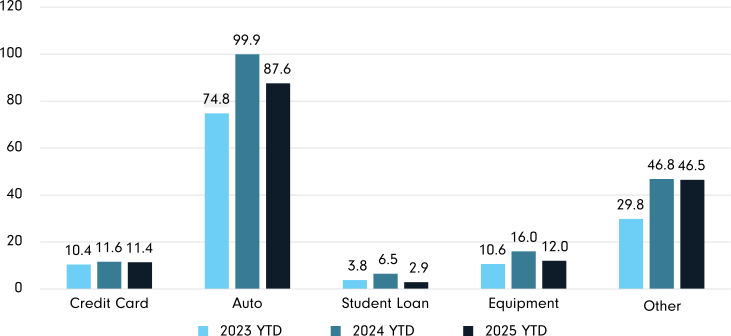
Asset-backed securities
Issuance slowed in April
compared to the record pace of
2024, but picked up in May and
June. Year-to-date 2025 issuance
is ahead of the same period in
2023 but still trails 2024 levels,
highlighting a dynamic market
with shifting issuance trends.
ABS Issuance ($B)
In the news...
For the first time, FICO has announced it will incorporate Buy Now, Pay Later (BNPL) loans into its credit scoring models. This
development marks a significant shift as BNPL products gain broader adoption in consumer financing. Designed to spread the cost
of purchases into manageable installments, these loans are increasingly used for everyday expenses. Typically split into four
payments over six weeks, BNPL enables flexibility for consumers while providers assume the merchant's credit and fraud risk.
This expansion reflects the growing influence of BNPL in the financial ecosystem, signaling heightened attention to how such
products impact consumer credit health.
Most Common BNPL Purchase Categories (%)
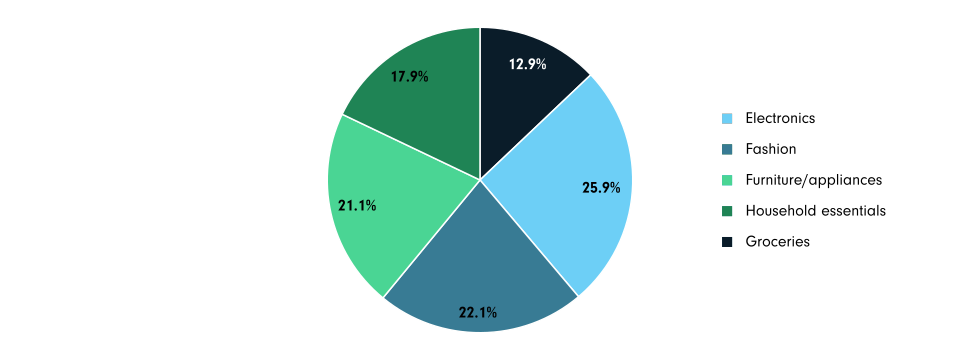
Source: Deutzche Bank, TransUnion.
Commercial mortgage-backed securities
CMBS Issuance ($B)
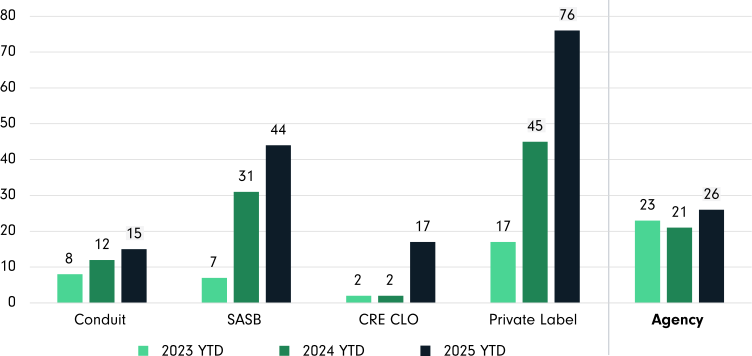
Recent trends in the CMBS
market reveal a dynamic shift in
issuance patterns. While conduit
issuance continues to slow,
single asset single borrower
(SASB) and CRE CLO1 sectors
now dominate, with CRE CLO
issuance nearly doubling 2024’s
full-year level ($17B vs $9B),
and SASB issuance showing a
42% increase from the same
year-to-date period in 2024.
Delinquency trends
On the delinquency front, the overall CMBS delinquency rate rose to 7.13% in June, reflecting a 0.05% month-over-month increase and a 1.78% rise
year-over-year.
The office sector experienced a record-high delinquency rate of 11.08%, surpassing previous peaks in December 2024 and July 2012. Other sectors
also saw delinquency increases, including lodging (+0.42%), retail (+0.07%), and industrial (+0.03%), with only multi-family showing an improvement
(-0.20%).
A sharp uptick was noted in the percentage of loans considered seriously delinquent — those 60+ days past due, in foreclosure, or non-performing
— reaching 6.85%, a 0.26% increase from the prior month.
These trends highlight ongoing challenges and shifts in the commercial real estate finance landscape.
Student loan update
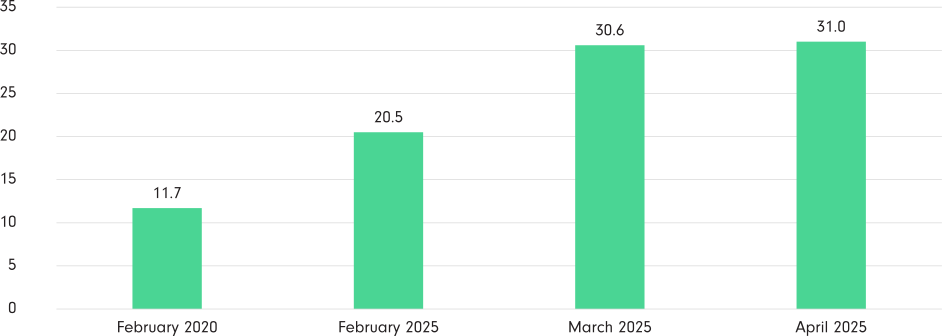
The rate of federal student loan borrowers 90 days or more past due has climbed sharply, increasing by over 50% since February 2025.
This puts approximately 5.8 million borrowers at risk of default, with nearly one-third expected to transition into default status by July.
Defaults typically occur 180 days after a loan is first reported as 90 days or more delinquent, triggering potential collection activity, such
as wage garnishment by the US Department of Education.
Projections indicate an additional one million borrowers could default in August, followed by two million in September, underscoring the
financial strain faced by borrowers.
Student Loan Default Rates (%)
Residential mortgage-backed securities
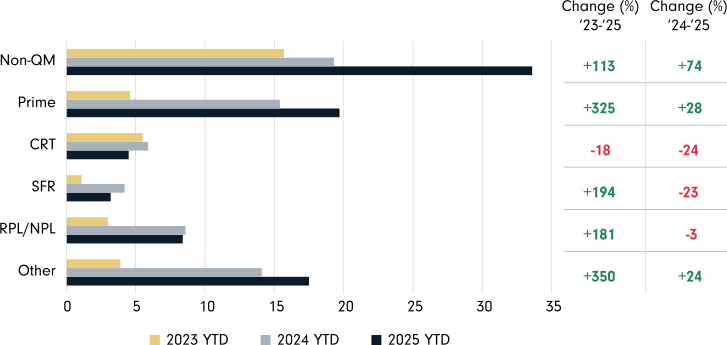
Year-to-date issuance in 2025
remains strong in the nonagency
RMBS market, driven by
growth in non-qualified
mortgages (non-QM) and prime
issuance. Non-QM issuance has
surged 74% compared to the
same period in 2024 and 113%
compared to 2023. Prime
issuance has increased by 28%
year-over-year and by an
impressive 325% relative to 2023.
Credit Risk Transfer (CRT), Single
Family Rentals (SFR) and
Reperforming/Non-Performing
Loans (RPL/NPL) have slowed
from the pace set in 2024. All
segments, except CRT, remain
well ahead of 2023 issuance.
RMBS Issuance ($B)
Key
Non-QM: Non-qualified mortgages
CRT: Credit risk transfer
SFR: Single family rental
RPL/NPL: Re-performing loans/non-performing loans
1CRE CLO - Commercial Real Estate Collateralized Loan Obligation
Deutsche Bank, Trepp, JP Morgan.
The views expressed are those of Diamond Hill as of July 2025 and are subject to change without notice. These opinions are not intended to be a forecast of future events, a guarantee of future results or investment advice. Investing involves risk, including the possible loss of principal. Past performance is not a guarantee of future results.