Concentration by Design
A look at the Diamond Hill Large Cap Concentrated Active ETF (DHLX)
A concentrated market…
by default
The cost of gaining broad exposure to the stock market, or
“beta,” has continued to decline over the past several decades with the growth
of passive strategies. This has made these strategies an increasingly
attractive option for many investors. However, the extreme success of a small
number of very large companies, combined with the fact that the most popular indices
are constructed on a market cap-weighted basis, has resulted in a highly concentrated
US equity market. The top 10 companies in the Russell 1000 Index currently
represent more than 37% of the market — a level much higher than
we’ve seen over the past four decades.
Exhibit 1 — Concentration of Top 10 Companies in the Russell 1000 Index (%)
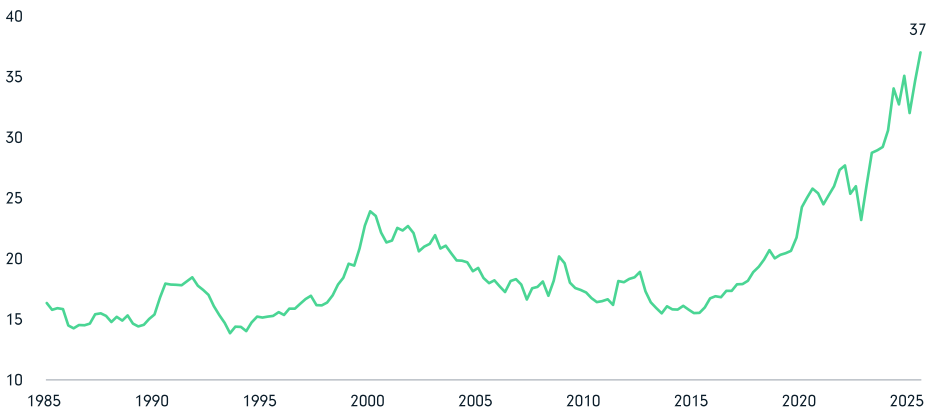
Source: FactSet, as of 30 September 2025.
With broad market exposure, many investors are concentrated
by default, but they don’t control which stocks they are concentrated in. And
with market cap-weighted indices, as valuations expand, investors end up with a
larger allocation to those stocks. The Diamond Hill Large Cap Concentrated Active ETF (DHLX) offers concentration by design: a valuation-sensitive, research-led
portfolio that can complement broad market exposure by focusing capital in our
highest-conviction ideas.
The discipline of focus
Our portfolio is built on a simple principle: own fewer
businesses but know them better. By limiting the portfolio to around 20
holdings, we ensure that capital is committed only to companies where our
conviction is highest — those with durable competitive advantages, prudent
balance sheets and attractive valuations.
This disciplined approach results in a portfolio that looks
meaningfully different from the benchmark, and one where every holding must
earn its place. Focus is a key differentiator, and our deep understanding of each
business serves as a critical form of risk mitigation.
Why concentration works
- Alignment with active management’s true
purpose
Active management was never meant to resemble the index, yet many actively
managed strategies don’t look much different than their benchmark. Concentrated
portfolios embody the purpose of active management by being
conviction-driven and benchmark-agnostic.
- Amplifying research edge
Depth matters more than breadth. With fewer holdings, our team can develop
deeper familiarity with each business, enabling more informed decisions with
a long time horizon.
- Potential for higher returns
Research suggests1 that investment
managers concentrating in their highest conviction ideas can lead to
better performance. The ability for strong stock pickers to concentrate
allows for their best ideas to really move the needle.
- Behavioral advantage
Concentration isn’t only about what you hold, but about how you behave.
Fewer positions reduce the temptation to chase trends or fill portfolios
with “just in case” ideas. This discipline allows us to stay patient,
resist market noise and focus on the most attractive opportunities.
Isn’t concentration risky?
It has been shown that most of the benefits of
diversification are achieved with around 20 stocks. However, a concentrated
strategy will inevitably produce returns that diverge meaningfully from the
index — both positively and negatively. This is an unavoidable price to pay to
generate long-term excess returns and is something investors must be
comfortable with.
Risk isn’t performing differently than the index — it’s the
permanent impairment of capital. Managing that risk requires a deep
understanding of each individual business.
Exhibit 2 — Diversification Benefits Taper After ˜20—30 Holdings
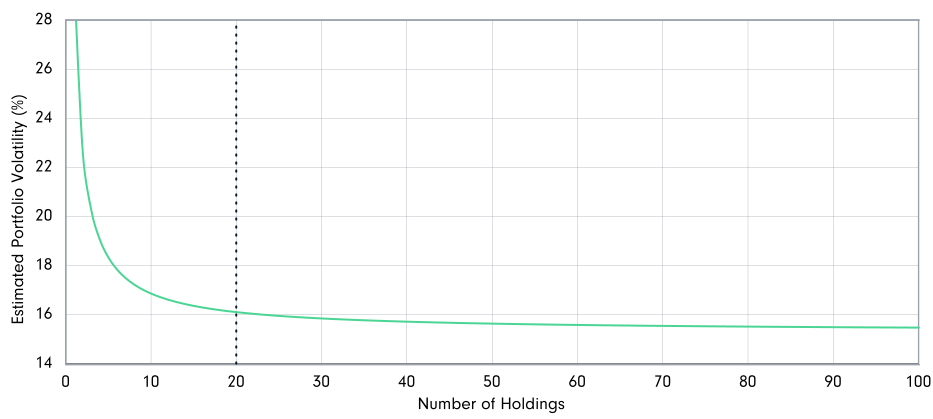
Source: Diamond Hill. This chart is for illustrative
purposes only, does not reflect actual performance, and is based on academic
research examining the relationship between the number of holdings in a
portfolio and estimated volatility (Evans & Archer 1968, Elton & Gruber 1977, Statman 1987). These studies analyzed random portfolios of US equities and found that most of the reduction
in portfolio-specific risk occurs within the first several dozen securities,
after which additional holdings provide diminishing diversification benefits.
The assumptions and results in these studies may differ from actual market
conditions and should not be interpreted as a guarantee of future results.
The Diamond Hill difference
At Diamond Hill, we treat every stock as an ownership
interest in a business. The Large Cap Concentrated Active ETF (DHLX) is
the purest expression of that philosophy: a portfolio distilled to our
strongest convictions, constructed to compound value over time.
In an investing world where “concentration” is increasingly
unavoidable, we believe a key distinction is whether it happens by default or
by design. This strategy is a deliberate, conviction-driven alternative that
now offers the tax efficiency, transparency and liquidity benefits of the ETF
vehicle.
Diamond Hill Large
Cap Concentrated ETF (DHLX)
Ticker: DHLX
Benchmark: Russell 1000 Value Index
Number of Holdings: 20-30
Expense ratio: 0.55%
Active Share (vs. Russell 1000 Value)
2: 89.9%
Maximum Individual Position Size: 10%
Maximum Industry Exposure: 25%
Maximum Sector Exposure: 35%
Minimum Market Cap: $15 billion
Top 10 Holdings are typically greater than 50% of net assets
1 Miguel Antón, Randolph B. Cohen and Christopher Polk, Best Ideas (Harvard Business School Working Paper 21-004, 2020), PDF
2 As of 30 September 2025.
Risk Disclosure: Because the
portfolio holds a limited number of securities, a decline in the value of these
investments may affect overall performance to a greater degree than a less
concentrated portfolio.
The Russell 1000 Index measures the performance of roughly 1,000 US large-cap
companies. The index is unmanaged, market capitalization weighted, includes net
reinvested dividends, does not reflect fees or expenses (which would lower the
return) and is not available for direct investment. Index data source:
London Stock Exchange Group PLC. See diamond-hill.com/disclosures for a full
copy of the disclaimer.
The views expressed
are those of the author as of September 2025 and are subject to
change without notice. These opinions are not intended to be a forecast of
future events, a guarantee of future results or investment advice. Investing
involves risk, including the possible loss of principal. Past performance is
not a guarantee of future results.
Carefully consider
the Fund’s investment objectives, risks and expenses. This and other important
information are contained in the Fund’s prospectus and summary prospectus,
which are available at diamond-hill.com or calling 888.226.5595. Read carefully
before investing. The Diamond Hill Funds are distributed by Foreside Financial
Services, LLC (Member FINRA). Diamond Hill Capital Management, Inc., a
registered investment adviser, serves as Investment Adviser to the Diamond Hill
Funds and is paid a fee for its services. Not FDIC insured | No bank guarantee | May lose value
/sitefiles/live/documents/insights/Blog/2025/A-844/2510_Concentration_by_Design_DHLX.pdf