On Truces, Tariffs and (Monetary Policy) Timing
Markets continued their year-to-date rise in October, with US markets notching more new highs as investors remain confident in artificial intelligence's (AI’s) potential to meaningfully affect a swath of industries. As measured by the MSCI ACWI Index, the global market was up 2% in USD terms. All major regions were likewise in the black, though returns in most were more moderate than they have been in recent months.
The month’s major headlines focused on a few key stories: a long-sought (if ultimately temporary) end to hostilities between Israel and Hamas, a likewise long-sought (if also ultimately temporary) end to trade tensions between the US and China and, as ever, global monetary policy moves. The first headline came early in the month as Israel and Hamas agreed to a peace deal to return prisoners and hostages to each other and end the fighting. Though cracks have already appeared and the next phase, which will include planning to rebuild Gaza, will require some uphill pulling, the deal offered some hope for the future.
Meanwhile, the US and China agreed to a one-year truce in their ongoing trade spat, cooling tensions which began building in April when President Trump first announced Liberation Day tariffs but which had escalated in the month as China announced a raft of rare earths export controls ostensibly aimed at protecting national security — but undoubtedly also incentivized by and intended to increase China’s leverage in the planned talks between Trump and Chinese president Xi Jinping, which took place later in October. In response to the export controls, Trump indicated the US would build a strategic mineral reserve and set a price floor intended to insulate the US from price swings. Tensions cooled, however, following Trump’s and Xi’s meeting, at which the two countries agreed to postpone export controls on both rare minerals and chips for a year. China and the US also agreed to lower tariffs on each other’s shipping industries. The initial agreement is expected to pave the way for a broader trade deal to be signed sometime in 2026 — either when Xi visits the US or Trump returns to China, which is currently expected to happen in April 2026.
The deal will be welcomed across the board, but particularly by China, whose economy continues struggling amid a handful of challenges, including the country’s ongoing recovery from a property market implosion. And there are other signs of weakness, including factory activity, which has now contracted for seven straight months; consumer prices, which face ongoing deflationary pressures; and GDP, which grew a paltry (for China) +4.8% year over year in Q3.
On the monetary policy front, though the headline hasn’t much shifted over the course of the year (or longer) — central bank heads remain committed to responding to economic data and doing their part to rein in inflation as needed — the major development in October, at least in the US, was the Federal Reserve’s needing to make a rate decision without their typical helping of data, thanks to the US government shutdown. As widely anticipated, the Fed decided to cut rates another 25 bps and bring an end to quantitative tightening but remains divided on the best path forward — including whether another rate cut will be warranted in December. The European Central Bank held rates at 2%, while Bank of Japan — which among developed countries has been alone in raising rates recently — left rates unchanged at 0.5% and indicated it didn’t foresee an immediate need for another increase. The Bank of England, which is set to meet the first week of November, is largely expected to hold rates, even as inflation has been softer than anticipated and the job market has shown signs of weakness.
Regionally, markets were up across the board, led by the Asia & Pacific region (+4%), where Korean stocks skyrocketed nearly +23% higher — a gain which made Taiwan’s likewise significant +10% month seem relatively moderate. Japan rose over +3%, while China declined nearly -4%. North American stocks saw a modest return — however, US stocks declined over -1%. Europe also provided a nice tailwind in the month, tied primarily to the UK’s nearly +2% gain. Germany detracted modestly from the region’s positive return, falling -2%. The Middle East & Africa (+1%) and Latin America (up less than 1%) were also positive but contributed minimally to the overall index return.
Exhibit 1 – October Returns for Major Markets (%)
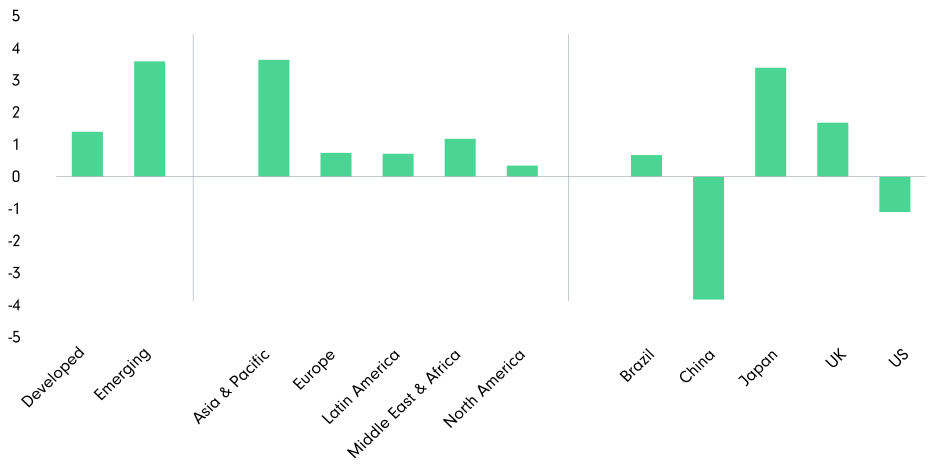
Source: FactSet, as of 31 October 2025.
From a sector perspective, technology (+12%) was far and away the primary driver of positive returns in October. Industrials (+2%) also contributed, though more modestly. A handful of sectors declined in October (including real estate, consumer discretionary, materials, communication services and financials), though none posed significant headwinds to overall index performance.
AI fever continues apace — though investors may be starting to look for signs the sky-high investments in the technology are likely to yield fruit. This was perhaps the message behind the drop in Meta’s share price after it announced earnings — and had relatively little to show to date for its AI-related investments (and indicated it would require further investment looking forward).
However, we believe attempts to narrowly read such near-term tea leaves are ultimately ill-advised. Rather, we prefer to identify high-quality companies trading at prices we believe are misaligned with their longer term (i.e. five-year) outlook. Over such a timeframe, we believe largely sentiment-inspired, near-term share price fluctuations are tempered, and valuations have an opportunity to align more accurately with a company’s underlying fundamentals, quality and growth outlook. As such, though we always pay attention to day-to-day developments, we will maintain our dedication to pursuing a rigorous, bottom-up philosophy that attempts to distill the near-term noise from the long-term news.
MSCI ACWI Index measures the performance of large- and mid-cap stocks in developed and emerging markets. MSCI ACWI ex USA Index measures the performance of large- and mid-cap stocks in developed (excluding the US) and emerging markets. The indexes are unmanaged, market capitalization weighted, include net reinvested dividends, do not reflect fees or expenses (which would lower the return) and are not available for direct investment. Index data source: MSCI, Inc. See diamond-hill.com/disclosures for a full copy of the disclaimer.
The views expressed are those of Diamond Hill as of November 2025 and are subject to change without notice. These opinions are not intended to be a forecast of future events. a guarantee of future results or investment advice. Investing involves risk. including the possible loss of principal. Past performance is not a guarantee of future results.
/sitefiles/live/documents/insights/Blog/2025/A-863/2511_International_Monthly_Commentary.pdf