Assessing the Health of the Consumer: Unpacking Risks and Realities
Recent headlines increasingly highlight consumer struggles and growing concern around consumer-related loans. While segments are feeling the effects of a slowing labor market, stubborn inflation and the lingering impact record-length government shutdown, we continue to see compelling value in select consumer-related investment opportunities.
Though the government shutdown has delayed key economic data, signs of a slowing labor market are already clear. Sluggish hiring and easing demand for workers have pushed non-farm payrolls lower, with major companies announcing recent layoffs. According to the latest Challenger report, US-based companies cut 153,000 jobs in October alone, an increase of 175% when compared to the same month last year.
Year to date, employers have announced more than 1 million job cuts, a 44% increase over the full-year total for 2024. At this pace, job reductions are on track to reach their highest level since the 2.3 million cuts recorded in October 2020. Drivers for job cuts have varied, including company restructuring, AI integration, shifting consumer habits, automation in manual jobs and softening demand. Together with slower hiring, these trends present a challenging labor environment. Through October, employers have announced nearly 500,000 planned hires, a 35% decline from October 2024 and the lowest year-to-date total since 2011. While the most recent unemployment rate, 4.3% in August, does not reflect the above-mentioned shifts, the unemployment rate has been creeping higher since mid-2023. Once October data — including the impact of the government shutdown — is released, the unemployment rate could rise by 0.4% to 4.7%, reflecting the temporary job losses during the period.
In our July commentary we explored the various ways inflation is measured, including the Federal Reserve’s preferred methodology, the Personal Consumption Expenditures Price Index (PCE). The core version of the PCE, which excludes food and energy, continues to show stubbornly elevated inflation. While prices have eased from their post-COVID peaks, they remain well above the Fed’s long-term 2% goal and have trended higher again following a brief spring decline.
Typically, delayed economic reports are prioritized and released within days of the government reopening. But the news isn’t great on the inflation front. Due to the shutdown, no October inflation data was collected, as government workers were furloughed for the entire month. The worst-case scenario? Key inflation metrics including CPI, PPI, and PCE may not be published at all, or the Bureau of Labor Statistics could be forced to issue a patchwork report with incomplete data. Either outcome risks leaving the Federal Reserve effectively in a data blackout ahead of its crucial December 10 meeting.
The longest government shutdown on record is finally reaching its end. The visible effects — missed paychecks for federal workers, disruption to air travel and national parks, delays in benefits — are all well documented. Less apparent, though, is the sharp decline in consumer sentiment, as Americans grow increasingly pessimistic about the economy and their personal finances, a shift that could weigh on consumer spending.
Looking ahead, the Congressional Budget Office estimated that a six-week shutdown will cut fourth-quarter growth by 1.5%, and while a reopening should provide a first-quarter boost, roughly $11 billion in economic activity will be permanently lost. By comparison, the previous record-setting shutdown in 2018 and 2019 lasted 35 days but was only partial, with many agencies still funded. That episode reduced GDP by just 0.02%, underscoring the severity of the current shutdown.
How fares the consumer?
Auto loans
According to Fitch Ratings, 6.65% of subprime borrowers were at least 60 days past due on their auto loans in October. The combination of inflationary pressures and the reengagement of student loan payments have made it challenging for those consumers to meet their financial obligations on time, and the dispersion between prime and subprime borrowers becomes apparent when we consider the 60-day delinquency rate since the financial crisis.
-
Prime borrowers’ 60-day delinquency rate has held steady, averaging roughly 0.48% since 1991 and measuring 0.37% in October 2025.
-
Subprime borrowers have reached 6.65%, the highest since 1993 and nearly twice the average over the period (3.66%).
There is some cyclicality to the subprime market, with the impact of tax returns helping to reduce delinquency rates early in the calendar year.
Credit cards
Thirty-day delinquency rates on credit card asset-backed securities (ABS) rose slightly in October, up 0.1% month over month to 1.3%, but remain 0.1% lower than a year ago. Retail credit card ABS showed a similar trend, rising 0.1% month over month yet down 0.2% year over year, to 3.4%. Consumer credit card utilization has continued climbing since the pandemic, hitting a record $1.23 trillion at the end of Q3 2025 — the highest level since the New York Fed began tracking in 1999.
It’s not unusual to see credit card debt increase in the third quarter; the last decline occurred in 2020, and before that, in 2011. As inflation persists and labor market conditions soften, consumers under pressure may increasingly lean on available credit — as consumers currently have access to an additional $4.1 trillion of available credit on their credit cards.1
The credit score migration
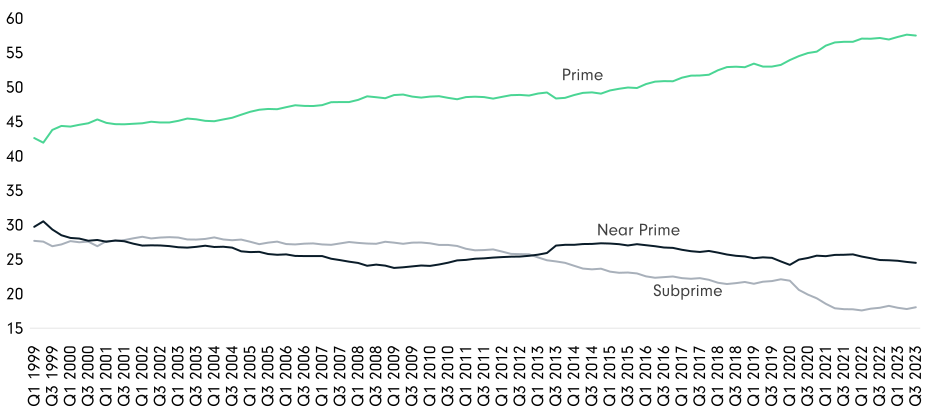
In early 2024, the Federal Reserve published a study examining how income support and forbearance programs during the early months of COVID that pushed consumer loan delinquencies to near-record lows across all credit score categorizations. This broad improvement in loan performance triggered a phenomenon often referred to as “credit score migration.” Stimulus payments helped reduce outstanding debt, while stay-at-home mandates curbed spending, enabling many consumers to boost their credit profiles.
As a result, many consumers moved out of the subprime category, pushing the share of subprime borrowers to its lowest level since the late 1990s. Many of these borrowers entered the near- prime category, leaving behind a subprime pool representing the most financially vulnerable households — increasing the risk profile. Today’s rising stress levels in both near prime and subprime segments can, in part, be traced back to this pandemic-era shift.
Exhibit 1 – Distribution of Borrowers: Credit Risk
Source: Board of Governors of the Federal Reserve System, January 2024.
The benefits of securitization
Headlines about consumer stress and underlying loan performance can be alarming at times, but it’s imperative that investors understand the structures of the deals that are exposed to this part of the market. When issuers assemble loan pools to structure asset-backed deals, credit risk is top of mind. While no underwriting process is perfect — and borrowers inevitably face life events like job change, family transitions or relocation — these risks are anticipated. That’s why these deals are structured with assumed levels of loss when constructed and are bolstered by credit enhancements designed to absorb those losses. These enhancements serve as a buffer, providing investors with additional protection if defaults exceed expectations established at the time of underwriting.
Credit enhancements
-
Excess Spread - Net interest that is left over after all expenses are covered with an asset-backed security. This type of extra interest can be deposited into a separate account to provide extra assurances on an investment. The lender will often collect extra money on the spread so that they can make up for potential missed payments in the future. This excess spread enhancement will be applied to all tranches of a deal.
| Weighted Average Coupon |
18.55% |
| Servicing fees |
2.63% |
| Financing Costs* |
5.82% |
| Excess Spread |
10.11% |
*Financing costs refers to the amount paid by the deal to investors.
-
Reserve Account - The issuer agrees to set aside a small percentage of the market value of the deal to serve as the reserve account. This reserve is used to support the outstanding tranches of the deal should any disruption in cash flows impact the trust's ability to pay for its monthly obligations.
-
Overcollateralization - The process by which the lender constructs the offered bonds such that they will be worth less than the actual value of the pledged assets acting as collateral. For example, the total deal balance could be $100 million but the issuance balance is $90 million, utilizing nearly $10 million as overcollateralization.
-
Subordination - A popular type of internal credit support is the senior/subordinated (or A/B) structure. It is characterized by a senior (A) class of security and one or more subordinated (B, C, etc.) classes that function as the protective layers for the A tranche. If a loan in the pool defaults, any loss thus incurred is absorbed by the subordinated securities first. The A tranche is unaffected unless losses exceed the amount of the subordinated tranches.
The senior securities are the portion of the ABS issue that has the most credit protection, while the lower quality (but presumably higher yielding) subordinated classes receive a lower rating or are unrated.
While headlines highlighting consumer stress and rising delinquencies can be unsettling, it’s important to remember that many securitized products are intentionally structured to provide some level of protection for investors. Deals backed by hard collateral — such as vehicles, equipment or real estate — provide an extra layer of protection through potential recovery from repossession. This underscores a key distinction between asset-backed securities supported by tangible collateral and those backed by unsecured obligations like credit cards or personal loans.
In times of economic stress or uncertainty, active managers can shift exposure toward higher-quality consumer ABS while maintaining selective exposure in lower credit tiers with hard asset backing. Ultimately, periods of consumer stress reinforce the importance of sound credit underwriting and the structural protections embedded in securitized transactions.
1New York Federal Reserve Consumer Credit Panel/Equifax study.
The views expressed are those of the author as of November 2025 and are subject to change without notice. These opinions are not intended to be a forecast of future events, a guarantee of future results or investment advice. Investing involves risk, including the possible loss of principal. Past performance is not a guarantee of future results.
/sitefiles/live/documents/insights/Blog/2025/A-865/2511_Fixed_Income_Monthly_Commentary.pdf