AI's Securitized Footprint: The Rise of Data Center Financing
Outside of the conflict in the Middle East, few topics have dominated market conversations in recent months more than artificial intelligence (AI) and its potential impact on the global economy. Rather than revisit the broader AI debate, this article focuses on a related trend within the securitized markets: the rapid growth of data center financing.
Data centers have rapidly expanded across the US, as cloud computing and AI drive higher demand for computing power. Despite concerns about energy use or impact on surrounding communities, demand for capacity continues to rise. For fixed income investors, that growth has created a new category of securitized collateral with distinct structural features and risk considerations. Today, the market relies primarily on two financing channels for these assets: asset-backed securities (ABS) and commercial mortgage-backed securities (CMBS). This commentary outlines how those structures differ and why issuers may favor one over the other.
Data centers 101
Types
- Enterprise data centers support a single business or organization. These facilities are often located near the user, allowing faster access for employees and customers.
- Colocation data centers serve multiple businesses looking to outsource information technology operations. These facilities provide integral services such as onsite security, power, cooling, equipment and technical support. A subset of colocation data centers are edge data centers, which are located closer to the end user to reduce latency.
- Hyperscale data centers are large facilities that are built for the sole purpose of computing and data storage. These locations can be single- or multi-tenant, housing thousands of servers and typically serve firms like Google, Amazon, Microsoft and IBM.
- Modular data centers are portable, self-contained units that allow businesses to move capacity wherever it is needed. They are often used in temporary settings such as construction sites or disaster areas.
Structures
- Triple-net leases require tenants to pay rent, taxes, insurance, maintenance and utilities while the landlord pays for core infrastructure.
- Modified gross leases require tenants to reimburse the operator for rent and power consumption, while the landlord is responsible for taxes, insurance and common area maintenance.
- Full-service or gross offer an all-inclusive rate with the landlord covering all expenses.
Asset-backed securities (ABS) data centers
Issuance in the data center ABS space has grown substantially since 2022, with 2026 starting off strong with $4.1 billion in issuance through February. Annualizing the first two months of issuance implies nearly $25 billion for the year. Issuance slowed in 2022 as financing costs rose during the Fed’s most aggressive rate hiking cycle in decades, but activity has increased meaningfully since then.
Exhibit 1 – Data Center ABS Issuance ($B)
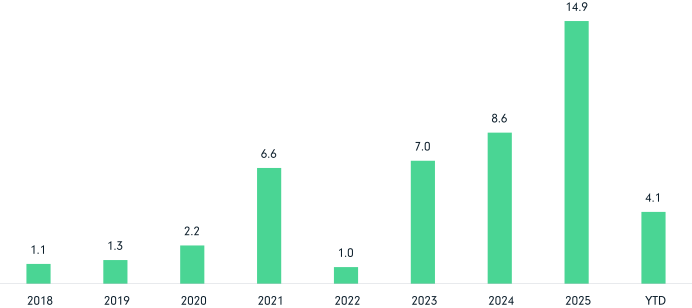
Source: Bloomberg. As of 28 Feb 2026.
In the ABS market, data center transactions are typically structured as master trusts, which allow issuers to add qualifying collateral and issue additional series of notes over time. While each transaction has its own nuances, the typical structure includes a final maturity roughly 25 to 30 years from issuance and an anticipated repayment date (ARD), generally five to 10 years after issuance depending on the tranche.
These deals are structured to pay interest but no principal to security holders prior to the ARD. Typically, an issuer has the option to prepay the outstanding notes without penalty, beginning two years before the ARD. While the issuer is not required to refinance the deal until the final maturity date, once past the ARD, the interest paid to investors will increase to a level based upon a pre-determined formula outlined in the original deal documentation. This increase in interest rate provides incentive for the issuer to pay off these securities by issuing a new securitization.
Cash flows for data center ABS is tied to underlying lease agreements, whether from multiple or single tenants. Consequently, the success of these structures depends heavily on tenant retention, particularly when lease renewals extend well beyond the deal’s ARD. For investors, data center ABS can offer exposure to one of the fastest growing segments of the economy through cash flows associated with these locations, backed by credit enhancements standard to asset-backed securities.
Commercial mortgage-backed securities (CMBS) data centers
Exhibit 2 – Data Center CMBS Issuance ($B)
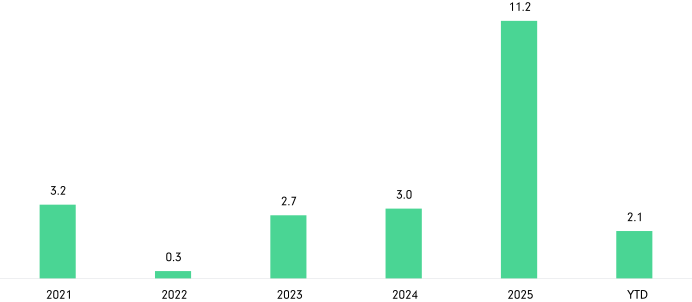
Source: Bloomberg. As of 28 Feb 2026.
The main segment of growth for the CMBS data center market has been in the single-asset single-borrower (SASB) market, though data centers can also be found in commercial real estate collateralized loan obligations (CRE CLO). In SASB transactions, credit risk depends on a single borrower and a single loan, which may itself be backed by one property or a portfolio of properties. Unlike ABS, which is secured by lease cash flow and can add qualifying assets over time, CMBS generally relies on a fixed collateral pool and focuses more directly on the underlying real estate.
Hyperscale facilities account for much of the CMBS issuance in this space because they are typically one or two tenants with little volatility. While ABS has a bit more flexibility regarding maturity and structure, CMBS tend to have a hard maturity at five years when the issuer must either refinance or face forced liquidation.
Borrowers cannot prepay a CMBS loan, but they may utilize a process called defeasance in which they can substitute a portfolio of US Treasury bonds as collateral that replicates the original loan's remaining cash flow stream. Once this occurs, the credit quality of the deal improves because there are no longer any credit concerns associated with the loan's future cash flow.
With data center CMBS deals, the debt is backed by loans to data center operators secured on the data center property. This differentiates from the ABS structure, where the debt is backed by the lease revenues from the data centers. In practice, CMBS refinancing depends more on property valuation, while ABS refinancing relies more on ongoing revenue tied to tenant activity.
Tale of the tape: ABS vs CMBS
| |
ABS |
CMBS |
| Structure |
Can add new collateral that meets criteria |
Fixed assets |
| Collateral |
Cash flows from tenants |
Mortgage on real estate |
| Types |
All |
Primarily hyperscale |
| Refinance/Maturity |
ARD take-out based on contract and tranche |
Refinance based on property valuation |
| Amount Outstanding |
$40.5 billion |
$18.0 billion |
While the segment continues to expand, spreads across both the ABS and CMBS markets have remained exceptionally tight as investor demand for AI-linked exposure has increased. As a result, Diamond Hill’s strategies currently have limited exposure to data center securitizations. In our view, relative value in other ABS and CMBS sectors remains more compelling at current levels.
As of February 28, 2026, Diamond Hill owned equity shares of Microsoft Corp., Amazon.com, Inc., International Business Machines Corp. and Alphabet, Inc.
The views expressed are those of the author as of March 2026 and are subject to change without notice. These opinions are not intended to be a forecast of future events, a guarantee of future results or investment advice. Investing involves risk, including the possible loss of principal. Past performance is not a guarantee of future results.
/sitefiles/live/documents/insights/Blog/2026/A-899/2503_Fixed_income_monthly.pdf