Positioning Consumer Exposure Amid Geopolitical Volatility
The ongoing conflict in the Middle East has increased market volatility as developments continue to unsettle investors. Our strategies maintain meaningful exposure to the consumer — directly through auto asset-backed securities (ABS), credit card ABS and consumer loan ABS, and indirectly through mortgage-backed securities, both agency and non-agency.
The most direct impact on the consumer has been the sharp rise in oil prices, driven by the increased risk in transporting the commodity through contested waters such as the Strait of Hormuz. While that increase has not yet impacted official inflation data, it has hurt the average consumer at the pump. Since the start of the most recent conflict on February 28, Brent Crude oil has risen from roughly $70 per barrel to $109 per barrel (as of March 19, 2026). More specifically, gas prices have jumped nearly 20%, from $3.44 per gallon to $4.37 per gallon, based on the average of regular, mid and premium grade gasoline, per AAA.
How have we been adjusting in response to this shift? Even before the conflict began, our fixed income team had already been working to upgrade consumer exposure in our portfolios in anticipation of an economic slowdown amid stubborn inflation and a weakening labor market. We believe shifting exposure toward consumers that are better positioned to weather conflict-related inflation offers more attractive risk-adjusted value than reaching down in credit quality to capture incremental spread.
Exhibit 1 – Brent Crude and Average Gas Price ($)
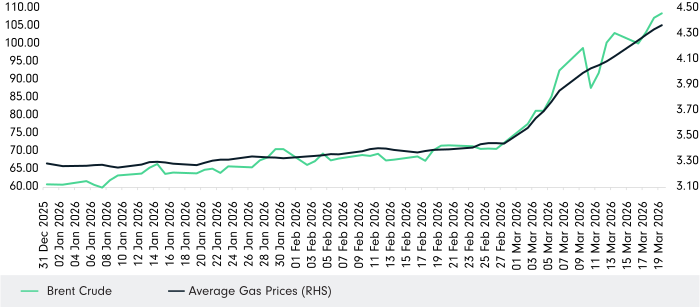
Source: AAA, Bloomberg.
The views expressed are those of the author as of March 2026 and are subject to change without notice. These opinions are not intended to be a forecast of future events, a guarantee of future results or investment advice. Investing involves risk, including the possible loss of principal. Past performance is not a guarantee of future results.
/sitefiles/live/documents/insights/Blog/2026/A-900/2503_FI_oil_consumer.pdf