The Fed Embarks on Easing Cycle and Rates Go...Higher?
We all know the story. After the worst pandemic since the Spanish Influenza in the early 1900s, inflation rocketed higher due to supply chain issues and too much demand chasing too few goods. Transitory became an ugly word and would come to represent what could be the one major failing of Powell’s time at the Federal Reserve. But love or hate him, one must admire the stubbornness with which Powell’s Federal Reserve tackled out-of-control inflation, refusing to bow to market pressure to slow or halt a historic tightening cycle until inflation was somewhat subdued. And while it is still too early to declare victory over inflation, the 2022-2023 tightening cycle appears to have done the job of easing pricing pressures.
As inflation cooled, expectations grew for the next easing cycle with questions ranging from how soon it would begin to how quickly it would progress. The markets received their answer on September 18 of this year when the Fed lowered rates — by a somewhat surprising 50 basis points (bps) — for the first time since the early days of COVID. In the days leading up to the decrease, opinions varied as to how much the Fed would move in the initial cut, and there was genuine uncertainty as to what action the Fed would take. Historically, the only easing cycles that started at anything higher than 25 bps were emergency meetings tailored to address a specific issue (dot-com bubble, Enron, Worldcom, Housing Crisis/Great Recession).
Exhibit 1 — Tightening Cycle to Cool Inflation

Source: Bloomberg, Federal Reserve.
The Fed followed up September’s 50 bps reduction with an additional 25 bps reduction on November 7, shortly after the US presidential election concluded. Regardless of which side of the aisle you reside on, the decisiveness of the election caused the markets to exhale and relax as concerns of a contested election faded into the background.
The expected hit to the labor market (only 12,000 jobs added in October) due to a major strike and two devastating hurricanes came as no surprise, nor was the subsequent comeback (227,000 jobs added) in November unexpected. Core inflation has stubbornly held the line at 3.2-3.3% annualized rate since mid-summer and is still ahead of the Fed’s targeted average of 2.0%, but the market is expecting an additional 25 bps in easing at the Fed’s final meeting on December 18th. A recovery in labor markets, as we saw in November, combined with stubborn inflation above target, is not necessarily the formula for rate cuts. In fact, one might expect a pause or even a rate hike if the labor market is strong and inflation remains. But it appears that the Fed is committed to finishing out the year with one last rate cut of 25 bps before plunging into the uncertainty of 2025. If we assume the Fed will indeed lower the Fed funds rate by an additional 25 bps at its final meeting, it will have decreased rates by 100 bps over the final four months of the year in an effort to achieve the ever-elusive soft landing. One would think that such an accommodating Fed would push rates lower across the board to benefit consumers and businesses alike, but that has not been the case. In fact, interest rates have moved in the opposite trajectory, increasing across the curve since the initial rate cut in September (Exhibit 2).
Exhibit 2 — Treasury Yields & Fed Funds Rate (%)
|
2Y Treasury |
10Y Treasury |
30Y Treasury |
Fed Funds |
| 17 Sep 2024 |
3.59 |
3.65 |
3.96 |
5.25 |
| 18 Sep 2024* |
3.61 |
3.70 |
4.03 |
4.75 |
| 30 Sep 2024 |
3.66 |
3.81 |
4.14 |
4.75 |
| 31 Oct 2024 |
4.16 |
4.28 |
4.47 |
4.75 |
| 7 Nov 2024* |
4.21 |
4.31 |
4.52 |
4.50 |
| 29 Nov 2024 |
4.13 |
4.18 |
4.36 |
4.50 |
CHANGE SINCE
17 Sep 2024 |
+0.54 |
+0.53 |
+0.40 |
-0.75 |
Source: FRED, Bloomberg. *Meeting of the Federal Reserve.
Uncertainty Surrounding Trump 2.0
One of the main culprits for the rise on the longer end of the curve has been the concern that policy changes from the incoming Trump administration could affect the long-term economic outlook. While equities climbed and rates rallied in the immediate aftermath of the Trump victory, the move in rates was relatively short-lived. Concerns ranged from the impact of tariffs on the US economy, a potential fight with Jerome Powell and the economic fallout from proposed mass deportations. Campaign talk about tariffs spanning 10% internationally to 60% on all goods from China stoked fears that inflation could reemerge in 2025. Trump has allayed concerns that he would attempt to fire Jerome Powell (which he can’t do) by stating that he expects Powell to finish his term in May 2026.
Trump has proposed deporting millions of illegal immigrants in the early days of his administration, which could return inflation to the forefront of economic concerns, fueled by the cost of carrying out the deportations (the American Immigration Council estimates a single year of deporting one million people would cost $88 billion), the impact on the labor market and the decrease in the overall customer base for businesses. Economists at the Peterson Institute for International Economics estimate that deporting 1.3 million immigrants would raise prices by 1.5% by 2028 while deporting 8.3 million immigrants would raise prices by 9.1%. Recently, 26 Republican governors pledged support for Trump’s deportation plan, but the specifics remain uncertain. Trump has yet to take office, and based upon his prior administration, expectations should be for some compromise of most if not all of his proposals so that he can get some version of them done. We’ve already seen some stabilization with the announcement of Trump’s proposed Treasury Secretary, hedge fund manager Scott Bessent, who has a more moderate approach regarding tariffs. Regardless, the potential for some version of these and other changes has created uncertainty and, therefore, a push higher in interest rates across the curve.
Mortgage Rates Split from Fed Action
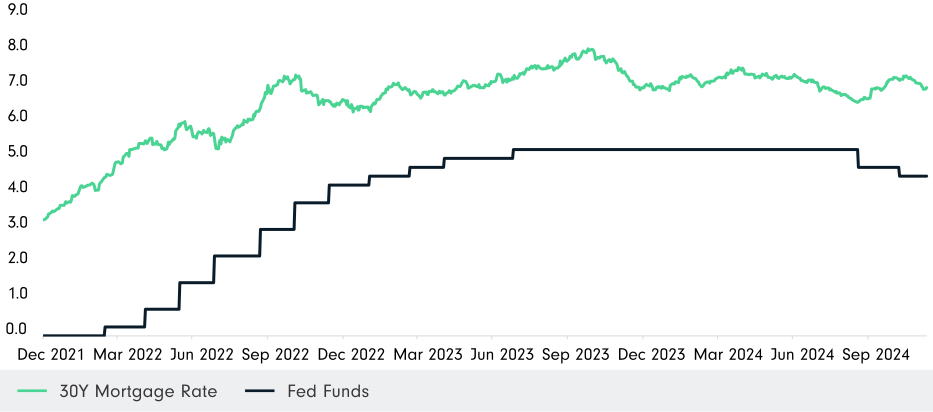
As the Federal Reserve increased rates throughout 2022 and into 2023, mortgage rates moved nearly in lockstep, climbing throughout that period. 30-year mortgage rates, as measured by the Bankrate.com US Home Mortgage 30-Year Fixed National Average, ended 2021 at 3.27%. As indicated in Exhibit 3, as the Fed moved, so did mortgage rates. The 30-year mortgage rate finished 2023 at 6.99% after peaking at 8.09% in late October 2023. Mortgage rates continued to climb even as the Fed held rates steady in 2023, and once the Fed started easing, mortgage rates inexplicably began to climb. We’ve already addressed some of the issues around the increase in longer-term rates, and mortgage rates are closely tied to longer-term rates, which explains some of the disconnect.
Exhibit 3 — 30Y Mortgage Rate vs Fed Funds Rate (%)
Source: Bloomberg.
Another factor influencing mortgage rates is the risk premium — the extra yield investors demand to hold mortgage-backed securities compared to US Treasuries — which has been climbing recently. Still, current mortgage rates are more than 0.45% lower than the same period last year and almost 1.00% lower than the peak level reached in October 2023. While this remains a challenge for new homeowners and affordability, homeowners who purchased in the past couple of years can refinance to a lower rate and save some additional money, which benefits the overall economy, depending on how they spend those savings.
Shift in Long-Term Expectations for the Federal Reserve
As we learned throughout 2023, market expectations versus the Federal Reserve’s expectations for the future path of rates rarely concur with one another. For example, at the end of 2022, Fed fund futures estimated the Fed funds rate would reach 4.535% by the end of 2023, including expectations for a 25-bps rate cut, while the Fed’s dot plot indicated a terminal rate for 2023 at 5.125% with no rate cut, only hikes. The reconciliation between the Fed and investors led to some rather painful performance for fixed income markets in the second and third quarters of 2023.
Headed into 2024, the market was pricing out a very aggressive Fed, with futures indicating roughly 160 bps in easing by year-end while the Fed was expecting to reduce rates by 50 bps (according to the December 2023 dot plot). The markets adjusting to the Fed projections led to negative performance in the first quarter and a return barely above zero in the second quarter (as measured by the Bloomberg US Aggregate Bond Index). The market’s acceptance of a less aggressive Fed in the coming year has also pushed rates across the curve higher. Exhibit 4 indicates the shift in market expectations throughout 2024 due to incoming economic data and geopolitical shifts.
Exhibit 4 — Shift in Market Expectations
|
Dec 2025 Fed Fund Futures |
FOMC Dot Plot Indication |
| 17 Sep 2024 |
2.925 |
|
| 18 Sep 2024* |
2.947 |
3.375 |
| 30 Sep 2024 |
3.616 |
|
| 31 Oct 2024 |
3.694 |
|
| 7 Nov 2024* |
3.774 |
|
| 29 Nov 2024 |
29 Nov 2024 |
|
CHANGE SINCE
17 Sep 2024 |
+0.811 |
|
Source: Bloomberg. *Meeting of the Federal Reserve, Dot Plot updated on a quarterly basis.
What Can We Expect in 2025?
As we head toward the finish line in 2024, markets are looking to the coming year and wondering how things will progress. Can we expect a third year of +25% return in the equity markets? Will the post-2022 recovery in fixed income continue now that rates are starting off at a much higher level than previously? What does Trump 2.0 truly look like and how does that impact the overall economy?
Financial firms are publishing their year-end outlook pieces for equities, fixed income, private credit and every other sector in the financial markets, but the fact is that no one knows what the coming year will bring. Too many variables can impact the markets and their performance, ranging from economic activity (or lack thereof) to geopolitical risks to domestic political gridlock to government shutdowns. Diamond Hill believes many factors will impact markets, and it is our job to build portfolios positioned to withstand market stress while also taking advantage of market dislocations to add value to portfolios.
Bloomberg US Aggregate Bond Index measures the performance of investment grade, fixed-rate taxable bond market and includes government and corporate bonds, agency mortgage-backed, asset-backed and commercial mortgage-backed securities (agency and non-agency). The index is unmanaged, includes net reinvested dividends, does not reflect fees or expenses (which would lower the return) and is not available for direct investment. Index data source: Bloomberg Index Services Limited. See diamond-hill.com/disclosures for a full copy of the disclaimer.
The views expressed are those of Diamond Hill as of December 2024 and are subject to change without notice. These opinions are not intended to be a forecast of future events, a guarantee of future results or investment advice. Investing involves risk, including the possible loss of principal. Past performance is not a guarantee of future results.
/sitefiles/live/documents/insights/FixedIncomePersp/2024/A-742/2312_Fixed_Income_Monthly_Commentary.pdf