US Consumers: Headline Strength, Hidden Strain
Consumer demand has held up better than many expected in the face of stubborn inflation, a cooling labor market, ongoing tariff uncertainty and war in the Middle East. While the high-level data still support the case for a healthy consumer environment, a closer look suggests an increasingly bifurcated economy. As shown below, the top-earning 30% of households account for over 50% of total consumer spending while the bottom 50% account for less than 30% of spending. In other words, many consumers are far more financially constrained than the headline numbers imply.
Top Earners Dominate Consumer Spending
Share of Spending by Household Income, by Decile
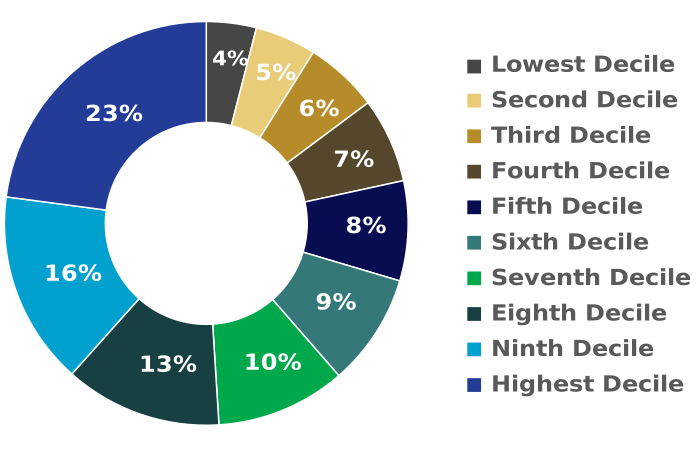
Source: US Bureau of Labor Statistics; data as of December 2025.
Bond investors can gain exposure to the strongest consumers through high-quality credit card issuers and prime loan structures, but these higher-quality areas often don’t offer much incremental compensation. More attractive yield can be found further down the credit spectrum into near-prime and subprime borrowers, but performance can deteriorate quickly if the economy weakens.
The tradeoff between yield and stability is where strong, bottom-up credit analysis becomes crucial. Today, data indicate early signs of consumer stress, including a modest uptick in delinquencies even within prime cohorts. While it’s too soon to know whether that’s simply noise or the beginning of a broader trend, caution seems warranted.
The current environment suggests to us that the potential for losses has increased, highlighting the importance of credit investments that can remain resilient if economic conditions deteriorate. This means higher-quality tranches within consumer credit, for example, and a higher bar for investing in subprime opportunities. Issuer selection also remains key. Strong, proven issuers—particularly those with durable funding structures—are more likely to operate without disruption in tighter markets and therefore are less likely to create servicing transfer risk in a downturn.
The views expressed are those of the author as of May 2026 and are subject to change without notice. These opinions are not intended to be a forecast of future events, a guarantee of future results or investment advice. Investing involves risk, including the possible loss of principal. Past performance is not a guarantee of future results.