Securitization in Focus — November 2025
Securitized markets head toward a standout year
YTD returns across the securitized universe remain exceptionally strong, with several subsectors on track for their best performance in more than a decade.
Key performance highlights:
- The Bloomberg Securitized Index delivered 8.26% YTD, its strongest January–November return since 2009.
- The ICE BofA CMO Index notched its best November YTD performance since 2000.
- The Bloomberg RMBS Index is on track for its best year since 2001.
- Excess returns have been led by agency RMBS, which is generating its strongest relative performance since 2010, while other subsectors lag 2024’s strong excess-return profile.
YTD Total Returns and Excess Returns (%)
|
YTD |
Best Since |
YTD Excess Return |
Best Since |
| Securitized |
8.26 |
2009 |
1.17 |
2010 |
| Agency RMBS |
8.35 |
2001 |
1.20 |
2010 |
| Agency CMOs |
9.22 |
2000 |
1.70 |
2015 |
| Non-Agency CMBS |
7.53 |
2019 |
1.13 |
2024 |
| Agency CMBS |
7.70 |
2020 |
0.77 |
2024 |
| ABS |
5.61 |
2010 |
0.42 |
2024 |
| ABS Auto |
5.24 |
2024 |
0.51 |
2024 |
| ABS Credit Card |
5.68 |
2011 |
0.55 |
2024 |
Asset-backed securities
ABS issuance remained strong in November, defying the typical holiday slowdown. Monthly volume reached $34.4 billion, nearly tripling last year’s level and extending the three-month average to $36.7 billion, well above the previous three-month average of $28.2 billion. Although softer than October’s peak of $42.7 billion, November’s activity pushed year-to-date issuance to $336.7 billion, surpassing the same period in 2024. Auto and truck ABS continued to dominate supply, accounting for more than half of total issuance, followed by the ‘other’ and consumer categories.
30+ Day Delinquencies (%)
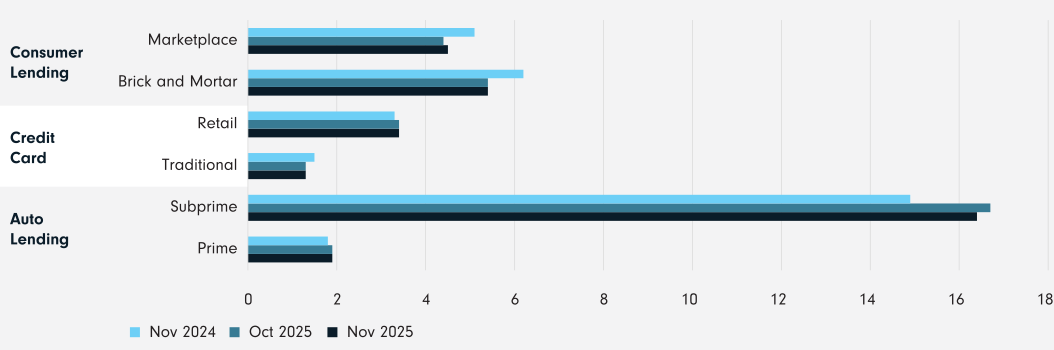
Despite ongoing concerns about consumer credit, 30-day delinquency rates across most ABS sectors remained stable in November, with several categories improving modestly. Prime auto, traditional credit card, retail card and brick-and-mortar consumer lending were unchanged month over month, while subprime auto improved from 16.7% to 16.4%. Marketplace lending was the only segment to show a month-over-month increase in delinquency, rising 0.1% to 4.5%.
Commercial mortgage-backed securities
Issuance ($B)
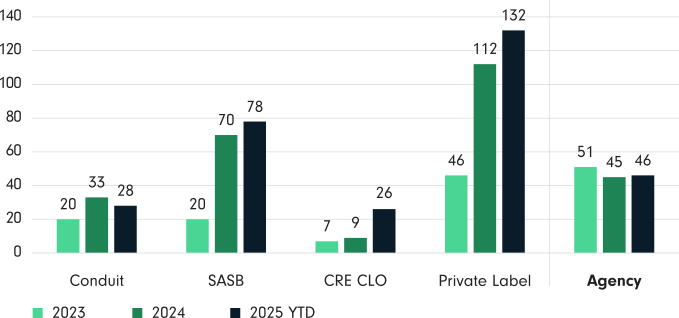
Private-label CMBS issuance surpassed $130 billion YTD through November, exceeding the full-year total for 2024 and significantly surpassing 2023’s full-year issuance. SASB1 transactions continued to drive the market with $78 billion issued, while conduit and CRE CLO2 structures contributed meaningfully to overall supply. November’s activity pushed 2025 private-label issuance 18% ahead of full-year 2024, reinforcing strong demand despite ongoing credit dispersion across property types.
1Single-Asset Single-Borrower
2Commercial Real Estate Collateralized Loan Obligations
CMBS trends in November
- The CMBS delinquency rate declined for only the fourth time in 2025, falling 20 basis points from 7.46% to 7.26% — marking the second decrease in the last three months.
- Retail, multifamily and office each posted modest improvements: Retail fell 0.15% to 6.74%, multifamily slipped 0.14% to below 7%, and office eased 0.08% from its all-time high to 11.68%. Lodging rose 0.10% to 6.17%, while industrial inched higher by 0.03% to 0.67%.
- The 30+ day delinquency rate, 6.40% a year ago, climbed through late 2024 and early 2025, briefly retraced in February, and then resumed its rise until September’s small improvement. After a modest uptick in October, another decline followed in November.
- Serious delinquencies (60+ days, foreclosure, real estate owned or non-performing) were essentially unchanged, edging up from 6.99% to 7.00%.
Residential mortgage-backed securities
Issuance
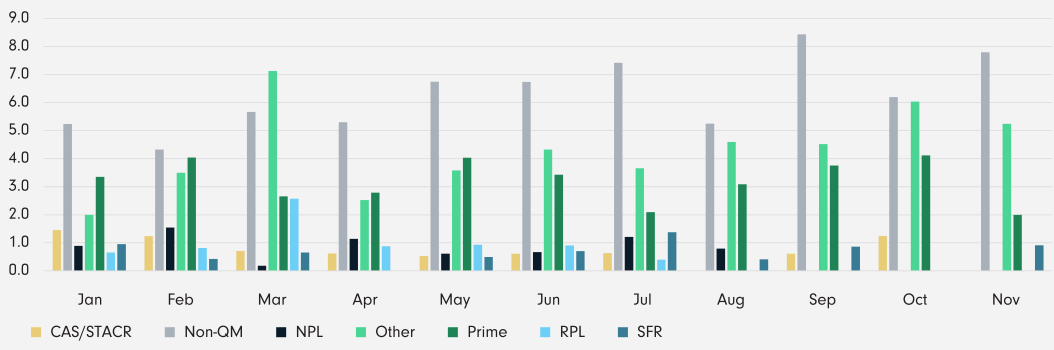
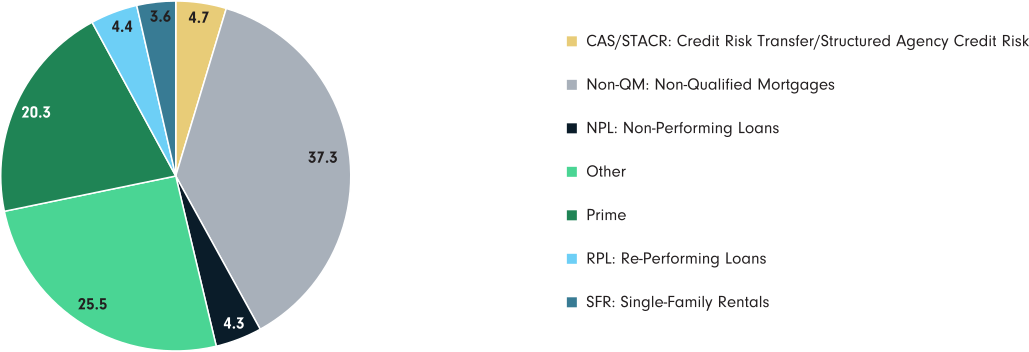
Non-agency residential mortgage-backed securities (RMBS) issuance totaled $10.4 billion in November, roughly in line with last year’s $10.1 billion, though below the September peak as volumes moderated. Despite two consecutive monthly declines, overall issuance remains well ahead of 2024’s full-year pace as borrowers continue to tap home equity through alternatives to cash-out refinancing. Non-qualified mortgage (non-QM) issuance reached a record $66.0 billion year to date, while continued momentum in the “other” sector — home-equity loans and lines, second liens and reverse mortgages — has driven category issuance to nearly 50% above 2024’s full-year total. Together, Non-QM and ‘other’ account for nearly 64% of 2025 non-agency RMBS activity.
2025 Monthly Non-Agency RMBS Issuance ($B)
2025 YTD Non-Agency RMBS Issuance (%)
The housing “perfect storm”: rates, prices and mobility
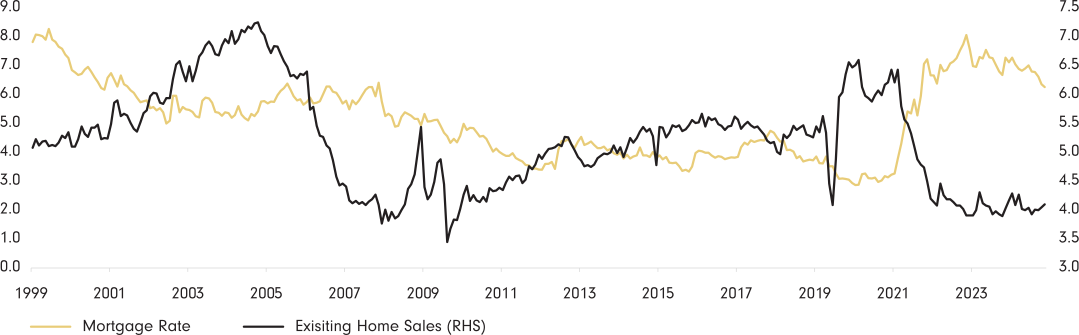
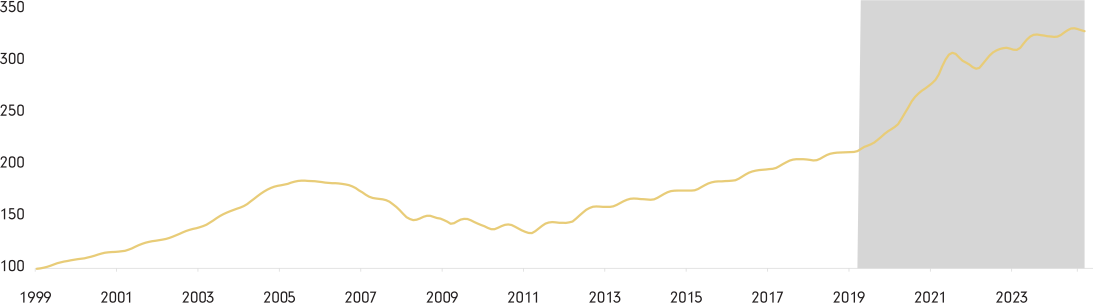
Elevated mortgage rates have sharply reduced housing turnover, as borrowers with significantly lower existing rates have little incentive to refinance or move. Home prices — still up roughly 54% on average since COVID — have only recently begun to moderate, while household formation slowed to 1.2 million as of June 2025, down from an average of 1.6 million over the prior four years. These factors have priced many potential buyers out of the market and limited supply from existing homeowners. As a result, borrowers seeking to access accumulated home equity increasingly favor alternatives to cash-out refinancing, including home-equity loans and lines, second liens and reverse mortgages — a trend reflected in the strong growth of the “other” category within non-agency RMBS issuance.
Mortgage Rate Impact on Existing Home Sales (%)
Average Home Price (thousands) ($)
Sources: Bloomberg, ICE BofA, Deutsche Bank, Barclays, Trepp, Bankrate.com, National Association of Realtors (NAR), S&P Case-Shiller.
Bloomberg US Securitized Index measures the performance of the securitized sector of the Bloomberg US Aggregate Bond Index. ICE BofA Agency CMO Index measures the performance of US dollar-denominated, fixed-rate agency CMOs publicly issued in the US domestic market. Bloomberg US Residential Mortgage-Backed Securities (RMBS) Index tracks fixed-rate agency mortgage-backed pass-through securities guaranteed by Ginnie Mae (GNMA), Fannie Mae (FNMA) and Freddie Mac (FHLMC).
Index data source: Bloomberg Index Services Limited. See diamond-hill.com/disclosures for a full copy of the disclaimer.
The views expressed are those of Diamond Hill as of November 2025 and are subject to change without notice. These opinions are not intended to be a forecast of future events, a guarantee of future results or investment advice. Investing involves risk, including the possible loss of principal. Past performance is not a guarantee of future results.