Headlines
Fed leadership. The president nominated Kevin Warsh to succeed Jerome Powell as Fed chair. Warsh served as a Federal Reserve governor from 2006–2011. His nomination goes to the Senate Banking, Housing and Urban Affairs Committee for consideration.
Securitization policy proposals. The administration outlined measures aimed at consumer affordability, including restricting institutional purchases of single-family homes, directing the Government Sponsored Enterprises (GSEs) to purchase up to $200 billion in mortgages (a quasi-QE framework) and proposing a 10% cap on credit-card APRs. Details remain limited; early headlines contributed to a pause in credit-card asset-backed securities (ABS) issuance in January.
Fed policy. The Federal Open Market Committee (FOMC) left rates unchanged at its late-January meeting. Futures now imply the first potential cut around late July.
Issuer commentary (earnings)
American Express (credit-card ABS)
Management argued a rate cap would likely reduce card availability and line sizes.
Bread Financial (credit-card ABS)
Reported resilient customer health in 2025, with positive sales and payments growth, lower delinquencies and lower losses despite inflationary concerns and soft sentiment.
GM Financial (auto ABS)
Credit performance tracked expectations, including recoveries; management expects retail net charge-offs in the mid-1% range given portfolio credit mix and estimated repossession recoveries.
Synchrony Financial (credit-card/consumer ABS)
Emphasized a resilient US consumer with rising transaction values and frequency; delinquency and charge-off rates declined year over year following earlier underwriting tightening.
Asset-backed securities
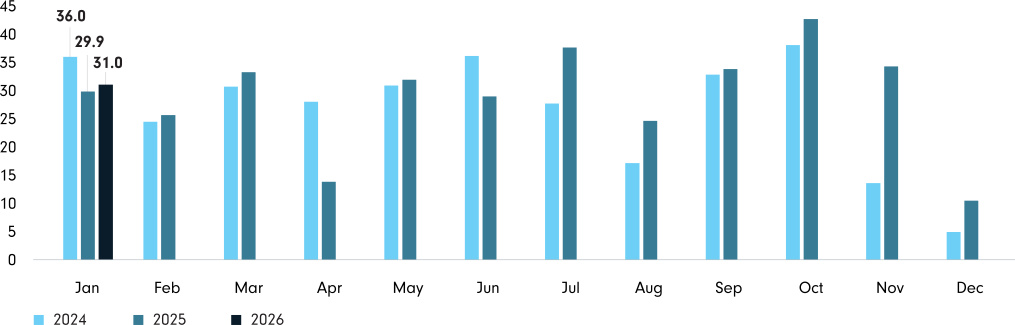
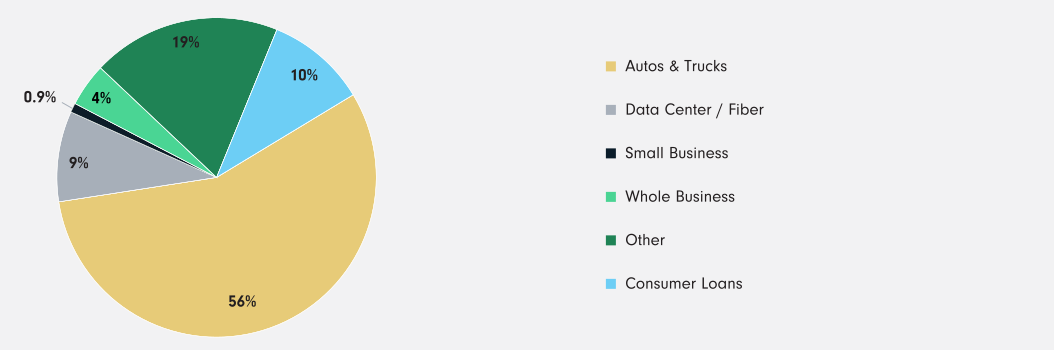
Following December’s seasonal slowdown ($10.5B, still above the four-year December average of $6.5B), ABS issuance reaccelerated in January to $31.1B, ahead of 2025’s $28.9B monthly average. Auto ABS led with $17.5B. Artificial Intelligence (AI)-adjacent sectors advanced, with fiber network ($1.0B) and data centers ($1.9B) running ahead of last year’s average monthly tally (~$2.1B). Whole-business ABS added $1.4B, including deals from Jersey Mike’s and Oncourse Entities (home-infrastructure warranties). “Other” consumer contributed $4.1B; notably, there was no credit-card ABS issuance in January as issuers assessed the proposed 10% APR cap.
Monthly ABS Issuance ($)
January ABS Issuance (%)
Credit-card APR cap: potential implications
A proposed 10% ceiling on credit-card APRs is arguably the most consequential — and least likely, as drafted — of the recent policy ideas. While a cap could offer relief to highly indebted borrowers, the economics of issuing and servicing cards (funding, fraud/risk ops, rewards, charge-off volatility) mean a hard ceiling would likely force business-model retrenchment: tighter underwriting, smaller lines and reduced access to credit, with the sharpest pullback for subprime and noticeable tightening even for prime borrowers. Market structure effects would be uneven — large, diversified banks (e.g., JPMorgan, Capital One, Citi) could adapt by trimming credit and repricing elsewhere, whereas smaller or monoline issuers that rely on card economics could face significant pressure. Legal authority is also uncertain given usury laws are typically set at the state level, raising execution and enforceability questions. In practice, the proposal reads as an opening move to push the industry toward voluntary concessions (e.g., fees, repricing, hardship options).
Commercial mortgage-backed securities
The commercial mortgage-backed securities (CMBS) market opened the year with a solid issuance pace: about $8.3 billion priced and a sizable pipeline that could bring January totals to roughly $14 billion, depending on timing. Approximately 93% of single-asset single-borrower (SASB) deals priced or in the pipeline are refinancings. With lending reopening, investor focus is less about deal availability and more about whether spreads need to widen to clear the added supply — though, so far this year, spreads have continued to grind tighter.
CMBS trends in January
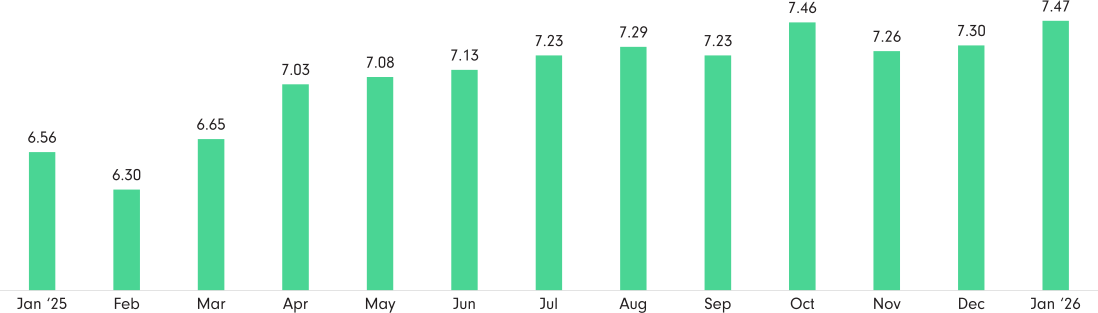
Overall: Delinquencies rose 17 basis points (bps) to 7.47% to start the year, driven by office +103 bps to 12.34%, a new all-time high (prior peak 11.76% in October 2025).
By property type:

Multifamily:
+30 bps to 6.94%, reversing last month’s decline.

Retail:
+12 bps to 7.04%, sixth increase in 13 months; still below the 7.82% peak (March 2025).

Lodging
-105 bps to 5.56%, lowest since March 2024.

Industrial
-18 bps to 0.62%, breaking a three-month increase.
Year over year: Headline delinquency +91 bps (6.56% → 7.47%).
Serious delinquency (60+ days, foreclosure, REO or non-performing): +9 bps in January (7.00% → 7.09%).
30+ Day CMBS Delinquencies (%)
Residential mortgage-backed securities
Issuance
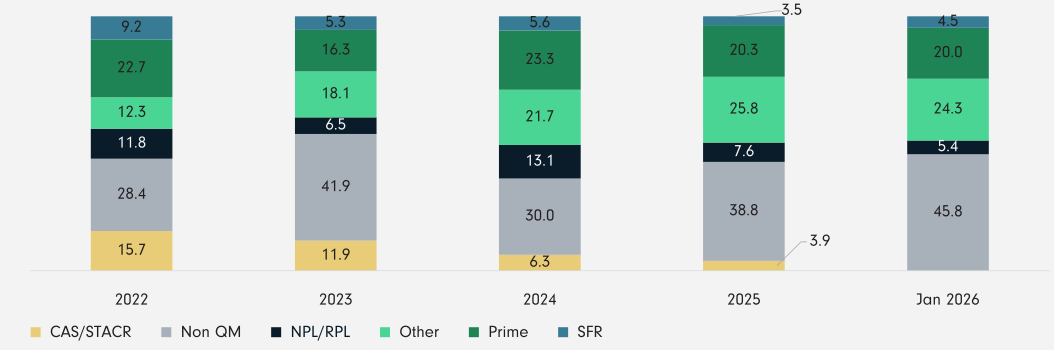
January issuance totaled $16.6B, in line with the 2025 monthly average. Non-qualified mortgage (Non-QM) deals led with 46% of volume (~ $7.6B); Non-QM securities do not meet Consumer Financial Protection Bureau guidelines and allow more flexible eligibility and documentation. The “other” bucket — home-equity loans/lines and reverse mortgages — contributed $4.0B (24%), consistent with the pace of recent years.
2025 Monthly Non-Agency RMBS Issuance (%)
Sources: Deutsche Bank, Trepp.
See diamond-hill.com/disclosures for a full copy of the disclaimer.
The views expressed are those of Diamond Hill as of February 2026 and are subject to change without notice. These opinions are not intended to be a forecast of future events, a guarantee of future results or investment advice. Investing involves risk, including the possible loss of principal. Past performance is not a guarantee of future results.