Evolution of the Asset-Backed Securities Market
Asset-backed securities (ABS) were introduced to the marketplace in the mid-1980s when Sperry Lease Finance created a new type of securitization backed by computer equipment leases. Before the introduction of the Sperry ABS deal, mortgages served as the primary source of securitization.
Securitization begins with an agreement between a lender and a borrower regarding the amount borrowed, the interest rate paid, the collateral used to secure the loan, and loan maturity. (For a more in-depth understanding of the securitization process and its benefits to investors, please see our paper, “Mechanics and Benefits of Securitization.”) The borrower’s obligation is then sold, or pledged, to a trust along with other similar loans, creating the securitized product.
Since the initial ABS deal, the market has continued to grow and diversify by implementing new types of securitizations, from auto loans and leases to cell phone payments. We will focus on the evolution of the ABS market and the emergence of new offerings over the past several years in response to the changing market environment since the 2008 global financial crisis.
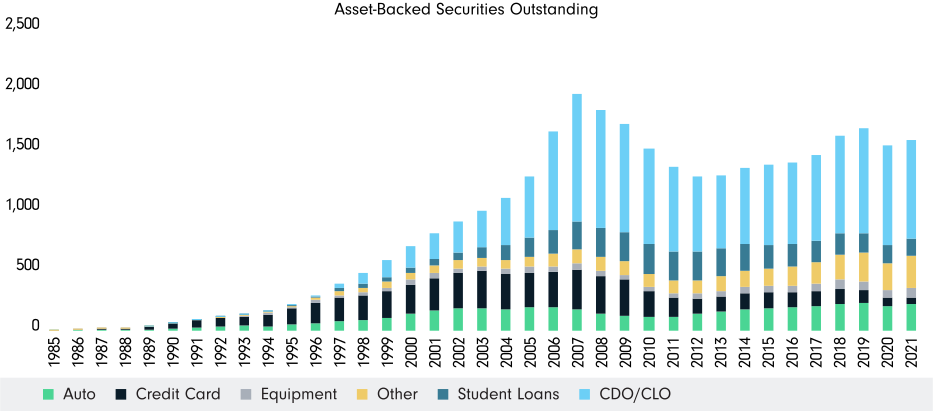
According to the Securities Industry and Financial Markets Association (SIFMA), the ABS market is a $1.6 trillion market that has grown substantially since its emergence in the mid-1980s (Exhibit 1).
Exhibit 1 — Growth of the ABS Market ($B)
Source: SIFMA.
The ABS market peaked in 2007 at $2 trillion ahead of the global financial crisis. It began to decline post-crisis, as issuance was significantly reduced, and outstanding deals continued to pay down. The market didn’t rebound until 2013 when securitization expanded beyond the traditional categories.
Although the ABS market has experienced considerable growth since the mid-1980s, it remains the smallest subset of the fixed income universe, trailing treasury, corporate, mortgage-related, municipal, and federal agency debt (Exhibit 2).
However, it is essential to note that small does not mean illiquid, concentrated, or risky. On the contrary, the ABS market offers investors a chance to diversify by investing in a broad market comprising various asset types. Additionally, how these deals are structured allows an investment manager to determine the level of risk they are willing to assume when investing.
Exhibit 2 — US Fixed Income Outstanding ($B)
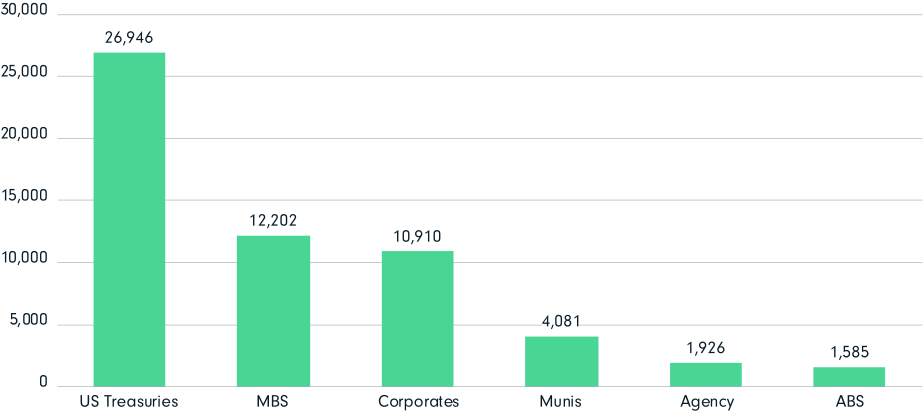
Source: SIFMA. As of 31 Mar 2024. MBS’s and ABS’s most recent available data are as of 31 Dec 2021.
Autos
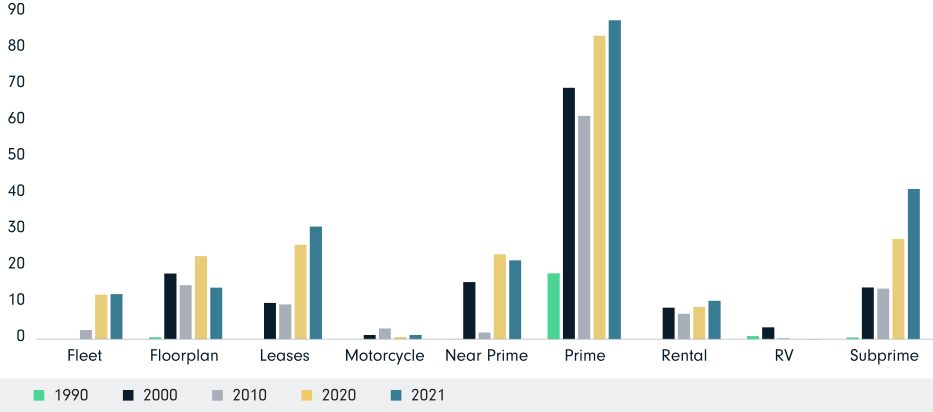
Over the years, the auto ABS market has evolved, offering various structures and opportunities for investment managers beyond typical securitization using auto loans as collateral. The auto seuritization market started with prime (borrowers with FICO scores greater than 720) and near prime (mid-to-high 600s to low 700s) auto loans. However, as those markets grew, investment bankers realized they could expand the securitization market to auto fleets, floorplans, and other markets.
The securitization of auto loans dipped into the subprime market (475-650 FICO scores) in the early 1990s, and this segment has since become the third largest segment of the auto ABS market. The variety of auto ABS combined with the tranche structure within the securitization market provides investors with a broad selection of opportunities that appeal to their specific risk-reward appetite.
Exhibit 3 — Auto Sector Breakdown, Outstanding ABS ($B)
Source: SIFMA.
Credit Cards
Credit card receivables — the future cash flows expected from borrowers’ credit card debt repayments — are pooled and transformed into marketable securities (credit card asset-backed securities, or ABS) that can be sold to investors.
By selling these bundled receivables to investors, credit card issuers gain immediate access to capital rather than waiting for cardholders to pay.
As companies collect on outstanding credit card debts, the funds are used to pay interest monthly, with the principal paid off at a pre-ordained pace after a pre-determined period to the investors holding these ABS, creating a continual flow of funds and making it an attractive investment for those looking for regular income streams.
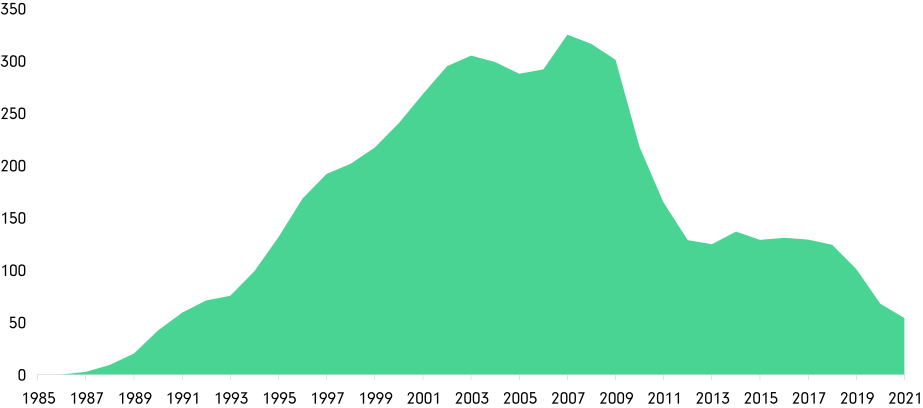
Securitization of credit card receivables peaked before the global financial crisis, with roughly $323 billion of outstanding debt at the end of 2007. As consumers worked to deleverage post-crisis and reduce their debt profile, outstanding credit card securitization dropped nearly every year from 2008 through 2021 (Exhibit 4). This deleveraging trend, combined with innovations in the personal loan business, has led to a continued decline in the reliance on credit cards.
Issuance in credit card securitizations peaked in 2008, with an all-time high of $55.8 billion, followed by $51.5 billion in 2009. In 2010, issuance plummeted to $6.5 billion, the lowest level since 2007 ($3.1 billion). Credit card issuance in the years 2011 to 2019 averaged $30.9 billion per year. In 2020, at the height of the COVID-19 pandemic, issuance was the lowest since 2007, with only $3.1 billion. Since then, the market has seen $14 billion in issuance in 2021, $29.6 billion in 2022 and $20.3 billion in 2023.
Exhibit 4 — Credit Card ABS Outstanding ($B)
Source: SIFMA.
Collateralized Debt Obligations (CDOs)/Collateralized Loan Obligations (CLOs)
While CDOs continue to wind down, with no new issuance in the sector since the global financial crisis, CLOs continue to grow as a segment of the overall fixed income markets. CDOs have decreased from $146 billion in December 2007 to just $68 billion in December 2021. Over the same period, the CLO market has grown from $291 billion to $636 billion. CDOs and CLOs make up just over half of the total outstanding assets in the ABS market.
While these securities are included in the ABS sector per SIFMA, they differ substantially from their ABS brethren. Traditionally, autos, credit cards, and other areas of the ABS market are securitized by grouping like assets, but CLOs are a diverse pool of senior secured bank loans made to businesses that are typically rated below investment grade.
Even though CLOs share some structural aspects with the rest of the ABS market, such as over-collateralization and waterfall payment structures, they differ substantially in other aspects. CLOs are actively managed, meaning the manager can add or remove positions from the pool to improve returns and/or risk characteristics.
Research associated with CLOs involves analyzing the deal’s structure and the underlying companies providing the asset’s cash flows. While CLOs are included in the ABS market by SIFMA, they are quite different from the standard areas of the market and require a certain level of expertise to identify potential risks and opportunities.
Other
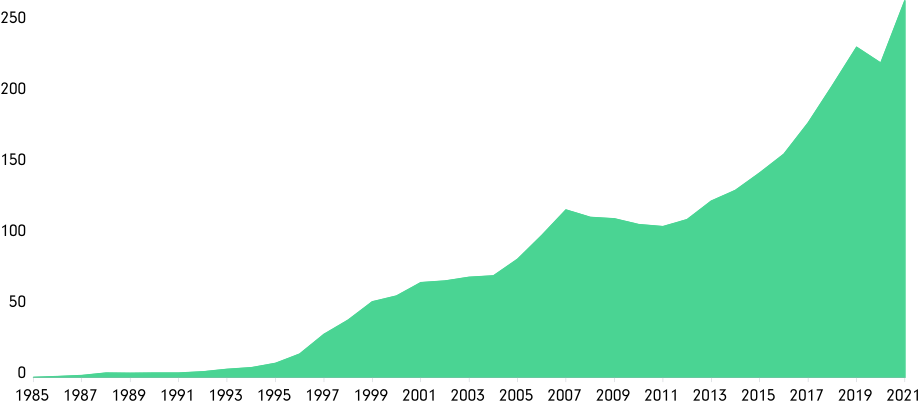
Despite its vague definition, the ABS market’s “other” category has emerged as one of the most dynamic and rapidly expanding segments. Over the past decade, this category has seen remarkable growth, expanding by an impressive 150%. It encompasses a range of innovative and unconventional securitizations, reflecting the market’s evolving creativity. These include novel deals backed by revenue from IP addresses and more esoteric collateral such as fine art, wine, spirits, and high-end jewelry. This growth underscores the increasing sophistication and adaptability of the ABS market in creating new investment opportunities.
Exhibit 5 — ABS “Other” Market Growth ($B)
Source: SIFMA.
Next, we’ll explore some newer areas in the ABS market and the opportunities this ever-evolving sector presents.
Cell Phone Contracts
To offset the rising cost of cell phones and extend client retention with multi-year contracts, phone carriers have moved away from subsidizing the cost of cell phones, instead charging consumers the full market price for devices. By amortizing the cost of the cell phones throughout the contract (24-36 months), carriers create a monthly receivable due from customers.
Verizon was the first company to leverage receivables from cell phone payments to access a cheaper source of debt financing. It has issued 36 deals since 2016, totaling more than $34 billion. There are a variety of benefits to the carrier issuing bonds securitized by payment plans: liquidation of longer-term cash flows, reduction of the overall cost of debt in primary markets, stronger credit ratings awarded to the securitization over unsecured corporate debt, and freeing up capital to reinvest in infrastructure and the acquisition of additional services.
These securities have performed well since their introduction to the market in 2016, and continued growth is expected, providing investors with a source of diversification within the ABS market.
Consumer Lending
Since the global financial crisis, marketplace lending and brick-and-mortar lending have emerged as alternative forms of financing to unsecured loans from traditional financial institutions, growing into a $43 billion area of the ABS market as of December 2021.
The marketplace lending business began with a British firm, Zopa, in 2005. Born from an idea that combined the financing aspects of the bond market with the innovation of the largest marketplace in the world, eBay, Zopa created an online marketplace for consumer loans. Essentially, the firm utilized technological advances to bring together borrowers and investors. In doing so, two needs were met: borrowers found a way to finance their debt quickly without the red tape of bank approvals and forms. At the same time, investors could generate attractive returns while diversifying risk amongst various borrowers. The success Zopa experienced in building a book of loans led to the launch of counterparts in the U.S., such as Lending Club and Prosper, in 2006. Thus, the peer-to-peer lending industry in the United States was born.
As the financial crisis spread throughout the economy, individuals turned to peer-to-peer lending companies for borrowing needs as banks put a hard ceiling on the size of their loan portfolios. However, this growth was a double-edged sword. Due to the Financial Crisis, borrower default levels increased, which raised investor concerns and led to higher interest rates for borrowers to compensate investors for the additional risk.
As the peer-to-peer industry grew, it evolved from simple loans between borrowers and investors. Institutional investors (hedge funds, insurance companies, etc.) began to fund loans for various entities that had emerged from the ashes of the financial crisis to originate consumer and small business loans. These firms were filling a void created by the departure of large financial firms focused on shoring up balance sheets.
As the business model evolved, so did the nature of the companies participating in this industry. Previously, marketplace lenders brought together individual borrowers and investors and served as facilitators (for a fee). Post-crisis, new entrants in the market (SoFi, Earnest, Avant) functioned more as traditional lenders and utilized funds raised through forward purchasing agreements with institutional investors.
Brick-and-mortar lending serves consumers by providing physical locations to apply for and make payments on loans. This service appeals to customers who value face-to-face interaction when conducting business and seek guidance through complex financial transactions.
Servicing Advances
Mortgage lenders can sell mortgage servicing rights to specialized firms to reduce leverage, operational risk, and cost. Mortgage servicing firms are paid a portion of mortgage payments to handle the logistics of servicing mortgage loans. They can also help reduce delinquency levels by working directly with borrowers in times of stress. Mortgage servicing firms’ responsibilities include but are not limited to acceptance and recording of mortgage payments, calculating variable rates on adjustable mortgages, payment of taxes and insurance, workouts and modifications, and supervising foreclosures.
A component of mortgage servicing rights is servicing advances, which are reimbursable cash payments made by the servicer if a borrower fails to make a scheduled payment or to support the value of the collateral property. These payments are not meant to serve as credit enhancement but to provide liquidity to the underlying securitization. Servicer advances are traditionally repaid from receipts associated with mortgage loans and represent a separation of a component of the mortgage servicing rights, securitized as a stand-alone credit.
Property Assessed Clean Energy (PACE)
PACE began in one of the most environmentally conscious communities in the United States: Berkeley, California. In November 2007, the Berkeley City Council took an innovative approach to assist residents interested in joining the green energy movement. Berkeley First was a new program to facilitate solar energy system installation by establishing a voluntary, long-term assessment of an individual’s property tax bill.
Berkeley established the Sustainable Energy Financing District to fund the installation of solar electric systems and repay the financing through property tax bills over 20 years. As the innovator in this new field, the program delivered four distinct advantages to homeowners trying to reduce their reliance on fossil fuels:
- Little upfront cost to the property owner.
- Capital costs would be repaid through a voluntary tax on the property, avoiding any impact on the property owner’s credit.
- The cost of the system would be comparable to financing through a home equity line of credit or second mortgage as the home secures the bond.
- Obligation for the loan transfers with the property.
Though PACE programs, both residential and commercial, have grown substantially over the last decade, the securitization of these loans is still in the early stages. Unlike most other ABS deals, the collateral associated with a PACE transaction is not a loan or lease but a voluntary tax lien agreed upon by the residential or commercial property holder to finance energy-efficient improvements. The first commercial securitization for PACE was completed in September 2017 by Greenworks Lending. This was a private deal arranged by investment management firms and, while not publicly available, illustrated the feasibility and appetite for such deals.
Residential PACE’s first securitization, HERO 2014, was completed by Renovate America on behalf of the Western Riverside Council of Governments (WRCOG). The WRCOG had to complete this securitization through state and federal legal channels due to reservations and objections from the Federal Housing Administration (FHA). Due to this legal wrangling between the FHA and the PACE industry, less than 40% of the mortgages linked to the residential properties in the deal were financed by government-sponsored enterprises. This initial $104 million deal was rated AA by Kroll and delivered a coupon of 4.75% with significant excess spread, overcollateralization, and a liquidity reserve of 3.0%. Participation in the deal was described as “big and chunky,” as the transaction was not broadly distributed but more focused on specific investors. This initial foray into securitization was followed by the second PACE securitization seven months later, issued on behalf of the WRCOG and the San Bernardino Associated Governments.
PACE securitization volume reached almost $1.0 billion in 2023, according to Morningstar DBRS estimates. Not surprisingly, with overall fixed income bond issuance down for 2023, PACE similarly saw a reduction last year, down sharply from the $1.5 billion in issuance in 2022. However, the robust pipeline of PACE assessment originations bodes well for future ABS, with more pools being available to potentially securitize. Meanwhile, Residential-PACE ABS volume totaled $0.4 billion in 2023, up from $0.3 billion in 2022.
Solar
Growth in the alternative energy market has resulted in significant migration to solar panel utilization. Before the introduction of securitization, the solar sector had depended upon investment tax credits and other subsidies to finance projects. Much like the other sectors discussed in this paper, the securitization of solar panel financing has made this sector more accessible to investors.
Regulatory limitations prevent master limited partnerships and real estate investment trusts from participating in the market, making securitization the most effective and efficient method of exposure to this sector. Since its introduction in 2013, the solar securitization market has grown exponentially, finishing 2021 with over $3.5 billion outstanding.
Even as the market grows, the basis of the securitization has changed. Initially, securitizations were dominated by purchasing power agreement leases but have shifted to solar loans. A purchasing power agreement is a contract where an individual or business permits solar panels to be installed on their property and agrees to purchase the power at a preset rate over a contracted period. The securitization process in this market is still in its infancy, and obstacles ahead may hinder the pace of growth.
As we advance, the most critical challenges to overcome are the lack of a steady market and the necessity of expansion beyond residential solar securitization. But, as the world turns more to renewable energy and investors focus on green investing, the potential for solar securitization continues to grow.
Emerging ABS Markets
As investors look for additional diversification and investment opportunities, the ABS market continues to evolve beyond the previously mentioned categories. Securitization deals ranging from diamonds to agricultural crops to venture capital have emerged over the past few years, and investors can expect even more innovative offerings in the future.
Opportunity for Diligent Managers
At Diamond Hill, we aim to exploit some of the pricing inefficiencies in the ABS market through our bottom-up analysis and our deep understanding of deal structures and the companies bringing them to market. Regularly meeting with firms that issue these deals provides insights into the issuing firm’s history, philosophy, background, and financial stability. We combine the qualitative aspects of understanding a company with the quantitative methodology of breaking down deals to their basic components to truly understand how they are structured and where risks may reside.
As of 31 August 2024, Diamond Hill owned shares of Verizon Communications Inc.
As of 30 June 2024, Diamond Hill owned debt in Verizon Communications Inc. and Avant Loans Funding Trust.
The views expressed are those of Diamond Hill as of September 2024 and are subject to change without notice. These opinions are not intended to be a forecast of future events, a guarantee of future results or investment advice. Investing involves risk, including the possible loss of principal. Past performance is not a guarantee of future results.
/sitefiles/live/documents/insights/Blog/A-154/2409_Evolution-of-the-Asset-Backed-Securities-Market.pdf