The Income of Fixed Income
Though recent events have brought additional uncertainty to capital markets, we continue to believe that the higher yield derived from investment grade fixed income is in its best position in years to mitigate continued interest rate volatility going forward. Assuming we are closer to the end of the Federal Reserve’s rate hiking cycle than the beginning, then the fixed income asset class should be well positioned to return to its place within an overall asset allocation as the ballast that provides an offset to the historic volatility of the overall markets.
The difference between now and the past several years is that fixed income today offers a cushion in the form of carry and yield since we’ve had this reset higher in rates across the curve. As Federal Reserve Chairman Jerome Powell has mentioned, it’s going to be a bumpy ride. No doubt — as employment, potential geopolitical issues, ongoing angst surrounding the banking industry and inflation numbers in the coming months are likely to create bouts of volatility. As bottom-up investors, we continue to be vigilant and on the lookout for interesting opportunities that the inevitable volatility might bring.
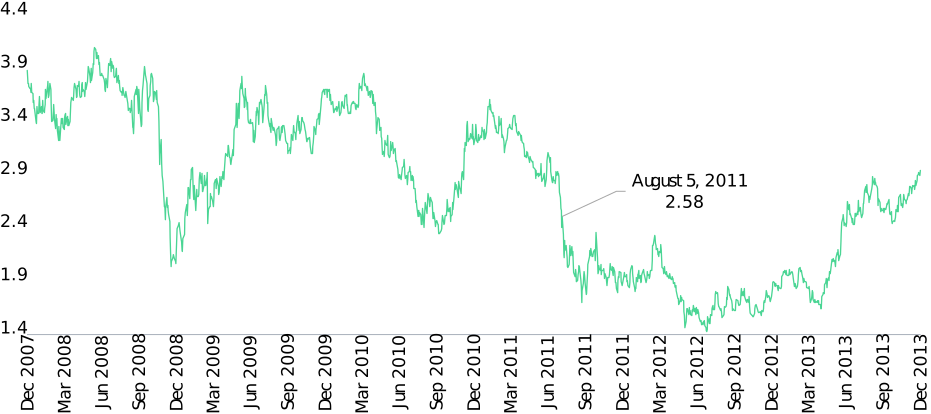
One potential bump that we may face in the future is the approaching ex-date for the debt ceiling and how close the US could get to defaulting. I don’t personally believe that we’re going to get to that point, but we must recognize that we’re living through a period in history where the vitriol and the combativeness between our two political parties has never been more egregious. If you look back to the summer of 2011, when the US was last in this position of running up against that ex-date, Treasuries rallied (Exhibit 1) leading up to and after Standard & Poor’s downgraded the credit rating of the US and the eventual extension of the debt ceiling. Rather than sparking a selloff in Treasuries — which one would expect given the potential for a default by the US government — investors piled into the perceived safety of the asset class.
Exhibit 1 — 10Y Treasury Yield (%)
Source: FRED.
But if history repeats itself, it’s anyone’s guess as to how the markets will react. As we consider the state of the fixed income markets today, it’s encouraging to know that the income of fixed income is back — after having been virtually absent for nearly a decade and a half. While we’re not sure what to expect, especially given the recent events that unfolded in the banking industry, we’re going to continue to look security by security, avoid any kind of interest rate predictions and take advantage when we see volatility rear its ugly head in the markets.
The views expressed are those of the author as of March 2023 and are subject to change without notice. These opinions are not intended to be a forecast of future events, a guarantee of future results or investment advice. Investing involves risk, including the possible loss of principal. Past performance is not a guarantee of future results.
/sitefiles/live/documents/insights/Blog/A-532/2303_The_Income_of_Fixed_Income.pdf