The State of the CMBS Market
In considering the overall commercial mortgage-backed securities market (CMBS), a lot of the recent headlines have focused on the office space. Some attention has been placed on the retail market, but that’s a story that has played out over the last decade with the pandemic simply accelerating the changing landscape of online shopping.
Office, on the other hand, is in focus now because it was considered one of the best asset classes in commercial real estate prior to the pandemic. Now with the work-from-home (WFH) movement, coupled with companies reducing their office space requirements, the perspectives on this area of the market are changing.
Another factor that hasn’t been talked about much in the commercial real estate space is the fact that a lot of the commercial assets that changed hands post-pandemic in late-2020, 2021 and the early part of 2022, were done at extremely low capitalization rates (cap rates) in what was essentially a zero-interest rate environment. The cap rate is the main metric of commercial real estate investing. It is used to describe investment properties and to determine their market value. In theory, cap rates are a simple concept (net interest income / purchase price) but in real-world application, there are many nuances associated with them. Low cap rates established during the period of zero interest rate policy or ZIRP may cause some serious issues down the road when it comes to refinancing.
If we look at the refinancing landscape in the CMBS world right now, the volume of loans maturing in the next three years is substantial. Some of that volume is made up of older assets — post global financial crisis — from a wave of issuance in 2012-2014. Many of those 10-year fixed rate loans are coming up for refinancing over the next 12-18 months. This could result in a perfect storm of the need to refinance tied to much higher rates than at origination, and some investors are going to start realizing some equity losses.
Right now, we believe that if you own a good property that’s fully leased and doing well, the issue is not on the bondholder’s side, but potentially an issue for the equity holder when your cap rate changes during refinancing. Those equity holders are probably not going to be able to take as much equity out as they’d like to or expected to a few years ago. That’s what we view as the real headwind in the office segment, so investors should expect to continue to see some negative headlines around the CMBS space.
We started trimming back our CMBS exposure in 2022, and with the market dislocations last year we took the opportunity to trade out of securities that we didn’t have as much conviction in and reallocate that capital into higher-conviction ideas. In effect, we not only reduced our exposure but, in our minds, we were able to upgrade the quality of issues that we own. Additionally, we exited most of our office exposure and swapped those assets into multi-family and other asset classes that we had more confidence in over the medium term.
That said, our broad view around commercial real estate and CMBS is that it’s a great time for investors who are willing to do the credit work and identify the solid long-term opportunities. Even the best of the best CMBS trade at wide levels right now, even in the AAA space. There are a lot of opportunities out there but also a lot of landmines. We believe investors need to be extremely cautious and not just buy something that’s cheap — you have to do the fundamental credit work. And we think that’s probably going to be the case for the next few years.
Understanding the Market
A (Very) Brief History
Successfully investing in the CMBS market requires a deep understanding of the history and nuances of this particular market. Over the past couple of decades, the world economy has experienced myriad crises: Long Term Capital Management, European debt crisis, 9/11 terrorist attacks, global financial crisis, Brexit, COVID and the Russian invasion of Ukraine. But one must go back to the 1980s and the Savings and Loan (S&L) Crisis to discover the beginnings of the CMBS market.
In response to the S&L Crisis — during which roughly one third of S&L institutions failed — the passage of the Financial Institutions Reform, Recovery and Enforcement Act created the Resolution Trust Corporation (RTC). The RTC was a temporary US government-owned asset management company that was tasked with liquidating real estate-related assets of the failed S&L firms. The RTC was able to sell the distressed properties by holding onto a sizable portion of the deals and selling off tranches to outside investors.
Due to the structures of the deals, investors would only face losses if defaults exceeded the portion that RTC had retained. This early form of credit enhancement helped establish a market for the securities as they carried significant protection for investors (RTC was the first and biggest line of defense), and the success of the program exposed an opportunity for banks to launch a new investment vehicle — private label or non-agency CMBS.
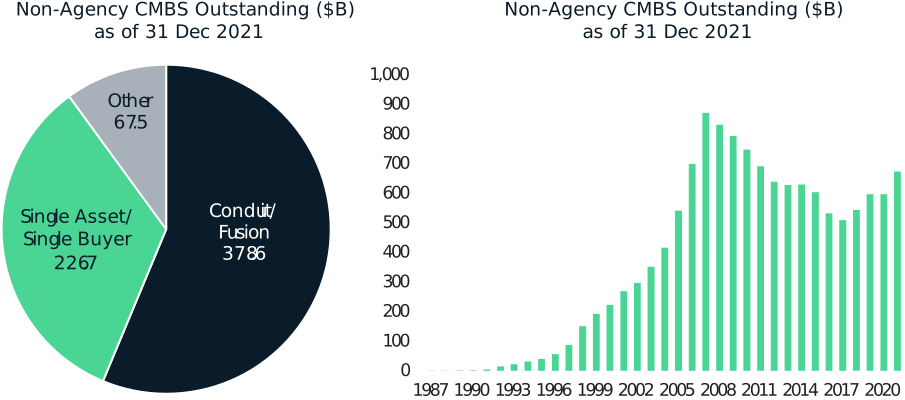
The market has evolved significantly beyond its beginnings to encompass various structures: Single Asset Single Borrower (SASB), Commercial Real Estate Collateralized Loan Obligations (CRE CLO), and Conduits and underlying collateral (hospitality, industrial, mixed use, multi-family, office, retail, etc.).
Exhibit 1 — The Non-Agency CMBS Market
Source: Securities Industry and Financial Markets Association (SIFMA).
Basic Structure
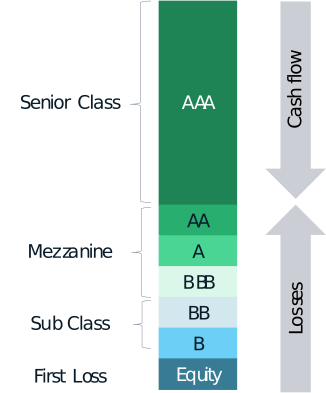
Each deal carries its own variations, but the basic structure is illustrated in Exhibit 2. The key takeaway is that investors can decide how much risk they want to take within each deal and can invest accordingly. The lower the tranche, the closer to the first loss position and therefore, investors must be incentivized to take on that additional risk via a higher spread.
Exhibit 2 — Sample Structure
For illustrative purposes only.
Deal Types
Conduit
Conduit securities are collateralized by many loans that can encompass a variety of property types from varying geographic regions. Typically, the top 10 loans account for a significant portion of the entire collateral. The interest rate on these deals is fixed and cash flow distribution follows a waterfall structure (principal and interest flow down sequentially while losses are allocated from the bottom up). Most of the underlying loans have 10-year maturities, but 5-year maturities have been issued more recently.
Single Asset Single Borrower (SASB)
As the name implies, these non-agency CMBS deals are composed of either a single asset serving as collateral (e.g., high-end hotel property in Hawaii) or a single borrower (e.g., chain of mid-level hotel locations under one company). While conduit deals have a fixed interest rate, SASB can be either fixed or floating depending on the deal structure.
CRE CLO
These deals are collateralized with bridge loans that are secured by transitional properties going through repositioning or redevelopment to generate additional revenue (e.g., apartment building going through renovations that upon completion can charge higher rent). The collateral can include but is not limited to multifamily, office, retail, lodging and industrial. These deals traditionally contain 10 or more commercial real estate loans that are generally floating rate. Unlike conduits and SASB, which follow a more standard procedure, CRE CLOs can be customized and are therefore more complex.
Collateral Types
Hospitality
Hotels, motels and resort properties, ranging from high-end trophy properties to boutique hotels to budget hotels/motels. Examples include Sandpiper Bay Resort, Port St. Lucie, FL, and Embassy Suites by Hilton in Dallas Market Center.
Industrial
A wide-ranging sector that includes warehouse/distribution centers (e.g., Amazon), refrigeration and cold storage centers, flexible buildings designed for both office and industrial space, heavy manufacturing buildings (e.g., high-capacity ventilation systems), light manufacturing buildings and data/communication centers e.g., (major telecom providers, specialized floors, near communication lines).
Mixed Use
Properties that combine working, shopping and living in an efficient, well-designed space and vary in size and scope (e.g., large apartment buildings with retail stores underneath).
Multi-Family
Apartment buildings, senior living facilities and student housing. Locations are broken down by age/quality from A properties (built in the last 2 years) to C properties (30-year property in need of rehabilitation).
Retail
Collateral in these deals cover the whole swath of retail from strip malls to anchored shopping centers to regional/super-regional malls.
Retail space has been the problem child both pre- and post-COVID as the consumer landscape has shifted from in-person shopping to online purchases with the rise of Amazon and other retailers that have made the push into online retail.
Office
Collateral ranges from high-rise office buildings to large medical offices to shopping malls. According to the US Energy Information Administration, there are more than 5.6 million commercial buildings in the US, with an estimated 87 billion square feet of floor space.
Opportunities for Active Managers — Exploiting Benchmark Inefficiencies
In our view, most income benchmarks are inefficiently built. The non-agency CMBS market is no different.
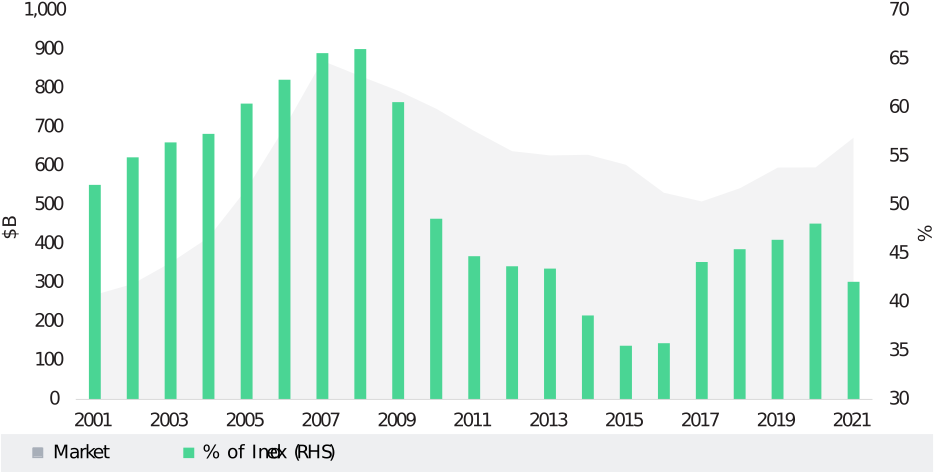
Methodology inclusion rules (for the Bloomberg US Aggregate Bond Index and the Bloomberg US CMBS Investment Grade Index) state that the only non-agency CMBS eligible for inclusion are conduit and fusion deals. SASB and floating-rate issues (CRE CLO) are excluded from the indexes. Additionally, the index-eligible component of the CMBS sector is significantly lower than its 2008 peak and continues to decrease (Exhibit 3) even though the market has grown over the past 20 years.
Exhibit 3 — CMBS Benchmark Exposure Over Time
Source: SIFMA, Bloomberg.
These factors present opportunities for asset managers who focus on bottom-up security selection. Investment in the right non-agency CMBS securities can provide differentiation from the market and the potential for attractive relative returns to traditional fixed income benchmarks over the long term. That said, we believe it’s critical to maintain a selective approach and invest the time and effort to truly understand the risk/reward profile of each investment.
/sitefiles/live/documents/insights/FixedIncomePersp/A-552/2305_Fixed_Income_Monthly_Commentary.pdf