Locked In: Consequences of Record Fed Tightening on Homeownership and Housing Supply
In recent months, our commentaries have focused on the consumer and the commercial mortgage-backed securities market. This month, we discuss a topic that has been in the news — the residential mortgage market. The most obvious and glaring aspect of the US housing market is the impact that the Fed’s most aggressive tightening campaign ever has had on the cost of housing. But that is not the only component to be considered, though the root of the issue does reside with interest rates.
Impact of Federal Reserve Tightening Cycle on Demand
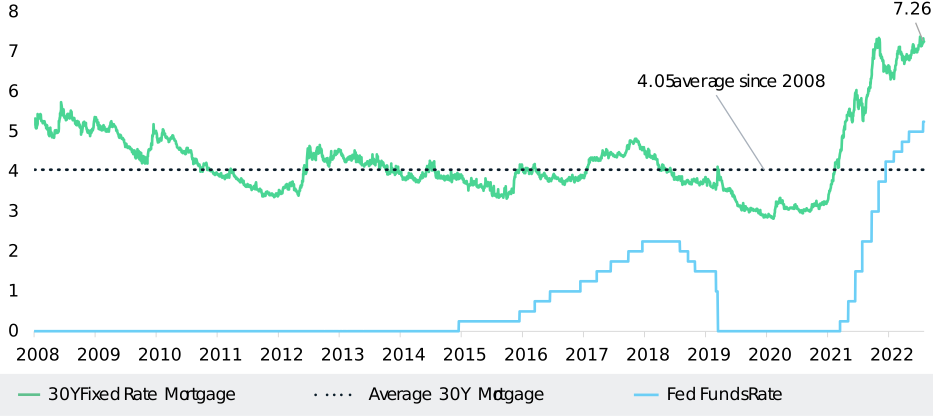
Since March 2022, the Federal Reserve has increased the fed funds rate by a staggering 5.25%, using the lower bound of its interest rate target. The correlating increase in the 30-year fixed rate mortgage has pushed many a potential homeowner out of the market. From 2008 to just before the lift-off in rates by the Fed, the average 30-year mortgage rate was 4.05%. The most recent reading at the end of July was 7.26%. Let’s look at an example to see the impact of the increase in mortgage rates on a traditional home loan.
According to Redfin, the median sales price for a home in the US in June 2023 was $425,000, so we’ll use that number for our example. A standard 30-year fixed rate mortgage at 4.05% for the $425,000 home would equate to a monthly payment of roughly $2,044 or $24,528 per year, excluding taxes and insurance, with zero downpayment. The same home at today’s current mortgage rate of 7.26% would have a monthly payment of $2,906 or $34,872 per year, which is a 42% increase in the cost of the same home just prior to the Fed’s tightening cycle. Without even considering the impact of supply and demand, home ownership has been pushed beyond many consumers’ reach and created a scenario where current homeowners are reluctant to sell and lose their current low mortgage rate.
Exhibit 1 — Bankrate.com 30Y Mortgage Rate and Fed Funds Rate (%)
Source: Bankrate.com, Bloomberg.
Golden Handcuffs and the Lack of Supply
Having a functioning housing market is hard when no one wants to sell. The dramatic increase in interest rates over the past 18 months has created what some have called the “golden handcuff” scenario. Homeowners that were able to lock in historically low rates or anything close to it are resistant to selling, which would force them to finance a new purchase at decades-high interest rates.
Before 2022, homeowners who were looking to upsize, downsize or relocate could stomach higher home prices because they were still getting incredibly attractive financing. But the weight of higher interest rates has cooled off any interest in taking advantage of higher home prices because the financing cost of a new home, even if smaller or cheaper, is most likely higher than your current mortgage payment.
Consider the previous example. Say a homeowner were to sell their current home for $425,000, with a monthly payment of $2,044 per month, using 4.05% as the mortgage rate. To maintain a similar monthly payment at the new mortgage rate of 7.26%, the same homeowner could only afford a $300,000 home. So, even if homeowners are looking to make a change, it’s a hard pill to swallow, and many have decided to maintain their current homes rather than accept higher financing charges. [This example excludes any benefit of built-up equity in the existing home and any potential downpayment, but it illustrates the impact of the golden handcuff scenario].
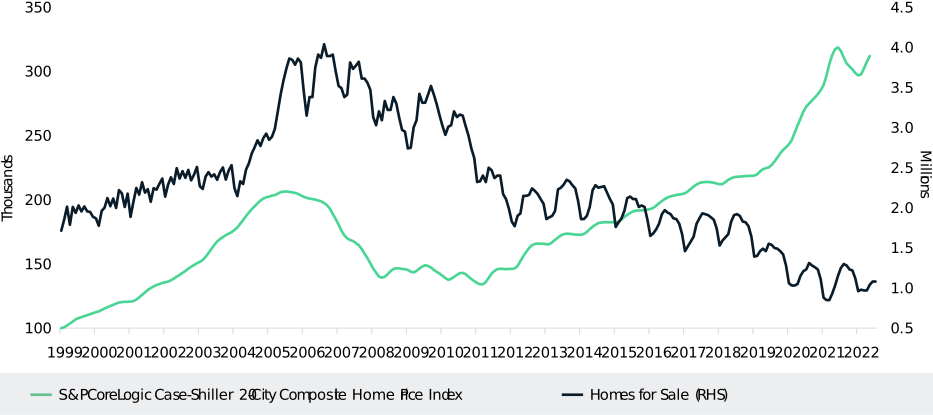
And there doesn’t seem to be much chance of change with this dynamic in the foreseeable future. Home prices jumped when money was historically cheap in mid-2020. Inventory is dwindling, so prices will remain high because no one can afford to move. People are held captive in an asset that has seen a severe rise in value over the last three years. But they aren’t making more money, and the economy hasn’t improved much.
Exhibit 2 — Home Price and Availability
Source: National Association of Realtors.
Impact on the Mortgage Market
The mortgage market is somewhat stuck as home prices continue to appreciate due to a lack of available supply and higher financing costs, resulting in a slightly stagnant market. But what does this mean for investment managers and clients?
In the agency residential mortgage-backed securities (RMBS) market, today’s opportunity is one of the best since the great financial crisis. The Fed’s ongoing efforts to reduce its balance sheet and the continued liquidation of the Silicon Valley Bank and Signature Bank RMBS portfolios by the FDIC has resulted in long-awaited spread widening for a sector that had been compressed for several years. This shift in the RMBS market has provided a solid entry point for investors that have been lighter on RMBS allocations over the past several years due to the Fed’s zero interest rate policy (ZIRP) and the growing of the Fed balance sheet through RMBS purchases during Quantitative Easing.
Agency passthrough mortgages with historically low coupons, thanks to ZIRP, are trading at significant discounts with the expectation of minimal prepayments due to the interest rate dynamics in the current market. There is a natural level of prepayment — somewhat immune to interest rate fluctuations — in the form of significant life events such as death, divorce, relocation or unavoidable downsizing or upsizing that must be taken into consideration. But a large swath of the mortgage market is being priced at a significant discount with the broad assumption that prepayments will be minimal to non-existent, which presents an opportunity for managers focused on individual security selection.
Consider a passthrough mortgage security originated in 2021 with a 2.5% coupon trading in the low $80s (par of $100). Purchasing that pool will provide an attractive pull to par ($80 to $100 at maturity) and steady income with the potential for additional income through prepayments — a reduced level from previous years but potentially higher than current expectations.
Even though the housing market will be in flux for the foreseeable future due to these dynamics, there are opportunities for managers willing to dig into the details to add to an area of the market where value has been harder to find over the past several years.
Beyond Rates: Mortgage Market Updates
Quantitative Tightening — Not Going to Plan
The originally announced plan was to have roughly $17.5 billion per month for the first three months and $35 billion per month moving forward roll off the balance sheet and not be reinvested into the mortgage market, thus reducing the overall allocation at a measured pace. The original plan would have equated to a reduction of $437.5 billion in the balance sheet.
The System Open Market Account (SOMA) MBS (mortgage-back securities) balance has only declined by $189.8 billion, roughly 57% behind the preordained plan. A quick review of the underlying mortgages in the SOMA holdings explains why.
Exhibit 3 — SOMA Holdings
| Coupon Range |
Balance |
% of Total |
| 1.5 – 2.5
|
$1.1 trillion |
45.3 |
| 2.5 – 3.5
|
$989 billion |
39.5 |
| 3.5 – 4.5
|
$314 billion |
12.5 |
| 4.5 – 5.5
|
$66 billion |
2.6 |
| 5.5 – 6.5
|
$2.2 billion |
0.1 |
Source: Federal Reserve.
Outside of significant life events such as divorce, death, relocation, etc., there is no incentive for homeowners with historically low mortgage rates to refinance. Even homeowners looking to step into the next level of housing (upsize) or reduce their footprint to reflect adult children moving out (downsizing) are reluctant to do so, given the disparity in their historical cost of funds compared to current levels. The Fed’s most aggressive rate hiking cycle has resulted in the extension of mortgage timelines as homeowners are content to pay their historically low mortgage rate, meaning the investors in these mortgages will have to wait much longer to get paid back. And thus, the impact of the Fed’s Quantitative Tightening program, payments slowing down, means that mortgages will languish on their balance sheet for much longer than anticipated.
FDIC liquidation of Silicon Valley Bank and Signature Bank MBS portfolios
Estimates vary but it is believed that roughly 80% of the liquidation of passthrough MBS and 56% of CMO (collateralized mortgage obligation) securities has been completed. Original expectations were to liquidate the securities in an orderly manner; roughly $1.5 – 2.0 billion per week which would equate to more than a year to complete the liquidation (~$114 billion in securities). Stronger than expected interest and better execution has led to a much faster timeline, with an increase in both the frequency of selling and targeted dollar amounts as well.
Fitch’s Downgrade of US Treasury Debt
Yes, it was a bit of a shock when the news broke on August 1, but not nearly as much as when S&P initiated the first-ever downgrade back in August 2011. That instance was filled with uncertainty around how the global markets would react and whether it was the first step in a painful downward spiral for fixed income markets. Having learned from the previous event more than 10 years prior, the markets took the Fitch action in stride with some immediate moves in the Treasury market. Recall that in August 2011, fixed income markets rallied on the downgrade and finished the year strong (Exhibit 4).
Exhibit 4 — Index Total Returns (%)
|
August 2011 |
September – December 2011 |
Full Year 2011 |
| Bloomberg US Aggregate Bond Index
|
1.46 |
1.86 |
7.84 |
| Bloomberg US Treasury Index
|
2.78 |
2.65 |
9.81 |
| Bloomberg US Corporate Index
|
0.07 |
2.19 |
8.15 |
| Bloomberg US Securitized Index
|
1.06 |
1.17 |
6.22 |
Source: Bloomberg.
As we know, past performance is not indicative of future returns, but it does provide some context for potential market reactions. Though there were some initial bouts of volatility (possibly fueled by the thinner markets tied to traders’ August vacations as well as a stronger than expected ADP jobs report), the overall market belief is that Fitch’s actions aren’t the main driver of recent yield movement in the Treasury market.
Bigger concerns for the Treasury market are an ever-resilient labor market (meaning potential additional rate hikes) and the news that the Treasury has increased auction sizes for the foreseeable future. The bottom line is that while Fitch’s actions help draw attention to the real budgetary issues facing Washington, it’s not necessarily telling us something we didn’t already know.
Bloomberg US Aggregate Bond Index measures the performance of investment grade, fixed-rate taxable bond market and includes government and corporate bonds, agency mortgage-backed, asset-backed and commercial mortgage-backed securities (agency and non-agency). Bloomberg Treasury Bond Index measures US dollar-denominated, fixed-rate, nominal debt issued by the US Treasury. Bloomberg US Corporate Index measures the performance of the US investment grade fixed-rate taxable corporate bond market. Bloomberg US Securitized Index measures the performance of the securitized sector of the Bloomberg US Aggregate Bond Index. The indexes are unmanaged, include net reinvested dividends, do not reflect fees or expenses (which would lower the return) and are not available for direct investment. Index data source: Bloomberg Index Services Limited. See diamond-hill.com/disclosures for a full copy of the disclaimer.
The views expressed are those of Diamond Hill as of August 2023 and are subject to change without notice. These opinions are not intended to be a forecast of future events, a guarantee of future results or investment advice. Investing involves risk, including the possible loss of principal. Past performance is not a guarantee of future results.
/sitefiles/live/documents/insights/Blog/A-587/2308_Fixed Income Monthly Commentary.pdf