Home Equity Securitization In Today's Rate Environment
In mid-September, the Federal Reserve launched its most recent easing cycle with a somewhat surprising 50 basis points (bps) reduction, the first time in a long time that a non-emergency easing cycle has begun with 50 bps.
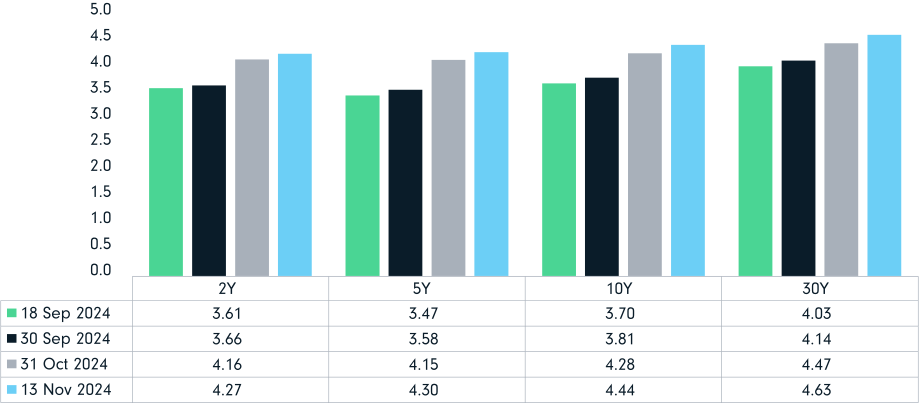
Immediate expectations for a shift lower across the curve were quickly squashed as the longer end of the curve stubbornly pushed higher. Since the September 18 meeting, the yield on the 2-year Treasury climbed from 3.61% to 4.27%, while the 10-year Treasury has moved higher by 74 bps as of November 13.
What is the reason for the seemingly counterintuitive move in the curve? There are a variety of explanations for the shift, ranging from the bond market viewing the move as a makeup for markets pricing in too much easing before the Fed meeting to the idea that the Fed is willing to tolerate higher inflation, as well as concerns around the US fiscal situation and the impact of the growing deficit burden.
Stronger-than-expected economic data has also helped push rates higher, such as non-farm payrolls (NFP) adding 254,000 jobs in September (compared to market expectations of 150,000 jobs) and the slight reduction in unemployment from 4.2% to 4.1%. Some of this move was offset by a relatively disappointing NFP report for October (12,000 jobs added compared to expectations of 100,000 jobs) but that month’s report came with a considerable amount of noise in the form of two devastating hurricanes and a strike at a major employer. It remains to be seen what kind of “catch-up” we could see in subsequent labor market developments, if any.
Exhibit 1 — Treasury Yields (%)
Source: FRED.
Whether it was the decisiveness of the US presidential election or the impact of the Trump trade, yields continued to push higher following the one-day rally after a weaker-than-expected NFP report in October. Even an additional 25 basis point rate reduction by the Fed on November 7 couldn’t halt the continued rise in yields across the curve — post-meeting, the 2-year Treasury climbed 6 bps, the 10-year 13 bps and the 30-year 11 bps through November 13.
Inflation remains stubborn, steadfastly refusing to move into the Federal Reserve’s desired target range of 2.0% as the US Consumer Price Index: All Items Less Food and Energy held the line at 3.3% year-over-year in September and October.
What does this mean for the consumer in the short and long term? There are many aspects to examine, but for this commentary, we’re going to focus on homeowners and, particularly, those homeowners sitting on a substantial build-up in equity over the past several years.
Many have become shackled by the golden handcuff theory that centers around the idea that their mortgage rate is so low relative to current levels that they can’t bring themselves to take advantage of the equity build-up and sell. The idea of having to upsize (or downsize) at such a significantly higher rate keeps them in their homes.
According to CoreLogic, homeowners with mortgages have seen their equity increase by a total of $1.3 trillion since Q2 2023, a gain of roughly 8% on a year-over-year basis. In Q2 2024, the average US homeowner gained approximately $25,000 in equity from the same time last year, with significant dispersion on a state-by-state basis.
How can homeowners access their equity if they are unwilling to refinance their mortgage at a higher rate or sell? There are various ways to gain access to equity that has built up over time, and we’ll explore some of these methods.
Home Equity Line of Credit
The Home Equity Line of Credit or HELOC is the tried-and-true approach to unlocking the equity in one’s home if they are unwilling to submit to a cash-out refinance, especially in the current rate environment. A HELOC is a line of credit that allows a homeowner to borrow, spend and repay their allotted equity amount as they go.
Borrowers can typically get access to a certain amount of the appraised value of their home minus the amount currently owed on the mortgage. This financial instrument allows homeowners to vary how much they owe at any one time based solely on the amount of equity they access. This line of credit can be used repeatedly, allowing a homeowner to borrow and repay parts of or the entire allotted amount over the life of the line. These lines of credit typically have a draw period wherein one may continually utilize the line of credit before entering into a repayment period. During the repayment period, the line essentially becomes a loan — homeowners can no longer access the line and enter into a repayment schedule to pay off the remaining balance within a set period, typically 10 to 15 years.
Second Mortgage or Home Equity Loan
Unlike a HELOC, a home equity loan is typically a lump sum loan, set at a fixed rate with equal payments due until the entire loan is paid off. Whereas with a line of credit, a homeowner has ongoing access to the entire sum, a second mortgage or home equity loan provides homeowners with one substantial amount and anything needed above and beyond the initial loan would need to be acquired through an additional loan.
Reverse Mortgages
With both HELOCs and second mortgages, borrowers face additional monthly costs, which must be considered when they consider the best way to access the equity in their homes.
In contrast, reverse mortgages are available to borrowers at least 62 years of age. The loan allows homeowners to access a portion of their home equity without the additional burden of monthly payments. Borrowers can utilize either a program from Ginnie Mae called Home Equity Conversion Mortgages (HECM) or private reverse mortgages from varying financial institutions.
These loans are designed for “house rich, cash poor” borrowers who live on a set budget and do not want to incur additional monthly costs. Homeowners do not make principal or interest payments during the term of the loan, and repayment of the loan (maturity event) occurs when the home is sold or vacated (i.e., the homeowner is placed in a retirement home), the loan is paid off or upon the death of the borrowers.
Borrowers must maintain the ability to make timely payment of property taxes, insurance and homeowner association fees and must maintain the property. How do lenders make money on these loans without monthly payments? The loan balance is negatively amortized until a maturity event occurs. A basic example of this would be an elderly homeowner who secures a $50,000 reverse mortgage and makes no payments for the life of the loan. When the homeowner passes away, the home is sold, and the lender is repaid the original $50,000 plus accrued interest, taken out of the equity in the home.
Home Equity Investment (HEI)
Unlike reverse mortgages, there is no age restriction regarding the eligibility for utilizing Home Equity Investments (HEI). However, like a reverse mortgage, an HEI provides a homeowner access to the equity built up in their home without making any monthly payment.
The key difference between the two, outside of the age requirement for reverse mortgages, is reliance on interest rates. Reverse mortgages’ interest rate calculation is based on the going market rate, and as rates have climbed, this option becomes less attractive as the associated costs climb.
HEIs are not interest-bearing and offer a potentially more attractive option to homeowners looking to tap the equity in their homes. So, how do HEI businesses earn money on their investments? The lender is granted the right to purchase a percentage interest in the home’s future value, i.e., as home prices appreciate, the lender’s percentage interest will increase at a commensurate level. “The home pays you back, not the homeowner,” is a common saying in the HEI industry.
The risk associated with this structure for the lender is a drop in home value; the original contract is $50,000, but because of a decline in the home’s value, the contract settles at $45,000, resulting in a loss of $5,000 for the lender. One issuer quantified that since starting 2015, only 36 contracts out of 2,773 have experienced losses versus the original investment amount. That equates to losses of roughly $553,000 compared to gains of $74 million. Issuing companies in the HEI market have mechanisms in place to protect from losses in severe market downturns, specific to each company. As indicated in the example, the upside is considerable, tied directly to the housing market.
Securitization of Home Equity Products
The securitization market, broadly speaking, has experienced a significant boost in issuance in 2024, with asset-backed securities (ABS) on pace for a record year and both commercial and residential mortgage-backed securities (CMBS and RMBS) recovering significantly from prior years’ drop-offs.
Specific to the non-agency residential mortgage market, issuance has increased more than 100% year-over-year through mid-November 2024, but issuance levels trail 2022 issuance by roughly 25%.
Home equity products, for the most part, fall under the “Other” category in the non-agency RMBS sector, and this sector’s issuance has grown nearly 180% compared to the same period last year and 58% from 2022. The combination of the market’s growth and the rise along the longer end of the curve has made vehicles utilized for accessing equity where cost is not tied directly to interest rates (HEI, in particular) that much more attractive in the current market.
Investors must offset the potential risk of a volatile or decreasing housing market with the upside of these opportunities. As with other securitizations in the marketplace, the structure of these deals is individually unique and offers investors certain protections through credit enhancements.
Timeline of Securitization
Home Equity Loans and Lines of Credit
Before the global financial crisis (GFC), home equity loans and line securitizations were issued regularly. However, when the GFC hit, issuers almost shut down entirely as declining home values decimated the industry.
In recent years, the instruments have made a concerted comeback, fueled by a surging housing market and homeowners chained to their homes by low rates and looking for ways to extract equity from their homes.
Reverse Mortgages
Home Equity Conversion Mortgage (HECM) loan originations began in the early 1990s, peaked in 2009 and have stabilized at roughly 50,000-60,000 loans per year. The securitization process of HECMs started with the first issuance in May 2008. Private reverse mortgages evolved to cover those not qualifying for the HECM program.
Home Equity Investments
The first HEI deals originated in 2007, and there are now roughly a dozen programs across 30 states. The sector has issued five unrated transactions from 2021 to 2023 and four rated transactions in 2023 and 2024.
The views expressed are those of Diamond Hill as of November 2024 and are subject to change without notice. These opinions are not intended to be a forecast of future events, a guarantee of future results or investment advice. Investing involves risk, including the possible loss of principal. Past performance is not a guarantee of future results.
/sitefiles/live/documents/insights/FixedIncomePersp/2024/A-735/2311-fixed-income-monthly-commentary.pdf