The Mortgage Market Mosaic: Understanding Modern Mortgage-Backed Securities
To understand today’s mortgage market, it’s helpful to examine its history and how it has grown into a $12 trillion market, according to SIFMA.
The Federal Housing Authority (FHA) was created in 1934 during the Great Depression as part of the New Deal to assist in the construction, acquisition and rehabilitation of residential properties. The FHA created and insured the fixed-rate mortgage to replace balloon payment mortgages and to help standardize the overall market.
Four years after the FHA was created, the Federal National Mortgage Association (Fannie Mae) was created to provide a liquid secondary market for mortgages so that mortgage originators could sell newly minted mortgages to Fannie Mae and use the proceeds to underwrite additional mortgages, namely FHA-insured mortgages.
In 1968, Fannie Mae was split, creating the current iteration of Fannie Mae, which is tasked with purchasing private mortgages, and the Government National Mortgage Association (Ginnie Mae), which is focused on supporting FHA-insured mortgages, Veterans Administration, and Farmers Home Administration-insured mortgages.
The Federal Home Loan Mortgage Corporation (Freddie Mac) was created in 1980 to expand the secondary mortgage market and create competition for Fannie Mae.
Agency and Non-Agency Mortgage-Backed Securities
Agency Mortgage-Backed Securities
In 1971, Freddie Mac issued its first mortgage pass-through security, a participation certificate. In 1981, Fannie Mae issued its first mortgage pass-through or MBS; in 1983, Freddie Mac issued the first collateralized mortgage obligation or CMO. Agency MBS pass-through mortgages deliver a pro-rata share of the interest and principal payments made monthly by homeowners to the investors who have purchased the security.
Both Freddie Mac and Fannie Mae are considered government-sponsored enterprises (GSEs) but do not carry an explicit guarantee from the US government. On the other hand, Ginnie Mae mortgage-backed securities (MBS) are backed by the US government’s “full faith and credit” guarantee. While there is no explicit guarantee on the mortgage-backed securities issued by Fannie Mae and Freddie Mac, consensus has been that these securities maintain an implied guarantee that would prevent a disastrous default.
Non-Agency Mortgage-Backed Securities
The non-agency mortgage-backed securities market began in the late 1970s as an alternative to the government-backed MBS market. While Salomon Brothers’ initial issuance was considered a failure, it laid the groundwork for what would eventually become the non-agency MBS market.
Limited by various state regulations and Depression-era securities laws, Congress passed the Secondary Mortgage Market Enhancement Act of 1984, which called on National Recognized Statistical Rating Organizations to provide credit opinions on each mortgage pool and charged the SEC with regulating the trading of these securities. This significant change opened the mortgage market to federally chartered financial institutions, including credit unions. Still, these new entities would never have the same level of guarantee, implicit or explicit, enjoyed by the GSEs and Ginnie Mae.
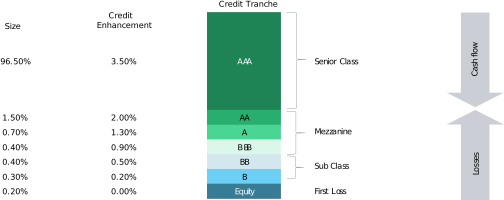
To create bonds that would be considered of equal quality to the GSEs and Ginnie Mae, at least from a rating agency standpoint, non-agency MBS issuers opted to separate pooled mortgages into tranches. Figure 1 illustrates how the implementation of tranches enabled issuers of non-agency mortgage-backed securities to appeal to various investors by delivering different options based on investors’ risk appetite.
For example, the senior class tranche is positioned such that the underlying tranches support and absorb any losses before they reach the senior class. Also, cash flows for the overall pool flow into the senior tranche first, paying it down with interest and principal payments. In contrast, the underlying tranches only receive interest payments once the tranche directly above is paid off in full.
Figure 1 — Tranche Structure
Types of Mortgage-Backed Securities
To Be Announced (TBAs)
In a TBA mortgage transaction, the seller of the mortgage-backed security agrees on a sale price without specifying which individual mortgages will be delivered on the settlement date. Basic characteristics, such as coupon rate and the face value of the bonds to be delivered, are agreed upon but little else.
Combining various pools into a standard format ensures that the TBA market is the most liquid mortgage market. Since these are the most liquid and readily tradable mortgage securities, they serve as the basis for pricing various mortgage-backed securities.
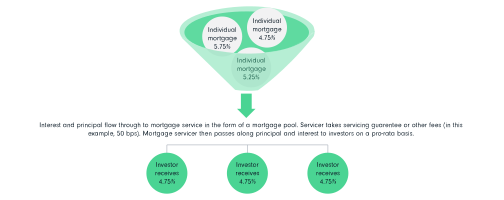
The cash flows in both TBA mortgages and specified pools utilize the pass-through process, where investors receive a prorata share of both principal and interest for the mortgages included in the pool (see Figure 2). This process can expose investors to prepayment or extension risk as rates move lower or higher, respectively.
Specified Pools
Specified pools, unlike TBAs, are securities associated with specific mortgage pools rather than a generic portion of the market. Due to their heterogeneity, these pools are not as liquid as the TBA market. However, they allow for more granular detail on the underlying mortgages and the opportunity to focus on specific attributes of the mortgage loan, such as seasoned mortgages, specific geography, or loans with maximum balances.
Figure 2 — Pass-Through Structure
Collateralized Mortgage Obligations (CMOs)
Collateralized mortgage obligations (CMOs) were introduced to the market in 1983 as an alternative to the pass-through market, attracting investors interested in diverse cash flows from specific mortgage pools. Investment banks played a key role by breaking down these mortgage pools into various cash flows, each tailored to different risk and return profiles. As the cash flows in a mortgage pool were broken into tranches, each tranche had an assumed weighted average life, and tranches were not paid until the bond ahead of it was paid off.
As the market evolved, so did the CMO market, as investment bankers created more types of CMOs to address specific client needs. Figure 3 illustrates the combination of mortgage pools and subsequent breakdown into CMO tranches.
Figure 3 — CMO Structure

Collateralized Planned Amortization Class (PAC) Tranches
PAC bonds were first issued in 1986 and represented some of the most innovative work in the CMO market. Unlike a pass-through mortgage, a PAC bond is designed to have a favorable weighted average life profile if prepayments and extensions remain within a preordained range.
PAC bonds have a specified principal payment schedule and are given priority for principal paydowns over other bonds in the pool, aptly named companion bonds. In a falling interest rate environment, borrowers who refinance to take advantage of the lower rates flood the mortgage deal with additional cash. Companion bonds to a PAC bond will absorb some of these extra cash flows to maintain the stability of the PAC bond’s cash flows.
Conversely, suppose interest rates are climbing, and less money is coming into the pool due to a decline in refinancing. In that case, companion tranches will forgo some of their cash flows to maintain the stability of the PAC bond. Because of this symbiotic relationship between PAC bonds and companion tranches, PAC bonds can prove to be more stable in a volatile interest rate environment, and, as expected, companion bonds have more sensitivity to interest rate fluctuations and are, therefore, more volatile.
Sequential Tranches
Sequential tranches are established in a specific order, with a single tranche receiving all principal payments before all other tranches until it is paid in full. This structure creates a series of bonds with short, intermediate, and long maturities and is designed to meet specific investor needs. Despite the targeted maturities, there is still a degree of uncertainty based on the optionality of the underlying mortgages as rates fluctuate.
Principal Only/Interest Only Tranches
As indicated by their names, principal-only/interest-only tranches of mortgage-backed securities focus solely on the principal and interest cash flows from a pool of mortgages. Due to the unique nature of these cash flows, these securities have significantly different characteristics from other CMOs and mortgage securities.
For an interest-only security, the interest amount received is directly tied to the outstanding principal balance, which depends on the prepayment rate of the underlying mortgages. An increase in prepayments reduces the principal balance faster, leading to smaller interest payments in the future. A decrease in the speed of prepayments reduces the outstanding balance more slowly and results in larger interest payments.
Due to the relationship between the principal and interest balances, the size of the payments from an interest-only bond will move in the same direction as rates. The value of an interest-only bond falls as rates decline and increases as rates rise, thus generating negative duration (a bond’s sensitivity to interest rate movements). Principal-only securities’ sensitivity to interest rate movements is the opposite of interest-only bonds. When interest rates rise and prepayments slow, the bond’s value decreases; when rates fall, prepayments accelerate, and the bond increases in value.
Other Types of CMOs
- Targeted Amortization Class (TAC) — These bonds are similar to PAC bonds, but instead of protecting against prepayment and extension risk, they safeguard against increasing prepayment speeds. Reverse TACs protect against a slowdown in speeds (extension).
- Floaters — A CMO structured so that its coupon resets regularly (usually monthly) and follows a specific index plus a spread, often subject to a cap or floor.
- Inverse Floaters — These are similar to floaters but with a coupon that moves in the opposite direction of a predetermined index.
Convexity
Convexity and duration are both used to assess the risk of fixed-income investments. Duration illustrates a bond’s sensitivity to interest rate movements and assumes a linear relationship between rates and price—when rates rise, duration increases (and vice versa). Convexity, on the other hand, recognizes that the relationship between bond prices and interest rates is typically sloped or convex and measures the change in duration as rates move higher or lower.
Duration provides insight into how a bond behaves from a pricing standpoint due to small moves in interest rates. However, convexity is a better measure for large fluctuations in interest rates.
If a bond’s duration increases as yields increase and the opposite occurs as rates decrease, the bond has negative convexity. An example would be a plain vanilla pass-through mortgage: as rates rise, the bond’s duration extends as prepayments slow down. As rates decrease, the bond’s duration shortens as prepayments increase and borrowers refinance their mortgages.
Extension and Prepayment Risks
All mortgage-backed securities are susceptible to prepayment, extension, and convexity risk. Collateralized mortgage obligations can mitigate some of these risks with cash flow structures that differ significantly from plain vanilla mortgage pass-through securities.
Extension Risk
As interest rates increase, the time over which a MBS investor expects to be paid back lengthens due to a decrease in refinancing. This leaves the investors with lower cash levels to reinvest in a market with higher rates.
Prepayment Risk
As interest rates decrease, the time over which an MBS investor expects to be paid back accelerates as borrowers look to refinance their current mortgage to a lower rate. This results in the investor receiving cash back sooner as borrowers repay their loans in full in an environment of lower rates from when they originally invested.
Managing Mortgage-Backed Securities
Security selection is a key tenet of our investment process for fixed income at Diamond Hill, especially when considering mortgage-backed securities.
A valuation approach often used for bonds with embedded options is decomposing the bond into its parts. For mortgage-backed securities, we conduct a creation-value analysis. During this process, we use various tools, including Bloomberg and Citigroup Yield Book, as well as proprietary valuation methodologies that provide secondary verification of the primary analysis conducted with Yield Book. We believe securities selected after applying this analysis offer better relative returns than similarly structured securities.
Our focus on bottom-up security selection differentiates Diamond Hill’s process from universal benchmarks and other managers in the fixed-income universe. Our approach to investing in mortgage-backed securities has historically led to a significant overweight to CMOs instead of investing in the standard mortgage-backed securities held by the benchmark. A strict capacity discipline enhances our ability to continue exploiting inefficiencies in the mortgage market while larger managers turn to the TBA market for their exposure to mortgages.
Investment Grade is a Bond Quality Rating of AAA, AA, A or BBB.
The views expressed are those of the author as of September 2024 and are subject to change without notice. These opinions are not intended to be a forecast of future events, a guarantee of future results or investment advice. Investing involves risk, including the possible loss of principal. Past performance is not a guarantee of future results.
/sitefiles/live/documents/insights/Blog/A-837/The-Mortgage-Market-Mosaic-2409.pdf