Change Is the Only Constant
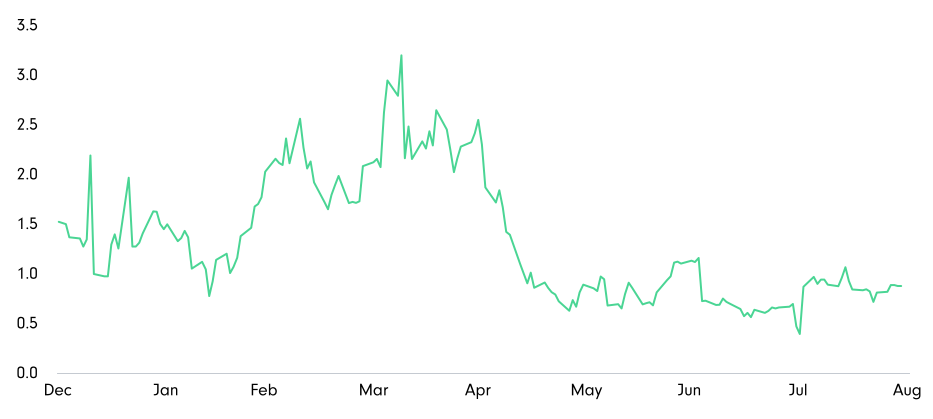
Expectations for Federal Reserve action in the September meeting have shifted substantially since the beginning of the year as the market has digested Liberation Day, a ratings downgrade on US debt, the uncertain path of inflation and the ongoing fiscal debate. The September contract for Fed Fund futures, an indication of market expectations, has shown as many as three 25-basis point (bps) cuts by the September meeting (immediately after the Liberation Day tariff announcements) and a 40% chance of a single 25-bps meeting on the heels of the most recent Federal Open Market Committee (FOMC) meeting (July 31). By the end of August, futures priced in a 90% chance of a 25-bps cut in September. While expectations for Fed action will continue to shift from now until the end of the year as additional economic data is released, the most important aspect of the Federal Reserve is the shifting nature of its members and the potential impacts to its independence.
Exhibit 1 — Expected Number of 25 bps Cuts by September FOMC Meeting
Source: Bloomberg.
Departure of Kugler, potential arrival of Miran
After an unexplained absence at the July 30 and 31 meeting of the FOMC, former Federal Reserve Governor Adriana Kugler submitted her resignation from the board on August 1. Kugler was nominated for the position on the Fed board and confirmed in 2023, and her term was set to expire in January 2026. While no explanation was offered from Kugler regarding the reasoning for her departure just months ahead of her term expiring, the vacancy paved the way for President Trump to fill another position on the influential board.
On the heels of Kugler’s departure, the president nominated Stephen Miran, who is currently the chair of Trump’s Council of Economic Advisors (CEA). It is important to note that Miran has been nominated to fill the spot on the board vacated by Kugler, meaning that his term would only last 4 ½ months, ending in January 2026. He has stated that he would take a leave of absence from his position as chair of the CEA and not resign, unless he is confirmed for the full 14-year Fed board term later in 2026.
So, what are the implications for this switch? Kugler had a short stint at the Federal Reserve, having been nominated in 2023 to serve out the remainder of Lael Brainard’s original 14-year term after Brainard left to become the director of the White House National Economic Council. While members are traditionally slotted into the hawk (stricter monetary policy) or dove (more lenient monetary policy) categories, Kugler has been viewed by most as middle of the road, as she hadn’t made definitive public statements leaning one way or the other. Given the President’s persistent calls for lower rates, it can be presumed that his nominee (Miran) will echo his hawkish stance. While Miran repeatedly affirmed his commitment to the Fed’s independence during his meeting with the Banking Committee, he has previously argued that the Fed’s independence is overstated and that the president should have more control over the central bank.
Possible ouster of Cook
While the Kugler departure was straightforward, if unexpected, the events surrounding Lisa Cook’s potential removal from the Fed are quite complex. Cook was nominated by President Joe Biden in 2022 and confirmed in 2023 to serve a 14-year term as a member of the Federal Reserve Board of Governors. President Trump announced his intention to fire Governor Cook on August 25, citing allegations that she committed mortgage fraud. Bill Pulte, the Director of the Federal Housing Finance Agency, alleges that Cook claimed two primary residences in 2021 to obtain better terms on both mortgages, as mortgage rates on second homes and investment properties are often higher than those for primary residences.
Since the Fed’s founding by Congress in 1913, no members of the Fed’s seven-member board of governors have been targeted publicly for removal by a sitting president. While there have been clashes between sitting presidents and the Federal Reserve historically — both Richard Nixon and Lyndon Johnson put considerable pressure on the Fed during their time in office — most disagreements occurred behind closed doors.
The Federal Reserve Act states that governors can only be removed “for cause,” meaning malfeasance, neglect of duty or inefficiency. Establishing a for-cause removal typically requires a proceeding that would allow Cook to answer the charges and present evidence, according to legal experts, which hasn’t happened in this case. The Justice Department argued that Cook’s contradictory statements regarding financial documents are sufficient grounds for removing her, even though the information was readily available and reviewed during her confirmation hearing in 2022. The historically dovish Governor Cook responded in court the week following Trump’s proclamation, contending that the President cannot remove her for something that occurred prior to her establishment as a Fed governor. On September 9, a federal judge blocked Cook’s removal from the Federal Reserve Board, allowing her lawsuit to proceed and for Cook to remain as Fed governor until her lawsuit is heard, and the judge ruled that it is “substantially likely” that Cook will succeed in her claim that Trump had no grounds to terminate her for cause. The administration will most likely file a quick appeal, but it appears that Cook will attend the FOMC meeting on September 16 and 17.
Planning for an uncertain future
The only thing that is certain in the coming months is uncertainty. Governor Kugler’s spot on the FOMC will be filled either by Stephen Miran or someone else nominated by the president if Miran is not confirmed, a scenario we view as unlikely, and it feels as though it may be a while until we have any kind of resolution regarding Governor Cook’s fate (potential Supreme Court ruling?). While one would hope that new members of the Federal Reserve will fight to maintain the independence that the organization has protected since its inception, recent developments have created uncertainty and concern in the market as to whether that will happen. The market is pricing in a 25-bps reduction in the Federal Funds rate at the September meeting, and Powell’s somewhat dovish speech at the Jackson Hole Symposium in August appeared to reinforce that notion. The market is aggressive in expectations, with nearly three 25-bps reductions through the end of the year pricing in the futures market, but Powell appears less than enthusiastic about replicating the easing cycle we witnessed last year (100 bps rate reduction over the final three meetings of the year), depending on the future path of inflation. The labor market’s continued weakening (see Exhibit 2 below) has fueled the market’s enthusiasm for rate cuts, but the uncertain impact of tariffs on inflation appears to be causing Powell and the Fed some hesitation. For investors, this reinforces the notion that rate prediction is a difficult and potentially damaging approach to portfolio management. While a correct prediction can serve as a tailwind for a portfolio’s performance, a misstep can serve as a painful headwind.
Bureau of Labor Statistics payroll revision
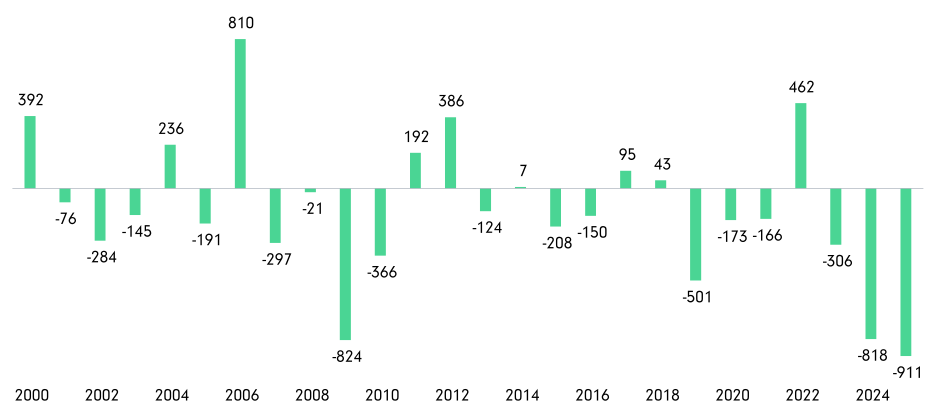
Each year, the Bureau of Labor Statistics (BLS) benchmarks the March payrolls level to a more accurate but less timely data source, the Quarterly Census of Employment and Wages (QCEW), which is based on state employment insurance tax records and covers nearly all jobs in the United States. In 2024, the adjustment was an eye-watering reduction of 818,000 jobs, or roughly 68,000 jobs per month. The adjustment announced September 9 for April 2024 through March 2025 basically told the 2024 report to “hold my beer” and delivered an adjustment of 911,000 fewer jobs created than reported, amounting to a reduction of roughly 75,900 jobs per month. The most recent report represents the largest adjustment in the history of the report, which dates back to 2000, well ahead of the previous record-level reduction of 824,000 in 2009. The adjustment was widespread — payrolls were marked down in nearly every industry and most states. There are a variety of reasons for what could be the culprit for the significant difference between the reported numbers and the adjusted numbers, including the birth-death model (an adjustment BLS makes for business opening and closing) and immigration (the QCEW report is based on unemployment insurance records, a program not available to undocumented immigrants).
Exhibit 2 — Preliminary Payroll Benchmark Revisions (in thousands)
Source: Bureau of Labor Statistics (BLS).
Quick reset on the Federal Reserve
The Federal Open Market Committee (FOMC) is composed of 12 members, eight permanent positions and four rotational positions. The eight permanent positions are the seven board members (including the Chairman) and the New York Fed President. Each year, four FOMC votes rotate among the 11 Federal Reserve bank presidents.
- Eight permanent members – Jerome Powell (Chairman), John C. Williams (New York, Vice Chair), Michael S. Barr (Governor), Michelle W. Bowman (Governor), Lisa D. Cook (Governor), Phillip Jefferson (Governor), Christopher Waller (Governor), Adriana Kugler Replacement (Governor).
- Current rotating members - Susan M. Collins (Boston), Austan Goolsbee (Chicago), Alberto Musalem (St. Louis), Jeffrey R. Schmid (Kansas City).
- Alternate members – Beth Hammack (Cleveland), Neel Kashkari (Minneapolis), Lorie Logan (Dallas), Anna Paulson (Philadelphia), Sushmita Shukla (First Vice President, New York).
- Current off rotation members – Mary Daly (San Francisco), Thomas Barkin (Richmond).
Committee membership changes at the first regularly scheduled meeting of the year.
| |
2026 |
2027 |
2028 |
Voting
Members |
New York |
New York |
New York |
| Cleveland |
Chicago |
Cleveland |
| Philadelphia |
Richmond |
Boston |
| Dallas |
Atlanta |
St. Louis |
| Minneapolis |
San Francisco |
Kansas City |
| |
Non-Voting
Members |
New York * |
New York * |
New York * |
| Chicago |
Cleveland |
Chicago |
| Richmond |
Boston |
Philadelphia |
| Atlanta |
St. Louis |
Dallas |
| San Francisco |
Kansas City |
Minneapolis |
* For the Federal Reserve Bank of New York, the First Vice President is the alternate to the President.
The views expressed are those of the author as of September 2025 and are subject to change without notice. These opinions are not intended to be a forecast of future events, a guarantee of future results or investment advice. Investing involves risk, including the possible loss of principal. Past performance is not a guarantee of future results.
/sitefiles/live/documents/insights/Blog/2025/A-839/2509_Fixed_Income_Monthly_Commentary.pdf