2026 Policy Proposals: Substantial or Symbolic?
The securitization market has entered 2026 amid a flurry of policy proposals aimed at lowering consumer costs. While politically compelling, many lack operational clarity — and their market implications vary widely. From a ban on institutional buying of single-family homes to a “quantitative easing in disguise” effort to reduce mortgage rates to a 10% cap on credit card interest rates, all options are apparently on the table. While each initiative aims to lower consumer costs, their practical impact ranges from symbolic to structurally disruptive — with meaningful implications for securitized markets.
Ban on institutional buyers: politically symbolic, economically marginal
The executive order would bar large institutional buyers — including Invitation Homes, Pretium and Tricon Residential — from purchasing single-family homes to operate as rentals. The restriction would apply only to new acquisitions, not existing portfolios.
The stated rationale is intuitive: if institutions outbid families, prices rise. However, most single-family rental homes are owned by small investors rather than the large institutions being targeted. Of roughly 15 million US single-family rental properties, institutional investors are estimated to own about 4%, less than 1% of the roughly 80 million single-family homes nationwide. Ownership is also unevenly distributed, with the Southeast and Southwest showing higher institutional penetration than other regions. The plan is in early stages and will face plenty of politicking on both sides of the aisle along with heavy lobbying from institutional owners. Similar efforts have been introduced by Democrats before, only to be blocked by Republicans.
Because institutional ownership is small, a ban may hand politicians an easy win while doing little for affordability. The focus on big buyers also misses the bigger story — mom-and-pop investors (often defined as owning one to nine non-owner-occupied homes) have accounted for a growing share of purchases in recent years. In fact, restricting large institutions could unintentionally tilt the field toward smaller investors, making it easier for them to scale up, tighten for-sale inventory and push outcomes in the opposite direction of the policy’s intent. Meanwhile, large firms have been moving upstream into homebuilding — adding rental supply through new construction — and Invitation Homes’ recent acquisition of ResiBuilt, a build-to-rent company, looks like a potential hedge against the risk of an acquisition ban.
Agencies buying residential mortgage-backed securities
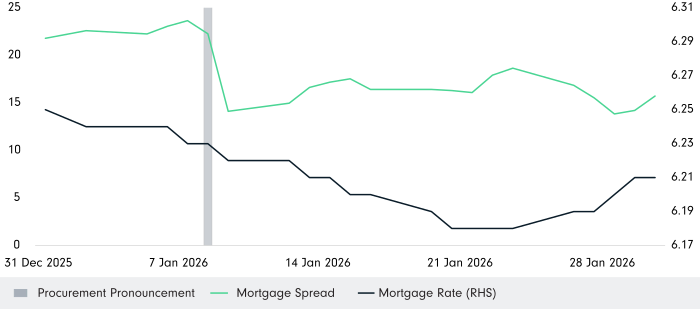
Unlike the housing proposal — which looks more symbolic than consequential — the administration’s push into mortgage finance and consumer credit is already moving markets. On January 8, the president directed the Federal Housing Finance Agency (FHFA) to begin purchasing residential mortgage pools via Fannie Mae and Freddie Mac, a move FHFA Director Bill Pulte quickly embraced. Agency mortgage spreads, which had been sitting in the low-to-mid 20s, tightened sharply the next day to about 14.1 basis points (bps). Since then, spread levels have fluctuated, ending January at 15.7 bps, according to the Bloomberg US Mortgage-Backed Securities (MBS) Index.
Exhibit 1 – Shift in Residential Mortgage-Backed Securities Spreads (bps) and Mortgage Rate (%)
Source: Bloomberg US Mortgage-Backed Securities Index, Bankrate.com.
The day after the announcement, Pulte confirmed that the purchases had begun, starting with an initial $3 billion purchase, but he did not disclose which coupons or types of mortgages were purchased. Since then, official details have unfortunately been scarce — no confirmed follow-on buying, pace of purchases moving forward or clarity on the intended coupon mix.
The market should get a clearer read once the Government Sponsored Enterprise’s (GSE) monthly volume summaries come out, but those reports arrive with a meaningful lag (December’s data, for example, wasn’t released until late January). However, with such a small sample size, is it possible to discern if there was an impact on the mortgage market?
Using the Bankrate.com US home mortgage 30-year national average as a proxy, we can see that the average mortgage rate has dropped since the announcement, from 6.23% to 6.21% as of January 31. While this move lower in mortgage rates could be considered a success, expectations for any kind of refinance wave would hinge on the rate dropping well below 6%, a key psychological level for the markets. Homeowners may not feel much immediate relief, but investors already have, as tighter spreads helped the Bloomberg US Mortgage-Backed Securities Index start the year up 0.41%.
Treasury Secretary Scott Bessent has framed the program as a counterbalance to the bonds rolling off the Fed’s balance sheet. The Fed still holds roughly $2 trillion of agency MBS accumulated through the financial crisis and COVID, and it has been letting that exposure decline gradually. At today’s runoff pace, it’s not yet clear the announced purchase amounts are large enough to meaningfully offset that normalization. And even with buying underway, the following key operational details remain unanswered.
- What’s the buying schedule? FHFA could pace purchases over time to help keep spreads and mortgage rates contained, or it could buy heavily upfront to push rates down quickly — with the risk that rates and spreads drift back wider once the buying stops. That choice becomes much easier to manage if the program ultimately expands well beyond $200 billion, allowing purchases to be sustained throughout the year.
- How will it be funded? Will the GSEs rely on cash on hand, or will they need to issue debt to finance the purchases?
- Which coupons are in scope? Buying in the belly of the curve has the most direct impact to primary mortgage rates, but those coupons are also already among the richest parts of the stack.
- What does this mean for GSE privatization? An IPO for both Fannie and Freddie has already been delayed and a further delay is expected to avoid disrupting the purchase plan.
10% interest rate limit on credit cards
Of the recent proposals, we believe a 10% cap on credit card APR would likely be the most impactful — and least likely to come to fruition in its current state. The economic downside is simply too large for the proposal to reach the finish line intact, which makes it feel less like a sure thing and more like an opening bid in a negotiation with the card networks and issuers.
While a cap would offer meaningful relief to the most indebted borrowers, the broader effects would likely be an overall negative for average consumers. Current credit card interest rates are high, but so are the costs associated with managing and providing these cards to customers. A reduction in card interest rates would likely force a reevaluation of the overall business model, with most firms likely finding the new dynamics untenable. JPMorgan CEO Jamie Dimon called the proposal an “economic disaster,” warning it could strip credit access from roughly 80% of Americans. Large, diversified lenders like JPMorgan, Capital One and Citi could adapt by tightening credit lines and raising fees, but smaller institutions could face a much harder adjustment — especially those whose economics depend heavily on their credit card business.
According to a recent study from the American Bankers Association, the proposed federal credit card limit would significantly reduce access to credit for millions of consumers, even those with strong credit scores and history. Initiated to specifically address Senate Bill 381, also known as the 10% Credit Card Interest Rate Cap Act proposed by Senators Josh Hawley (R – Missouri) and Bernie Sanders (I – Vermont), which contains language that would institute a five-year time frame for the interest rate limit, much longer than the administration’s one-year proposal. The analysis draws on data collected between December 5, 2025 and January 16, 2026 and highlights three core conclusions:
- 74%–85% of open credit card accounts would be closed and/or see credit lines materially reduced.
- 137–159 million cardholders would effectively lose the ability to use their credit cards.
- No segment of the country could be immune from the impact, as the state-by-state analysis reflects the nationwide data.
While some believe that the biggest impact would fall on those with less-than-perfect credit, the study suggests most — if not all — consumers would be affected. A 10% limit on interest rates would likely translate into tighter credit standards, reduced credit limits, higher and more expansive fees, reduced or eliminated benefits/rewards, and far fewer low-rate promotional offers. The impact is far-reaching: even among consumers with credit scores above 600, the study estimates 71%–84% would see accounts closed or experience a significant reduction in their credit limit, and super-prime borrowers (credit scores above 780) would feel the pinch as well.
A cap on credit card interest rates may sound intriguing — and it’s certainly a strong soundbite for politicians looking to win points with consumers — but the real-world risks are substantial and far-reaching. In periods of stress, consumers could lose access to regulated credit and be pushed toward newer, less regulated options (like buy now, pay later or unsecured consumer loans) that often carry even higher effective rates than credit cards, ultimately reducing spending power and weighing on the broader economy from small businesses to large employers and everything in between.
How has the market reacted? Credit spreads, the extra yield investors demand over Treasuries to compensate for perceived risk, initially widened in the immediate aftermath of the announcement, but have since tightened. Meanwhile, the credit card asset-back securities (ABS) market has effectively gone into a holding pattern: year-to-date new issuance has been non-existent as issuers weigh their options in the face of this industry-changing proposal.
Proposed consumer relief meets practical constraints
These proposals reflect the administration’s effort to deliver visible consumer relief at a time when affordability remains the central economic pain point. Across housing, mortgage finance and consumer credit, however, the gap between political positioning and market mechanics is wide.
The ban on institutional homebuyers could be construed as largely symbolic, given the limited share of housing involved. Agency mortgage purchases can impact mortgage levels short term, but the durability of that impact remains uncertain without clarity around scale and timing. A 10% credit card interest rate cap, which could resonate with consumers, carries the greatest potential for economic disruption, threatening to potentially shrink credit availability in ways that could ripple across consumer spending and broader economic activity.
Markets have responded in a variety of ways, but mostly with trepidation and caution. Spreads have experienced short-lived volatility before normalizing while issuance in the credit card ABS sector has stalled. Without greater clarity around implementation, funding and political feasibility, markets will continue to fluctuate with every proclamation or proposal.
In the end, lowering costs for consumers is a worthy objective. Whether these initiatives meaningfully achieve that goal — or instead shift costs elsewhere in the system — will depend less on their headline appeal and more on the details of their execution.��
Bloomberg US Mortgage Backed Securities (MBS) Index tracks fixed-rate agency mortgage-backed pass-through securities guaranteed by Ginnie Mae (GNMA), Fannie Mae (FNMA), and Freddie Mac (FHLMC).
Index data source: Bloomberg Index Services Limited. See diamond-hill.com/disclosures for a full copy of the disclaimer.
The views expressed are those of the author as of February 2026 and are subject to change without notice. These opinions are not intended to be a forecast of future events, a guarantee of future results or investment advice. Investing involves risk, including the possible loss of principal. Past performance is not a guarantee of future results.
/sitefiles/live/documents/insights/Blog/2026/A-888/2502_Fixed_income_monthly.pdf