Securitization as a Strategic Focus
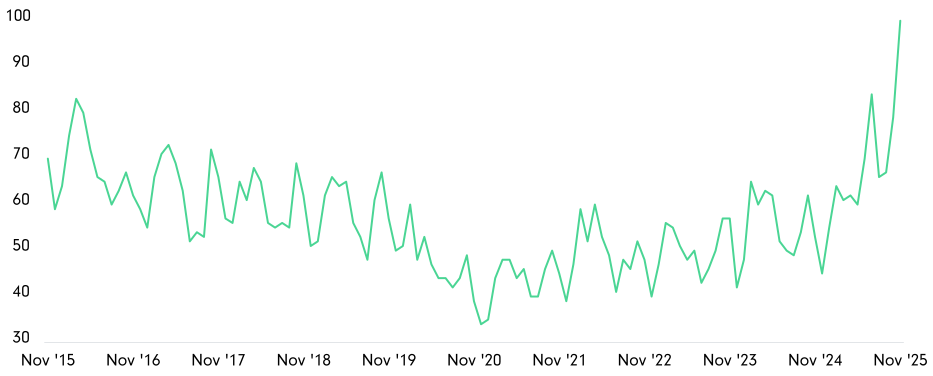
It feels as though you can’t read an investment manager summary or white paper without encountering commentary on the virtues of investing in the securitized sector — whether asset-backed securities (ABS), commercial mortgage-backed securities (CMBS), collateralized loan obligations (CLOs) or residential mortgage-backed securities (RMBS). A simple search on Google Trends shows a steady increase in interest in the term securitization over the past ten years. The numbers represent search interest relative to the highest point on the chart for the selected region and time period. A value of 100 — which reflects the reading for November 2025 — represents peak popularity for the term; a value of 50 indicates the term is half as popular; and a score of 0 means there were not enough searches to register activity.
Exhibit 1 – Google Search Trend for Securitization
Source: Google.
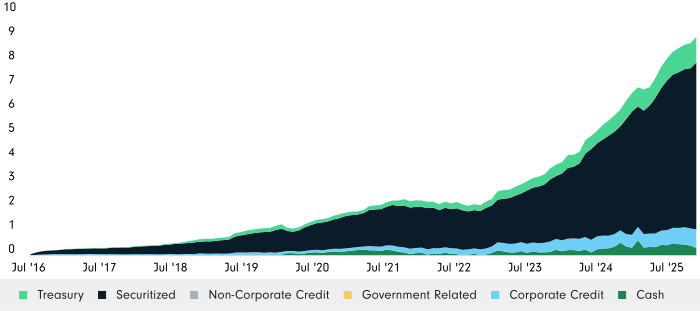
Although broader investor interest has only recently shifted towards securitization, this has been a core area of focus for Diamond Hill since the launch of our fixed income platform in mid-2016. Our philosophy — with roots back to the mid-80s and carried through several mergers before coming to Diamond Hill nearly ten years ago — has consistently maintained a focus on the securitized sector. This approach is not the result of a trend or a search for near-term performance, but rather a core belief that inefficiencies within the securitized market can provide savvy investors with attractive risk-adjusted returns, particularly relative to passive indices. Exhibit 2 illustrates the distribution of sector investments across the Diamond Hill fixed income platform over time, which has averaged roughly 75.2% of assets since inception.
Exhibit 2 – A Longstanding Focus on Securitization ($B)
Source: Diamond Hill as of 31 Jan 2026.
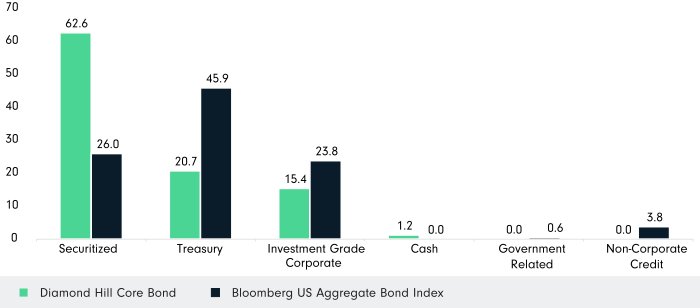
Zooming in on Diamond Hill’s Core Bond strategy, month-end sector allocation as of 31 January 2026 (Exhibit 3) shows that the strategy’s focus remains squarely on the securitized markets, especially when compared to the benchmark.
Exhibit 3 – Diamond Hill Core Bond Sector Allocation (%)
Source: Diamond Hill as of 31 Jan 2026.
Resident vs Tourist
Looking at a portfolio’s allocation at a single point in time isn’t enough to understand how a manager deploys capital across market segments. As Exhibit 4 illustrates, the sustained overweight to securitized assets has consistently differentiated Diamond Hill Core Bond from both the index and its peers, as represented by the eVestment Core Fixed Income Universe.
Exhibit 4 – Differentiation Through Securitization (%)
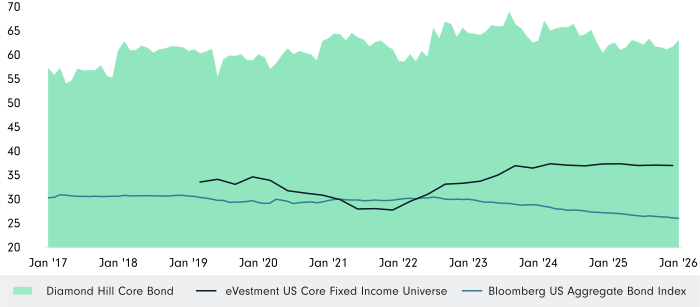
Source: eVestment, Diamond Hill. Detailed information for the eVestment Core Bond Universe only dates to 31 March 2019.
As markets continue to discuss the benefits of the securitized market, it serves clients well to work with investors that have treated this asset class as a meaningful component of their allocation for decades, not merely as a tactical move. The securitized market has expanded into new and exciting areas of finance — many of which emerged from the financial crisis — and has continued to evolve and grow more complex, requiring the expertise of seasoned investors who can allocate capital when opportunities arise.
Relying on an investment manager with experience through multiple market cycles — including the financial crisis, the European debt crisis and the unprecedented volatility surrounding COVID-19 — along with shorter bouts of dislocation can benefit clients who are still working to understand the complexities of this market.
The benefits of securitization
When discussing our overweight to securitized assets, we think it is important to revisit why this asset class presents opportunity and how it differs from traditional corporate debt. While we explored this in depth in two earlier pieces — The Mechanics and Benefits of Securitization and Equity? Debt? Securitized? Understanding the Differences — we offer a brief refresher here.
Corporate debt is relatively straightforward: investors are paid semiannual coupon payments from the issuer and are directly tied to that company’s performance. This company-specific risk can expose investors to economic shifts, operational missteps and even scandals (accounting or otherwise).
Securitized assets work differently. Investors gain exposure to a diversified pool of loans — whether backed by consumers, businesses or commercial collateral — through a single security structured to distribute risk across many borrowers. When issuers pool loans to structure an asset-backed deal, credit risk is central to their process. No issuer is perfect at underwriting, and the borrowers underlying these loans experience the same life events and business pressures as all of us — job changes, elderly parents needing support, children moving in or out, divorce, relocation, etc. Such disruptions can lead to financial strain and potential losses, which is why securitized deals are structured with an assumed level of loss.
Credit enhancements are also incorporated to provide additional protection if losses exceed the levels anticipated at underwriting. These enhancements help absorb unexpected stress and support more resilient outcomes for investors.
Relative value in securitized markets
For an asset manager focused on relative value and a bottom-up approach to investing, securitized sectors of the market are particularly compelling. Whether due to less traffic (though that may be less true in recent months), the complexity of the underlying collateral, or the size of these markets relative to other sectors, securitized assets offer meaningful opportunities for differentiation from the Bloomberg US Aggregate Bond Index while maintaining a similar risk profile.
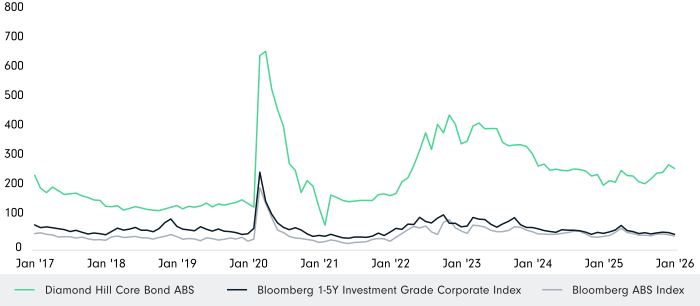
We explore these concepts in greater detail in Rethinking Core Fixed Income: An Active Approach to Finding Alpha. Exhibit 5 highlights one example of the relative value opportunities we seek to capture over longer time horizons, illustrated through our ABS exposure.
Exhibit 5 – Relative Value Through ABS Exposure (Option Adjusted Spread) (bps)
Source: Yield Book.
Bloomberg US Aggregate Bond Index measures the performance of investment grade, fixed-rate taxable bond market and includes government and corporate bonds, agency mortgage-backed, asset-backed and commercial mortgage-backed securities (agency and non-agency). Bloomberg US ABS Index measures the investment grade, US dollar-denominated, fixed-rate taxable bond market. Bloomberg US 1-5Y Investment Grade Corporate Index tracks the performance of investment-grade, fixed-rate, US dollar-denominated corporate bonds with remaining maturities between one and five years. Index data source: Bloomberg Index Services Limited. See diamond-hill.com/disclosures for a full copy of the disclaimer.
The views expressed are those of the author as of February 2026 and are subject to change without notice. These opinions are not intended to be a forecast of future events, a guarantee of future results or investment advice. Investing involves risk, including the possible loss of principal. Past performance is not a guarantee of future results.
/sitefiles/live/documents/insights/Blog/2025/A-875/2602_Securitization-as-a-Strategic-Focus.pdf